
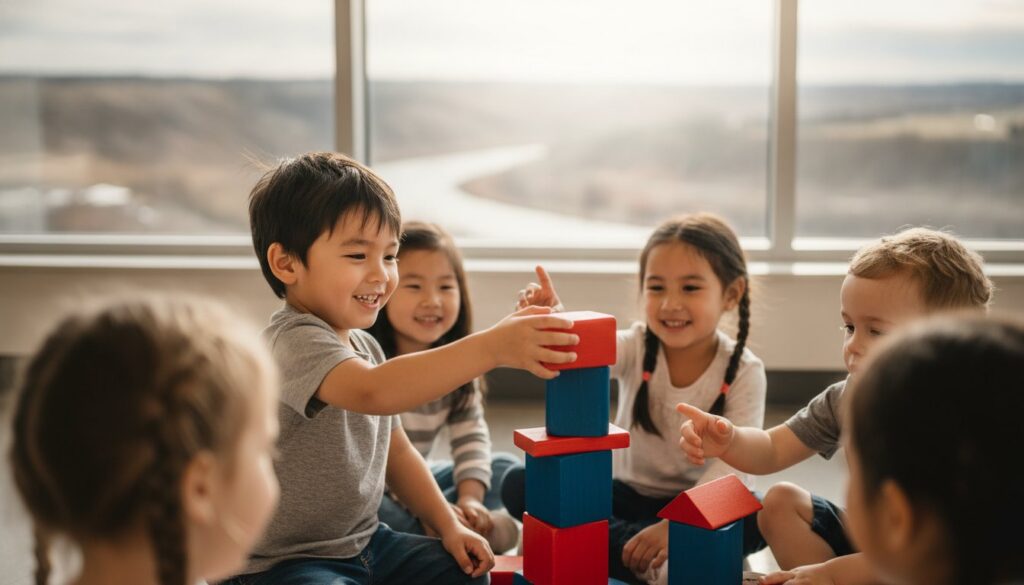
You are at the park when you notice your child pull away as a peer approaches to share a toy. That familiar pang of worry settles in your chest as you wonder if they’re truly ready for the social complexities of a busy classroom. It’s completely normal to feel a sense of urgency regarding social delays, but the right preschool social skills activities can transform these playground meltdowns into moments of genuine connection and growth.
We understand that social development is the invisible curriculum that makes all other learning possible. By integrating intentional play into your daily routine, you can replace frustration with the relief of seeing your child thrive. This article shares research-backed strategies that align with Alberta early learning standards to build your child’s empathy and self-regulation. You’ll gain practical tools to resolve conflicts at home and a clear understanding of how to foster the confidence your child needs for kindergarten readiness. We’ll explore structured games and sensory-focused exercises designed to unlock your child’s latent capabilities and prepare them for a lifetime of meaningful relationships.
Key Takeaways
- Understand why social-emotional mastery is the strongest predictor of long-term success within the Alberta Kindergarten curriculum.
- Access over 20 practical preschool social skills activities that turn everyday play into meaningful lessons in empathy and cooperation.
- Learn how to use intentional “Teaching Tips” to guide your child through complex social cues and emotional regulation during home-based play.
- Explore how professional peer environments and Personalized Learning Plans nurture your child’s unique social personality beyond the home setting.
- Discover how a “play with purpose” philosophy bridges the gap between simple games and the essential milestones required for kindergarten readiness.
The Foundation of Preschool Social-Emotional Learning
When you watch your child struggle to share a favorite truck or navigate a busy playgroup, it’s natural to feel a wave of concern. You aren’t just seeing a playground spat; you’re witnessing the early stages of a complex developmental process. To understand what social skills are, we must look beyond simple manners. These skills represent a child’s growing ability to read subtle social cues, regulate intense emotions, and cooperate with peers toward a common goal.
Many parents worry that focusing on play might delay academic progress. However, research consistently shows that these “soft skills” are the hardest work a child’s brain will ever do. This developmental heavy lifting is known as executive function. It includes the mental flexibility to change tasks and the self-control to wait for a turn. Without this foundation, even the most gifted child will struggle to focus on literacy or numeracy in a classroom setting.
The “Play with Purpose” Philosophy
There is a significant difference between unsupervised free time and the intentional preschool social skills activities we use to foster growth. While all play is valuable, “play with purpose” involves a structured environment where every game has a latent learning goal. Whether it’s a sensory-focused building project or a rhythmic group song, these activities are designed to teach reciprocity and impulse control. It transforms a simple game into a safe laboratory where children can test social boundaries and discover their own latent capabilities.
Why Social Skills Matter for Alberta Kindergarten Readiness
In Edmonton and across Alberta, educators increasingly prioritize social competence during initial assessments. Success in the Alberta Kindergarten curriculum depends heavily on a child’s ability to enter a group confidently and resolve minor conflicts independently. We align our approach with local standards to ensure every child meets the Kindergarten Readiness goals essential for a smooth transition. By mastering these social milestones now, your child builds the internal resilience needed to thrive in a structured school environment.
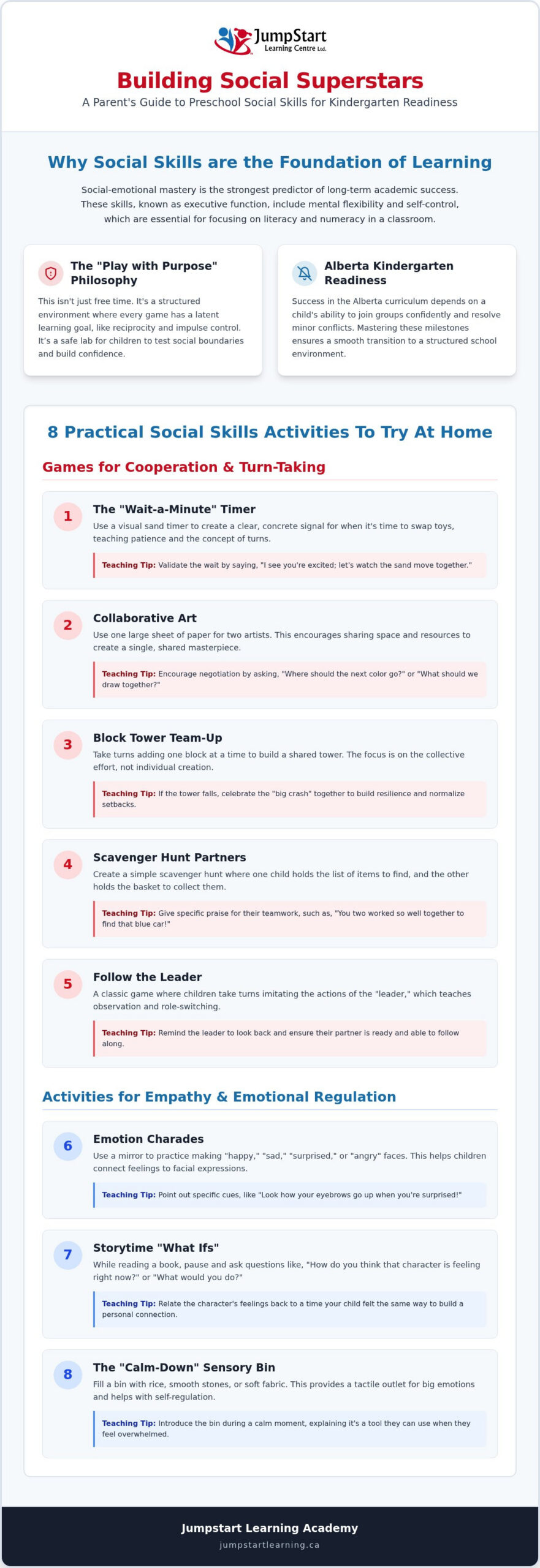
10 Practical Social Skills Activities to Try at Home
Life in Edmonton can be fast-paced, and finding time for structured learning often feels like another item on a never-ending to-do list. However, building your child’s confidence doesn’t require hours of preparation or expensive equipment. Many effective preschool social skills activities can be woven into your existing morning or evening routines. Parallel play is a vital stepping stone for three-year-olds where they play independently near peers to build the foundational comfort needed for future collaboration.
Games for Cooperation and Turn-Taking
Learning to share space and resources is a sophisticated cognitive leap. These activities help children transition from “me” to “we” through intentional, shared goals.
- 1. The “Wait-a-Minute” Timer: Use a visual sand timer during play to show when it’s time to swap toys. Teaching Tip: Validate the wait by saying, “I see you’re excited; let’s watch the sand move together.”
- 2. Collaborative Art: Use one large sheet of paper for two artists to create a single mural. Teaching Tip: Encourage negotiation by asking where the next color should go.
- 3. Block Tower Team-Up: Take turns adding one block at a time to a shared tower. Teaching Tip: If it falls, celebrate the “big crash” to build resilience.
- 4. Scavenger Hunt Partners: Give one child the list and the other the basket. Teaching Tip: Praise them for working as a team to find each item.
- 5. Follow the Leader: Take turns being the one who chooses the next movement. Teaching Tip: Remind the leader to look back and ensure their partner is ready.
Activities for Empathy and Emotional Regulation
Developing empathy is a scientific and heart-centered process that begins with recognizing one’s own internal state. Integrating social skills activities into daily life helps children decode the complex world of human emotion.
- 6. Emotion Charades: Use a mirror to practice “happy,” “sad,” or “surprised” faces. Teaching Tip: Point out specific cues, like the shape of the mouth or eyebrows.
- 7. Storytime “What Ifs”: Pause during a book to ask how a character might be feeling. Teaching Tip: Relate the character’s feelings to a time your child felt the same way.
- 8. The “Calm-Down” Sensory Bin: Fill a bin with rice, smooth stones, or soft fabric to use when emotions run high. Teaching Tip: Teach that this tactile space is a proactive tool for self-regulation.
- 9. Puppet Role-Play: Use puppets to act out a common conflict, like wanting the same toy. Teaching Tip: Let your child “help” the puppets find a kind solution.
- 10. Shared Snack Prep: Have your child help count and distribute portions for the family. Teaching Tip: Highlight the joy of providing something helpful for others.
While these home exercises are powerful, growth often accelerates in a professional, nurturing peer group. If you’re looking for a structured environment to expand on these skills, see how our Preschool Program can support your child’s unique journey.
Bridging the Gap: From Home Play to the Preschool Classroom
While practicing preschool social skills activities at home builds a vital foundation, a peer group environment acts as a powerful catalyst for growth. At home, your child interacts with adults who are naturally more patient and accommodating. In a classroom, they encounter peers with their own unique desires and boundaries. This shift requires children to apply what they’ve learned in real-time, navigating the beautiful complexity of human interaction under the guidance of expert mentors.
We believe every child possesses a unique social personality. To nurture this, we utilize Personalized Learning Plans that identify specific strengths and areas for growth. Whether your child is a quiet observer or a high-energy leader, these plans ensure they receive the specific support they need to feel confident. The progression from our Preschool Program for 3-year-olds to our Junior Kindergarten Program for 4-year-olds is a carefully designed social journey. It moves from parallel play toward complex, collaborative projects that prepare them for the expectations of the Alberta Kindergarten curriculum.
The Role of Professional Educators as Mentors
In our licensed early learning centre, educators do more than supervise; they facilitate growth. When a conflict arises over a shared resource, our teachers step in to turn a moment of frustration into a “teachable moment.” They provide the calm, steady, and optimistic guidance needed to help children find their own words and solutions. This professional mentorship ensures that social challenges are never overwhelming but are instead seen as opportunities for transformation.
Next Steps for Your Child’s Social Journey
If you feel your child is ready for a more social environment, trust that intuition. It’s often the first step toward uncovering their latent capabilities. When you tour a potential school, look for these social milestones in the classroom:
- Children engaging in sustained play with at least one peer.
- Evidence of “play with purpose” where activities have clear social goals.
- Teachers using heart-centered language to resolve peer conflicts.
- A nurturing environment that feels both structured and joyful.
We invite you to see these essential skills in action by exploring Jumpstart’s programs, where your child’s emotional well-being is our primary focus.
Empowering Your Child’s Social Future
You’ve discovered how intentional play acts as a catalyst for executive function and emotional resilience. By integrating preschool social skills activities into your daily life, you’re providing the essential scaffolding your child needs for a successful transition to the classroom. We know that while home play is the vital starting point, the dynamic environment of a peer group is where these skills truly blossom into lifelong capabilities.
As a licensed Alberta Early Learning Centre, we specialize in this transformation. Our experienced educators use personalized learning plans for every student to ensure that social-emotional growth remains at the heart of the academic journey. We’re here to be your partner, turning the anxiety of school readiness into the joy of seeing your child connect and thrive. Join our Preschool Program and watch your child’s confidence grow!
The path toward your child’s social success is built on small, consistent steps. We look forward to walking that path with you and celebrating every new connection and milestone along the way. For parents who want to model these social connections through adult team sports in Calgary, you can learn more about South Calgary Recreational Hockey League (SCRHL).
Frequently Asked Questions
What are the most important social skills for a 3-year-old to have?
At age three, the most critical skills include basic turn-taking, the ability to express needs verbally, and a growing awareness of others’ feelings. While they aren’t expected to be master negotiators, they should begin to transition from parallel play to brief moments of cooperative interaction. These foundational behaviors are exactly what we target through intentional preschool social skills activities, helping children move beyond solitary play toward meaningful peer connection.
How do I know if my child is “socially ready” for preschool in Edmonton?
Social readiness in Edmonton is often measured by a child’s curiosity about other children and their ability to follow a simple group routine. You don’t need to wait until your child is perfectly social to enroll them. In fact, most children develop these skills within the classroom environment. If your child can manage brief separations and shows an interest in shared play, they’re likely ready to benefit from a structured, nurturing peer group.
Can social skills be taught, or is my child just naturally “shy”?
Social skills are absolutely learnable competencies, much like reading or riding a bike. While some children possess a more reserved temperament, often labeled as “shy,” they can still master the mechanics of social interaction through consistent practice. By using structured preschool social skills activities, we help children build a social toolbox. This allows even the most quiet students to find their voice and enter peer groups with quiet, steady confidence.
What should I do if my preschooler refuses to share during playdates?
Refusing to share is a developmentally appropriate stage where children are exploring the concept of ownership. Instead of forcing a hand-over, try using a visual timer to show when a turn will end. Validating their feelings by saying, “It’s hard to wait for that truck,” helps lower their defenses. This approach teaches them that their possessions are safe while slowly introducing the rewarding experience of reciprocity and cooperative play.
