
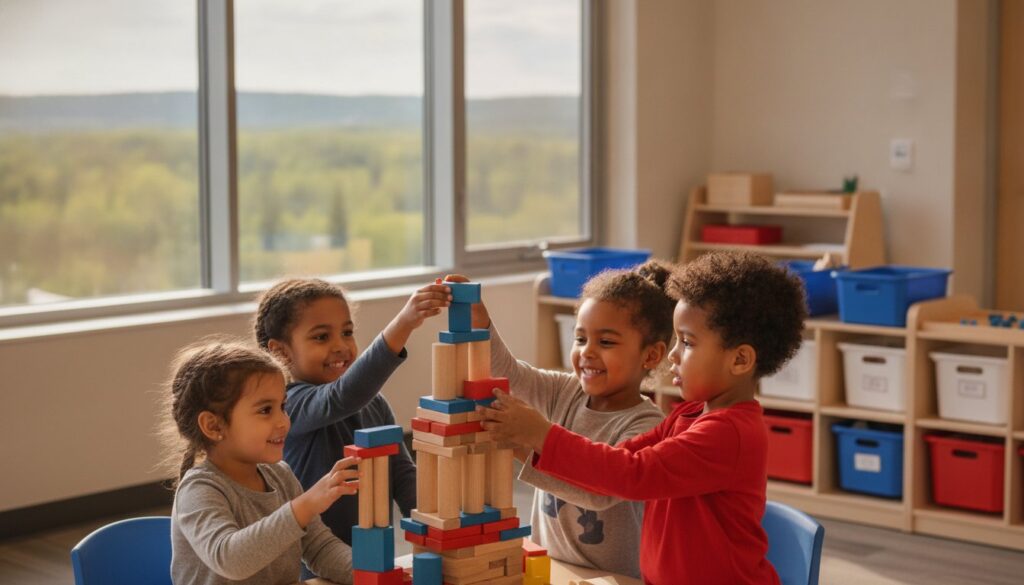
What if the very thing you fear will limit your child’s imagination is actually the key that unlocks it? Many parents worry that a structured classroom might feel too restrictive for a three or four year old, but the benefits of a structured preschool environment actually provide the safety net children need to take creative risks. You want your child to explore and create, but you also want them to be ready for the academic expectations of the Alberta primary school system. It’s natural to feel anxious about whether they’re truly prepared for the transition from home to a formal learning environment.
When children know what to expect, their anxiety melts away, leaving room for deep focus and genuine discovery. We’re here to help you see how a predictable, intentional routine fosters emotional security while building the literacy and numeracy foundations your child needs. In this article, we’ll look at how a balance of play and purposeful instruction creates a confident, self-regulated learner who’s ready to take on the world. You’ll discover how the right framework doesn’t just teach facts; it transforms a child’s ability to engage with their peers and their environment with joy and resilience.
- Understand how predictable routines lower stress levels, allowing your child’s brain to shift from survival mode into an active state for discovery.
- Explore the core benefits of a structured preschool environment for building essential executive function skills like working memory and self-regulation.
- Discover the “Play with Purpose” philosophy, which uses intentional play as a vehicle for academic growth without stifling your child’s natural creativity.
- Learn how a balanced framework helps children master social-emotional milestones, such as following multi-step directions and practicing patience with peers.
The Psychology of Predictability: Why Structure Builds Confidence
Structure often gets a bad reputation in early education. Many parents picture a rigid, uninspired classroom where children sit quietly in rows; however, that couldn’t be further from the truth. A truly structured preschool environment is a gentle, balanced framework of routines and intentional activities designed to meet a child’s unique developmental needs. It provides the “scaffolding” that supports young learners as they reach for new skills, rather than a cage that limits their movement. By grounding the day in core early childhood education principles, teachers create a predictable rhythm that feels safe and inviting.
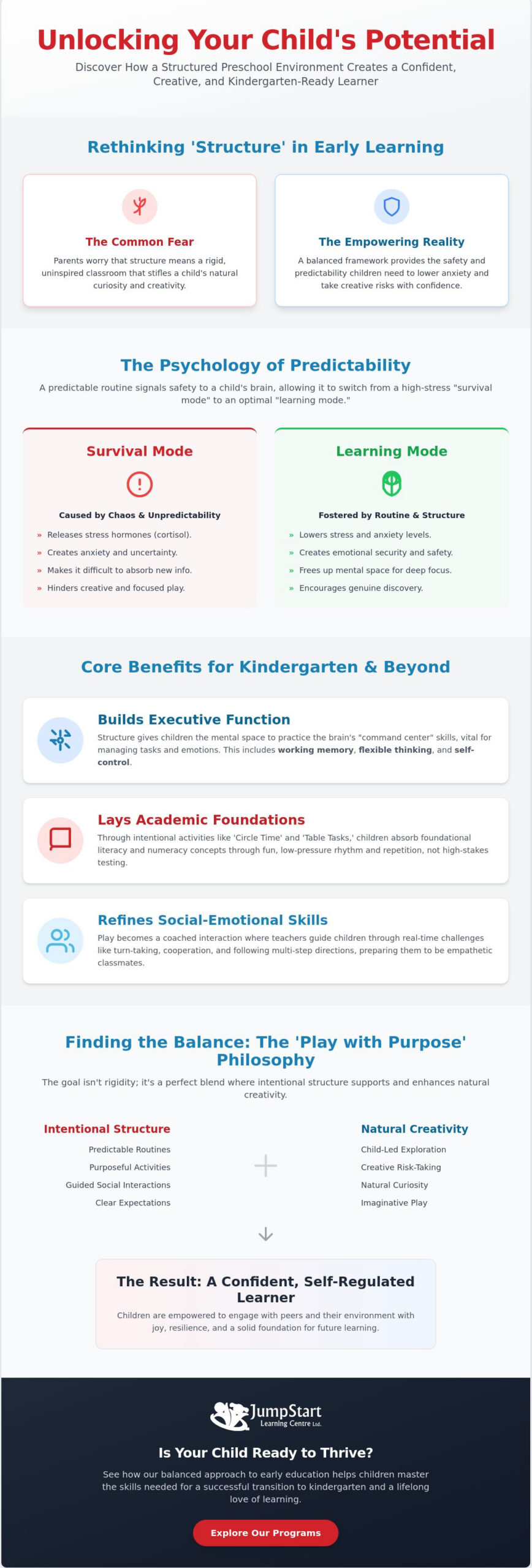
There’s deep science behind this approach. When a child’s day is chaotic or unpredictable, their brain often stays in “survival mode,” releasing cortisol and staying alert for potential changes. This state makes it difficult to absorb new information or engage in creative play. One of the primary benefits of a structured preschool environment is how it lowers these stress levels. Predictability signals to the brain that it’s safe to move into “learning mode.” This shift is essential for mastering complex tasks and managing the “big feelings” that naturally arise when a child is away from home.
Reducing Transition Anxiety Through Routine
Separation anxiety is a significant hurdle for many families, but routines act as a reliable anchor. We often use the “First/Then” principle to help children visualize their progress through the morning. For example, “First we have circle time, then we have snack.” This simple logic, combined with visual schedules, gives even a 3-year-old a sense of agency and control over their day. You can see these benefits of our Preschool Program in action as children walk into the classroom with confidence. It turns a scary unknown into a series of achievable, joyful steps that foster independence and emotional resilience.
Core Developmental Benefits: From Executive Function to Social Mastery
Have you ever watched your child struggle to remember a simple two-step instruction? It’s a common hurdle, but one that’s easily overcome through consistent practice in a supportive setting. The benefits of a structured preschool environment extend deep into the brain’s command center, building what educators call Executive Function. This includes working memory, flexible thinking, and self-control. By providing a reliable framework, we give children the mental space to practice these skills without feeling overwhelmed by chaos or uncertainty.
Building the Foundations of Literacy and Numeracy
Concepts like letter recognition and early counting don’t require high-pressure testing to stick. Instead, we use “Circle Time” and “Table Tasks” to introduce academic ideas through rhythm and repetition. These intentional activities allow children to absorb foundational knowledge while feeling like they’re simply part of a fun, shared experience. Intentional grouping of students also fosters peer-to-peer learning, where children build social confidence by explaining ideas to one another. If you’re curious about how this looks in practice, you might find our Junior Kindergarten Program is the perfect fit for your child’s next steps.
Refining Social-Emotional Skills for Kindergarten
Social-emotional growth is the ability to navigate peer conflicts independently and express needs clearly. In a structured setting, play isn’t just a break; it’s a coached interaction. When a dispute over a toy arises, teachers are there to guide children through turn-taking and waiting. This real-time coaching helps children master the art of following multi-step directions and cooperating with others, ensuring they enter the primary school system as confident, empathetic classmates.
Finding the Balance: How ‘Play with Purpose’ Bridges Structure and Creativity
Many parents worry that a rigid schedule will crush their child’s natural curiosity. However, the true benefits of a structured preschool environment come from a philosophy we call “Play with Purpose.” This isn’t about making three-year-olds sit at desks for hours. Instead, it’s about using play as the primary vehicle for a carefully designed curriculum. A program that is “play-only” often misses critical developmental windows for literacy and numeracy, while an “academics-only” approach can lead to burnout and frustration. By blending the two, we ensure children are engaged in ways that feel like a game but build lasting academic foundations.
In Edmonton and Beaumont, we know that every child arrives with a different set of strengths. That’s why Jumpstart uses personalized learning plans to ensure our framework meets your child exactly where they are. One of the greatest benefits of a structured preschool environment is that it provides a reliable safety net while remaining flexible enough to adapt to your child’s individual pace. If you are also considering specialized options like French Immersion, you can visit their website to see how French Elite Montessori applies these principles. When you visit a potential school, use this checklist to identify a healthy, supportive structure:
- Visual Schedules: Are there clear, pictured routines posted at the child’s eye level?
- Calm Transitions: Do the teachers use predictable songs or signals to move between activities?
- Intentional Zones: Are the learning centers organized with specific goals, like sensory exploration or fine motor practice?
- Coached Play: Does the play look intentional, with teachers asking questions that prompt deeper thinking?
Preparing for the Next Stage in Edmonton and Beaumont
The transition to Kindergarten in Alberta is a major milestone that requires both social and academic readiness. To make this shift smooth, we use regular, gentle assessments to ensure your child is meeting provincial developmental benchmarks. These aren’t stressful tests; they’re heart-centered check-ins that help us identify if a child needs extra support or a new challenge. We’re here to be your partner in this journey, transforming parental worry into the joy of seeing your child thrive. We invite you to book a tour or enroll today to see how “Play with Purpose” can prepare your little learner for a lifetime of success.
Empowering Your Child’s Next Great Adventure
Choosing the right start for your child is one of the most important decisions you’ll make as a parent. We’ve seen how the benefits of a structured preschool environment go far beyond simple routines; they build the emotional resilience and cognitive scaffolding your child needs to succeed. By balancing intentional play with academic goals, you’re ensuring they enter the Alberta school system with confidence and a genuine love for learning. This structured approach doesn’t stifle creativity; it provides the safe harbor children need to take bold new risks.
As a licensed early learning centre, Jumpstart Learning Academy offers a research-based curriculum and personalized learning plans designed for every unique student. Our experienced educators specialize in Pre-K and Kindergarten readiness, focusing on both the heart and the mind. We’re committed to turning your transition anxieties into a shared celebration of your child’s growth and achievements. Every milestone reached is a testament to their potential and your dedication to their future.
Secure your child’s spot for the 2026 school year—Enroll now at Jumpstart Learning Academy. We’re ready to help your little learner discover their latent capabilities and start their educational journey with joy and confidence.
Frequently Asked Questions
Is a structured preschool environment too stressful for a 3-year-old?
Structure actually lowers stress by removing the anxiety of the unknown. For a three-year-old, a predictable routine provides a sense of safety that allows their brain to relax and focus on discovery. Rather than being rigid, this framework acts as a comforting guide that helps them navigate their day with confidence and joy.
How does structure help with my child’s behavioral issues?
Clear expectations and consistent boundaries help reduce the frustration that often leads to behavioral outbursts. When children understand the “why” and “when” of their day, they feel more in control and less overwhelmed. This environment allows teachers to provide real-time coaching on self-regulation, turning challenging moments into valuable growth opportunities.
What is the difference between a structured preschool and a traditional daycare?
The main difference lies in the intentionality of the curriculum and the focus on developmental milestones. While traditional daycare provides essential care, a structured preschool environment is designed around specific literacy, numeracy, and social goals. It uses every activity as a building block for future academic success, ensuring your child is actively learning rather than just being supervised.
Can my child still be creative in a structured classroom?
Creativity actually flourishes within a structured framework because children feel safe enough to take risks and explore. One of the key benefits of a structured preschool environment is that it provides the necessary scaffolding for creative play. By having dedicated time for artistic expression, children can dive deeper into their projects without the distraction of a chaotic setting.
How do routines in preschool help with kindergarten readiness?
Preschool routines mirror the expectations of the Alberta primary school system, making the eventual transition much smoother. By practicing things like waiting in line and following multi-step directions, children build essential executive function skills. These daily habits ensure they enter kindergarten feeling capable and ready to focus on their new curriculum.
