
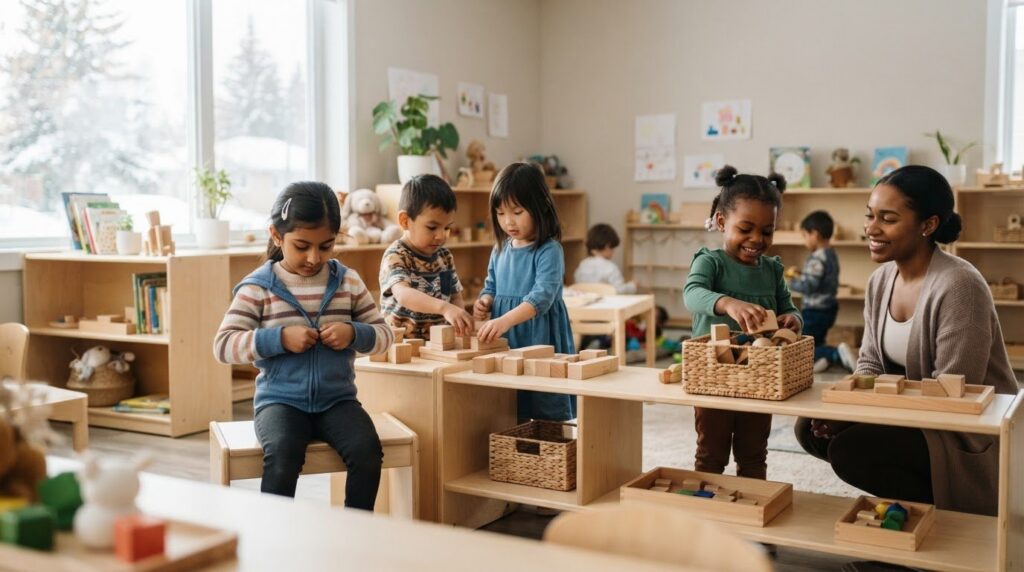
What if helping your preschooler become independent means stepping back just enough, not stepping away? When a jacket zipper sticks or tidying up takes longer than expected, it’s natural to want to help. Developing independence in preschoolers takes patience: everyday tasks are new skills, and each child learns at their own pace.
Small, supportive opportunities help children build confidence without leaving them to manage frustration alone. This guide offers practical ways to practise independence at home, respond when a task feels difficult, and decide when to step in. Purposeful play and predictable preschool routines also give children regular chances to make choices, keep trying, and notice their progress without comparing themselves with others.
Key Takeaways
- Independence includes self-care, making choices, working through small challenges, and knowing when to ask for help.
- Use a gradual approach: demonstrate a task, invite your child to try, pause, and offer support when needed.
- Purposeful play and predictable preschool routines give children meaningful practice with choice and persistence.
- Support developing independence in preschoolers by noticing individual progress rather than comparing your child with others.
What Developing Independence in Preschoolers Really Looks Like
Independence doesn’t mean a preschooler does everything alone. It means taking a growing part in everyday life: trying self-care tasks, making simple choices, working through small problems, and asking for help when needed.
Supported independence means giving a child room to try while staying close enough to encourage, guide, or step in when needed. That balance lets children practise new skills without feeling they must manage every challenge by themselves. The theories of child development offer broader context for how children’s physical and intellectual capabilities grow over time.
How can you tell your preschooler is building independence?
Look for participation, not a perfectly finished task. Your child might try to put on a coat, even if the sleeves get twisted, or carry toys toward the shelf before asking for help with the last few. Choosing between two activities is another small sign of growing confidence.
Progress looks different from one child to another and can vary from day to day. A child may manage a familiar task independently but need reassurance when tired or facing something new. That doesn’t mean they’ve lost a skill. With developing independence in preschoolers, effort, willingness to try, and the ability to seek help are meaningful signs of growth, whether or not a task is completed without assistance.
How to Encourage Independence in Preschoolers, One Small Step at a Time
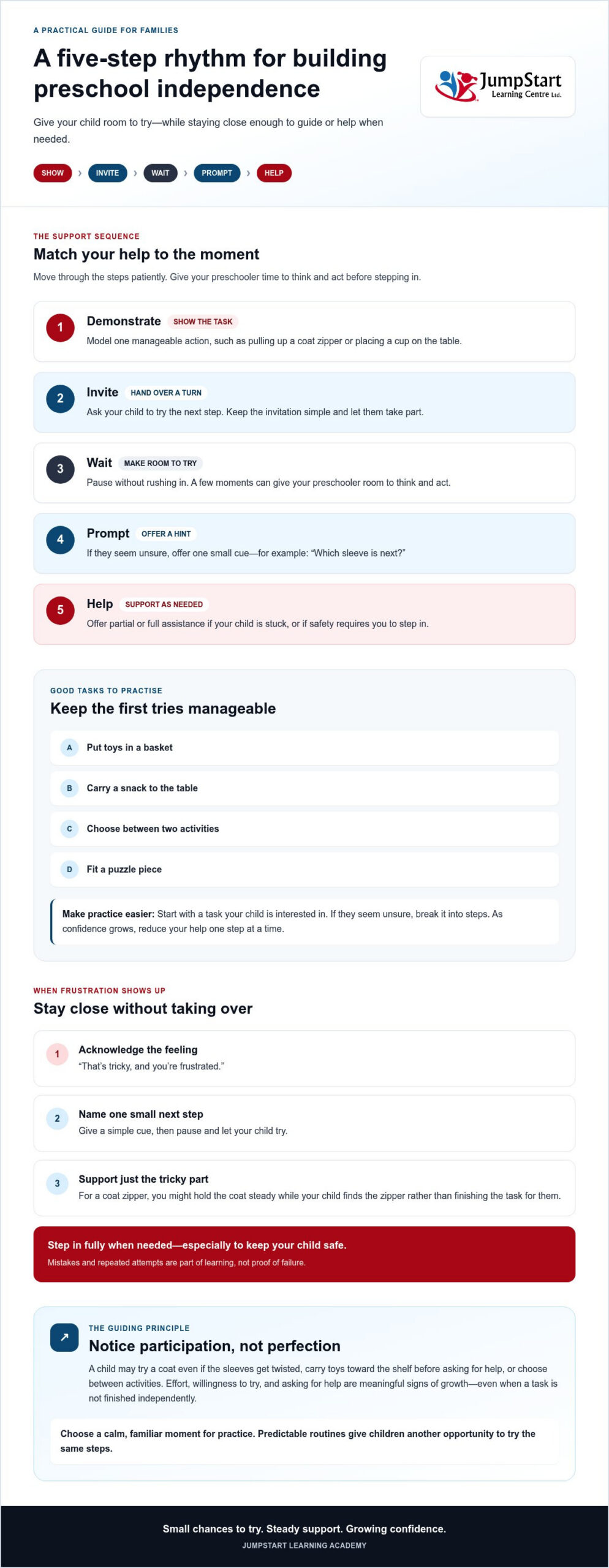
A steady sequence helps you match your support to your child’s current ability: show the task, invite them to try, pause, offer a prompt, then help if needed. Waiting can feel slow during a busy routine, but a few moments give your preschooler room to think and act.
- Demonstrate: Show how to pull up a coat zipper or place a cup on the table.
- Invite: Ask your child to try the next step.
- Wait: Give them time to respond without rushing in.
- Prompt: Offer a hint, such as “Which sleeve is next?”
- Help: Give partial or full assistance if they’re stuck or safety requires it.
Try this approach with manageable tasks: putting toys in a basket, carrying a snack to the table, choosing between two activities, or fitting a puzzle piece. Start with a task your child already shows interest in, then break it into steps if they seem unsure. As confidence grows, reduce your help one step at a time. Show only what’s needed, then gradually hand the next step back to your child. These practical routines also reflect guidance on ways to build independence in preschoolers.
What should you do when your child gets frustrated or asks for help?
Start by acknowledging the feeling: “That’s tricky, and you’re frustrated.” Then name one small next step and pause. You might hold the coat steady while your child finds the zipper, rather than finishing the task for them. Mistakes and repeated attempts are part of learning, not proof of failure. Step in fully when needed, especially to keep your child safe.
Make practice easier by choosing a calm, familiar moment instead of introducing a new task when everyone is in a rush. A predictable routine gives your child another opportunity to try the same steps. Preschool can reinforce that practice through supportive learning experiences.
How Preschool Supports Independence Through Purposeful Play and Routines
At preschool, purposeful play gives children meaningful reasons to make choices, stay with a challenge, and ask for help. While building with blocks, a child might decide what to create, try different ways to balance a piece, then ask an educator or peer for a suggestion. These moments offer practice with initiative and persistence in a supportive setting, an approach championed by early learning providers such as childrenoftomorrow.school.
Predictable classroom routines provide another kind of practice. Children can gradually take part in transitions and everyday tasks, with educators offering calm prompts or hands-on help when needed. Families can reinforce this learning at home with familiar routines. The NAEYC’s tips for parents also describe ways to invite young children to participate in daily activities.
What can families look for in an independence-supporting preschool?
Look for educators who give children time to try, notice their efforts, and offer support without taking over too quickly. Purposeful play and structured learning can both create chances to make choices and practise new skills. A supportive approach to developing independence in preschoolers responds to each child’s progress rather than comparing children or promising identical outcomes.
Jumpstart Learning Academy’s Preschool Program is designed for three-year-olds. Its research-based curriculum combines structured academics with purposeful play, while personalized learning plans and assessments help educators support individual learning. For more about preschool in Edmonton, read this Edmonton preschool guide, or view preschool enrollment information.
Keep Building Confidence, One Step at a Time
Developing independence in preschoolers isn’t about expecting children to manage every task alone. It grows through small chances to try, make choices, solve simple problems, and ask for support. A calm prompt or a little extra time can help your child keep going, while predictable routines and purposeful play offer practice at home and in preschool.
Every child’s progress looks different. Focus on effort and growing confidence rather than comparing milestones. At Jumpstart Learning Academy, a licensed early learning centre serving Edmonton and Beaumont, the research-based curriculum brings structured academics together with purposeful play. Personalized learning plans and assessments support each child’s individual learning.
Explore how preschool can support your child’s next steps. Explore preschool enrollment at Jumpstart Learning Academy.
Frequently Asked Questions
Is it normal for a preschooler to want to do everything by themselves?
Yes. Wanting to try tasks independently is a common way for preschoolers to practise agency and discover what they can do. Confidence, skill, and willingness can shift from day to day, so a child may manage a familiar task one morning and want help the next. They can still need reminders, reassurance, or comfort. Independence develops gradually, not as an all-or-nothing milestone.
How can I encourage my preschooler to be more independent?
Choose one manageable routine and show your child its first step, such as putting on a coat or placing toys in a basket. Then give them time to try. Offer two simple choices when appropriate, and use a calm prompt if they get stuck. Notice their effort, not only the finished result, and adjust your help to what they need that day.
What should I do if my preschooler gets frustrated while trying to do something alone?
Acknowledge the frustration first: “That feels hard right now.” Offer a small hint or partial help, such as holding a container steady while your child opens it, instead of immediately taking over. Keep safety and emotional comfort in mind. If your child needs a pause, that’s okay. You can help them return to the task when they’re ready without expecting every attempt to end independently.
Can preschool help children develop independence?
Yes. Supportive routines and purposeful play give children repeated chances to make choices, participate, and practise solving small challenges. Educators can adjust prompts and assistance to each child’s needs. At Jumpstart Learning Academy in Edmonton, a research-based curriculum combines structured academics with purposeful play, while personalized learning plans and assessments support individual progress. Familiar, consistent expectations at home and preschool can reinforce developing independence in preschoolers over time.
