
What if the choice between a child’s happiness and their future academic success wasn’t actually a choice at all? Many parents feel a deep sense of anxiety when weighing play based learning vs academic preschool, fearing that prioritizing structure might overwhelm their little ones. It’s natural to want the best of both worlds: the joy of discovery and the security of knowing they’re ready for the rigors of Kindergarten.
You’ll discover how a ‘Play with Purpose’ approach builds essential cognitive foundations without sacrificing the wonder of childhood. We’ll explore how structured programs in Alberta use research-backed methods to foster literacy and numeracy through intentional engagement. This guide breaks down the differences between daycare and specialized preschool, examines the benefits of a guided curriculum, and provides clear steps for securing a spot in a program that treats your child’s potential with the care it deserves.
Key Takeaways
- Understand why the debate over play based learning vs academic preschool is a false choice and how the ‘Play with Purpose’ model combines the best of both worlds.
- Explore how intentional instruction nurtures ‘hidden’ skills like emotional regulation, focus, and the ability to follow multi-step directions.
- Identify the core literacy and numeracy foundations your child needs to transition smoothly into the 2026 Alberta curriculum.
- Get practical advice on what to look for during school tours in Edmonton, from classroom layout to specific educator certifications.
Play-Based vs. Academic Preschool: Moving Beyond the False Choice
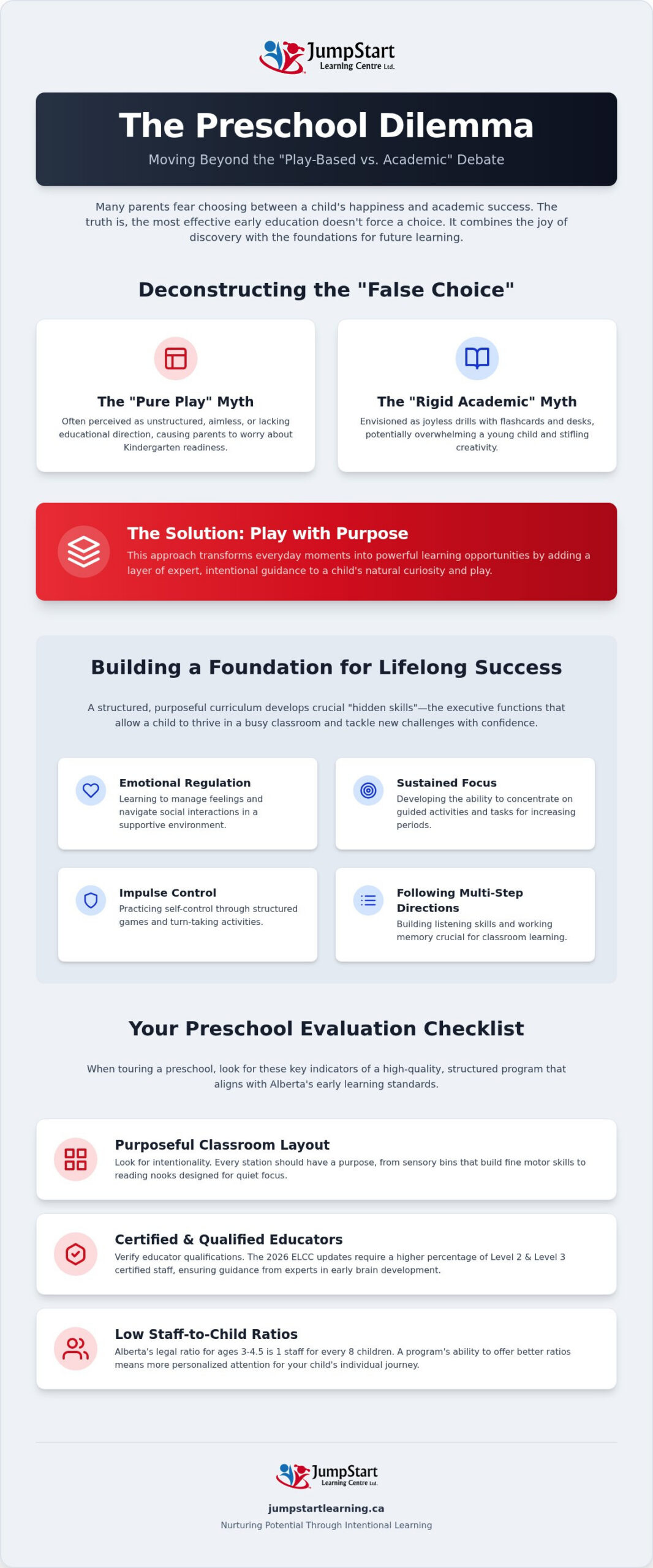
Many parents feel caught in an impossible tug-of-war when comparing play based learning vs academic preschool. There’s a common misconception that “academic” means rigid desks and flashcards, while “play” means a lack of direction. In reality, the most effective early childhood education moves beyond this false choice. At Jumpstart Learning Academy, we define structured academics as intentional, research-based instruction that maps directly to developmental milestones. This structure isn’t a cage; it’s a scaffold. When a child’s day has a predictable rhythm, they feel safe enough to take the cognitive risks necessary for deep growth.
The ‘Play with Purpose’ Philosophy Explained
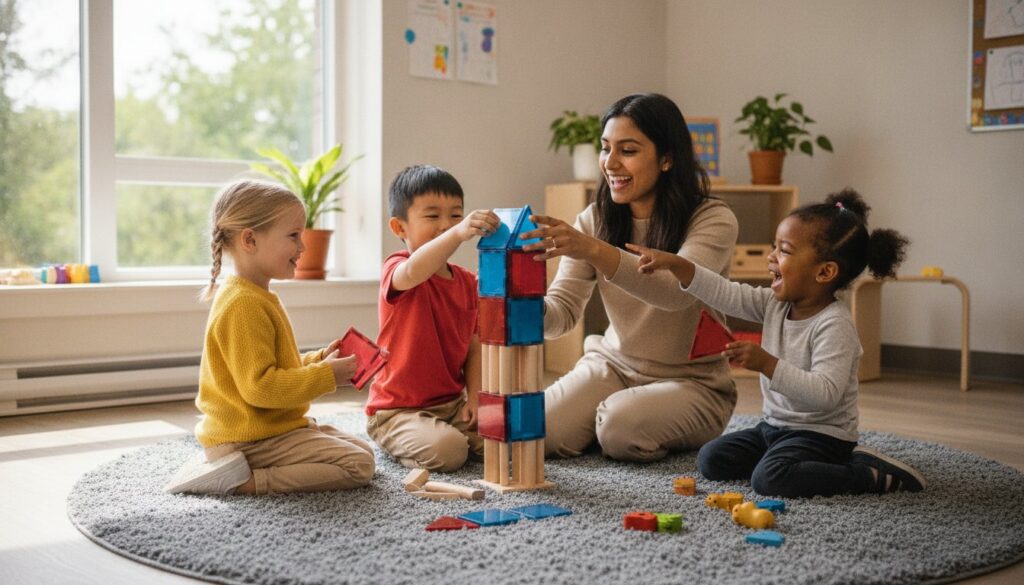
Our approach transforms everyday moments into powerful learning opportunities. While learning through play is a foundational concept, our “Play with Purpose” model adds a layer of expert intentionality. For example, when a child in our Preschool Program (3 Year Olds) builds with blocks, a teacher doesn’t just watch. They engage the child to count the levels or predict which shape will balance best. This turns a simple game into a lesson on spatial reasoning and numeracy.
This sensory-focused foundation is where we discover a child’s latent capabilities. By blending scientific rigor with a nurturing environment, we help 3 and 4-year-olds uncover skills they didn’t know they had. It’s about shifting from the frustration of struggle to the joy of achievement. This methodical progression ensures that every student is seen and supported on their individual journey. By providing a clear path forward, we lower the stress for families and provide a sense of order in what often feels like a chaotic educational landscape.
The Cognitive and Social Benefits of a Structured Curriculum
Choosing between play based learning vs academic preschool shouldn’t feel like a compromise. A structured environment actually accelerates the development of vital executive functions. When children engage in guided activities, they practice impulse control, sustained focus, and the ability to follow multi-step directions. These are the “hidden” skills that allow a child to thrive in a busy classroom. By creating a predictable routine, we help children build the resilience and confidence they need to tackle new challenges without fear.
This structure is particularly effective for literacy and numeracy. As Alberta moves toward updated curriculum standards in 2026, specialized instruction ensures your child isn’t just playing, but building a foundation for Grade 1. Recent research on play-based curricula suggests that while play is essential, the intentionality behind the activities is what drives long-term academic success. It’s about moving from simple discovery to meaningful mastery.
Aligning with Alberta’s Early Learning Standards and Cogito Streams
For many families in Edmonton, the goal is entry into competitive Cogito or private school streams. These programs require a high level of readiness that unstructured care often misses. Our Junior Kindergarten Program (4 Year Olds) uses personalized learning plans to meet these specific benchmarks. We bridge the gap between early childhood and the rigors of elementary school by aligning our daily purposeful play with provincial outcomes. To better understand your options, you can read our guide on Choosing the Best Preschool in Edmonton: A Parent’s Guide for 2026. If you’re ready to see how we can support your child’s journey, you can explore our enrollment process today.
How to Evaluate a Structured Preschool Program in Edmonton
Finding the right fit between play based learning vs academic preschool requires a keen eye during your school tour. Start by observing the classroom layout. A truly structured environment shows intentionality; every station has a purpose, from sensory bins that build fine motor skills to reading nooks designed for quiet focus. In Edmonton and Beaumont, you should also verify educator qualifications. The 2026 ELCC updates require a higher percentage of Level 2 and Level 3 certified staff, ensuring your child is guided by experts who understand early brain development.
Don’t forget to ask about staff-to-child ratios. While Alberta’s legal ratio is 1 staff member for every 8 children aged 3 to 4.5, a program’s ability to provide personalized attention is what truly matters. As the American Academy of Pediatrics clinical report emphasizes, play is the primary way children develop the social and emotional resilience needed for life. The goal is a program that nurtures this internal growth just as much as literacy and numeracy milestones. It’s about finding a guide who values integrity and genuine connection over high-pressure tactics.
The Jumpstart Approach: Preparing Your Child for Kindergarten
Our Preschool Program (3 Year Olds) and Junior Kindergarten Program (4 Year Olds) are designed as sequential, transition-focused tiers. We adopt a “nurturing mentor” role, which means our educators act as steady guides who are deeply invested in each student’s well-being. We help children navigate challenges like following multi-step directions or social sharing with patience and quiet confidence. This structured yet heart-centered approach ensures your child moves toward Grade 1 with a sense of joy and readiness. If you’re looking for a partner in your child’s education, you can secure your child’s spot-Enroll at Jumpstart Learning Academy today.
Preparing Your Child for a Lifetime of Success
Choosing the right path for your child doesn’t have to be a source of stress. When you look beyond the traditional debate of play based learning vs academic preschool, you’ll find that structure and joy coexist beautifully. By selecting a program that prioritizes “Play with Purpose,” you’re providing your child with the executive functions and cognitive foundations required for the 2026 Alberta curriculum. As a licensed Alberta early learning centre, Jumpstart Learning Academy offers a research-based curriculum with a specialized literacy and numeracy focus designed for lasting achievement. Our methodical approach ensures every student feels supported while they discover their latent capabilities. You can secure your child’s future; enroll at Jumpstart Learning Academy today. Your child’s journey toward confidence and academic mastery starts with a single, intentional step. We’re honored to be your partner in this transformative process.
Frequently Asked Questions
What is the difference between a daycare and a structured academic preschool?
Daycare primarily provides broad supervision and childcare. In contrast, a structured preschool focuses on specific educational milestones. Programs like our Junior Kindergarten Program (4 Year Olds) use a research-based curriculum to prepare children for Grade 1. While daycare offers a safe environment, our academy provides intentional instruction that transforms daily activities into foundational learning moments for long-term academic and social success.
Is my child too young for a structured academic program at age 3?
Three-year-olds thrive in environments that offer both warmth and a predictable rhythm. Our Preschool Program (3 Year Olds) introduces structure through sensory-focused play rather than rigid drills. This approach helps them build impulse control and emotional resilience early. We focus on the individual journey of every student, ensuring they feel secure as they begin to explore more complex social and cognitive challenges.
How do structured academics help with the Cogito program entry in Edmonton?
Entry into Edmonton’s Cogito streams requires strong foundations in literacy and numeracy. A structured preschool helps children master these core competencies while developing the ability to follow multi-step directions. Our educators guide students through personalized learning plans that align with Alberta’s Kindergarten benchmarks. This specialized focus ensures your child has the quiet confidence and academic skills necessary to excel in more rigorous elementary streams.
Will my child still have time for free play in a structured preschool?
Absolutely, as play is essential for a child’s well-being. When parents weigh play based learning vs academic preschool, they find our “Play with Purpose” model offers the perfect balance. We weave intentional learning into active play sessions throughout the day. This ensures children enjoy the freedom of childhood while building the focus and social skills required for a smooth transition to school.
