
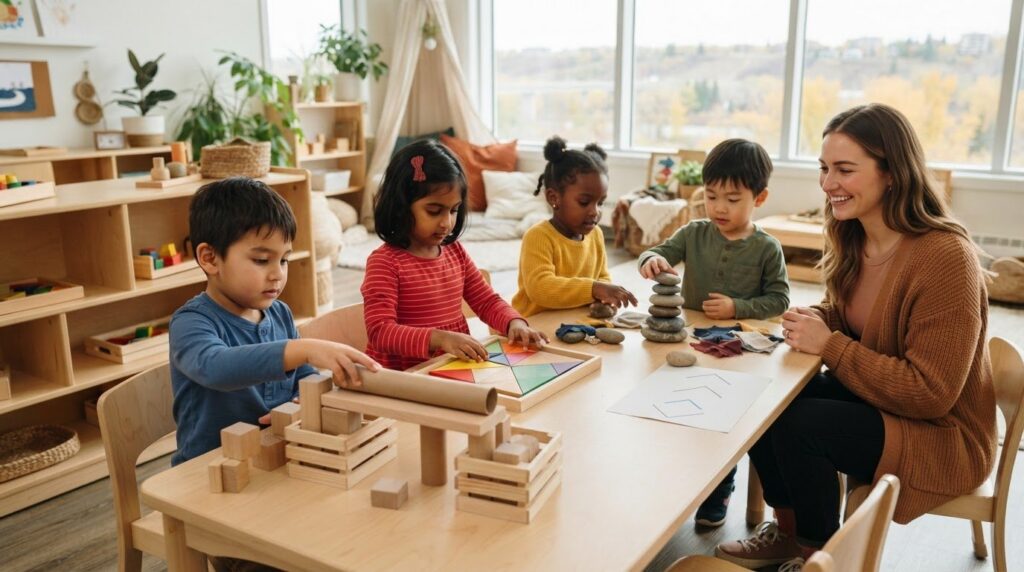
A preschooler’s problem-solving is about more than finding the right answer. It means noticing a challenge, considering possible solutions, and trying them out. Enhancing problem-solving skills in preschoolers starts with giving children room to explore, make choices, and learn from what happens.
When your child gets stuck, it can be tempting to step in and fix things. But everyday play gives children opportunities to practise flexible thinking, persistence, and managing frustration. This article explains what problem-solving involves, what makes activities effective, and which abilities help children work through challenges. You’ll also find playful ways to encourage these skills at home or in an early learning setting.
Key Takeaways
- Recognize problem-solving as a process: children notice a challenge, consider options, and learn by trying.
- Choose play activities that let children make meaningful decisions, test ideas, and adjust their approach.
- Support persistence, flexible thinking, communication, and emotional regulation by giving children time to work through challenges.
- Use an age-appropriate preschool program to give children structured opportunities to practise these abilities through purposeful play.
1. What Are Problem-solving Skills?
Problem-solving skills help children notice a challenge, consider options, and test a solution. Play lets young children practise each step through real interactions. At 16 months, children may use trial and error; preschoolers can work through more complex tasks. Cognitive play also exercises memory and logical thinking, abilities that support learning at school.
In pretend play, a child can follow arrow cards like a robot, moving from place to place in sequence. Loose parts such as cardboard tubes, blocks, and fabric invite children to experiment and invent solutions. Puzzle boards, blocks, and reusable household materials are practical choices. In Canada, costs vary depending on the materials, their condition, and whether families reuse items or buy new toys.
A puzzle encourages trial and error: a child turns a piece, checks its shape, then tries another space. A maze offers a similar challenge as children compare paths and revise their choices. These activities support analysis, prediction, and persistence. They also encourage children to develop strategies independently rather than memorize one answer.
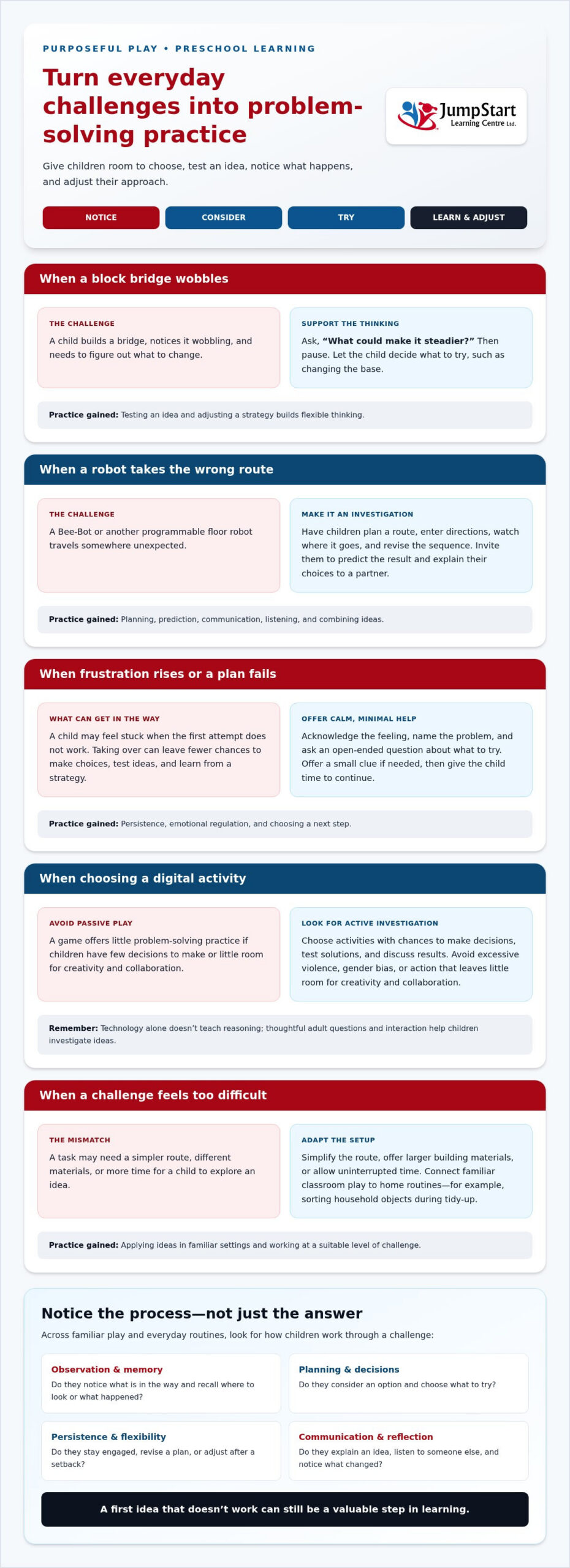
When frustration rises, calmly name the problem and ask what the child might try. Offer a small clue, then give them time to continue. Educators can observe whether a child identifies a challenge, tests ideas, adjusts after setbacks, and explains choices during familiar play. Notice these actions across activities, not just whether the child finishes.
Provincial and territorial early-learning guidance in Canada can be reflected in curricula through play, inquiry, and social interaction. For example, an educator can document how a child explores materials, makes choices, and works with peers.
2. Characteristics of effective preschool problem-solving activities
Effective activities offer meaningful choices, time to test ideas, and reasons to adjust strategies. A block-building challenge, for example, might invite a child to make a bridge, notice it wobbling, and change the base. During play, an educator can ask, “What could make it steadier?” Then pause so the child can decide what to try. This kind of interaction lays a foundation for flexible thinking.
Technology can help when it invites active investigation rather than passive watching. With a Bee-Bot or another programmable floor robot, children can plan a route, enter directions, observe where it travels, and revise the sequence. The activity becomes richer when children predict the result and explain their choices to a partner. Social interaction also lets them practise listening, negotiating, and combining ideas.
Connect a classroom challenge to familiar situations at home. If children sort blocks by shape at school, they might sort household objects during tidy-up. Adapt the task to each child: simplify a route, offer larger building materials, or allow uninterrupted time. If frustration appears, acknowledge the feeling and offer minimal help, such as an open-ended question. Too much help can take over the thinking, leaving children fewer opportunities to choose, test, and learn from their own strategies.
3. Problem-solving skills and their component abilities
Problem-solving draws on several abilities, not just finding the right answer. If a child’s mitten is missing, they must notice the problem, recall where it might be, choose somewhere to look, and assess the result. These steps involve memory, observation, and decision-making. Learning from an attempt is a success, even when the first idea doesn’t work.
Children also need to identify what is getting in the way and imagine possible actions. If a paper picture keeps slipping off the fridge, a preschooler might try a different magnet or choose another spot. Ask what changed after each attempt. This helps children connect actions with outcomes and consider what they observed before choosing what to try next.
Planning and flexible thinking work together. During a pretend trip, a child might discover the play road ends at a cushion and decide to reroute it. A useful part of enhancing problem-solving skills in preschoolers is giving them opportunities to revise a plan without rushing to supply the answer. Children aged 21 to 36 months may choose solutions with fewer trials, reflecting development through practice.
Self-regulation helps children stay engaged when a plan fails. They can pause, name a feeling, and choose a next step, such as asking a friend to hold a sheet of paper. Communication matters too: children explain their ideas, listen to someone else, and agree on what to try. These connected abilities support confidence and reasoning.
To enhance problem-solving skills in preschoolers, notice the process during everyday routines. When a child can’t reach a book, observe whether they recognize the obstacle, consider an option, and adjust after trying. The practical takeaway is that problem-solving develops through observation, planning, persistence, communication, and reflection, not correct answers alone.
Jumpstart Learning Academy: Preschool Program (3 Year Olds)
Jumpstart Learning Academy’s Preschool Program (3 Year Olds) connects purposeful play with structured academics, giving children opportunities to practise thinking through challenges. Its research-based curriculum supports intellectual and social growth, while personalized learning plans and assessments help educators respond to each child’s learning journey.
For families in Edmonton looking for a learning environment where preschoolers can explore ideas, make choices, and build early problem-solving skills, Jumpstart Learning Academy offers structured, teacher-led programs. Through purposeful play, guided instruction, and hands-on activities, children practise early learning skills while building confidence and preparing for their next stage of education.
Contact Jumpstart Learning Academy to learn more about its Preschool Program (3 Year Olds).
Keep Curiosity Moving Forward
Every challenge a child works through can be a small step toward greater independence. Notice how your preschooler approaches everyday puzzles, choices, and changes in plans. This helps you offer encouragement that fits the moment without taking over. A steady approach to enhancing problem-solving skills in preschoolers supports confidence and learning.
For families considering a structured next step, Jumpstart Learning Academy offers a Preschool Program (3 Year Olds), Junior Kindergarten Program (4 Year Olds), and Kindergarten Program (5 Year Olds). These programs provide an early learning pathway as children move toward their next stage of education.
Contact Jumpstart Learning Academy today to explore an early learning option for your child. Keep making space for questions, experiments, and fresh attempts. Small discoveries can open the way to bigger confidence.
Frequently Asked Questions
What Are Problem-solving Skills?
Problem-solving helps a child move from noticing a difficulty to choosing and reviewing an action. For example, if a snack container won’t open, a child might describe the obstacle, try a different grip, then ask for help if needed. The skill includes recognizing when a strategy isn’t working, not just reaching the desired result.
What problem-solving skills are developmentally appropriate for preschoolers?
Preschoolers can practise naming a simple challenge, choosing between a few possible actions, and changing their approach after feedback. Skills develop gradually: children aged 7 to 18 months experiment with strategies to reach goals, while children aged 21 to 36 months may choose solutions with fewer trials. Readiness varies by task, experience, and support.
What activities help preschoolers develop problem-solving skills at home?
At home in Edmonton, invite your child to sort laundry by colour or find which container fits a set of toys. Ask them to explain their choice, then let them test it. A simple cooking task, such as deciding how to divide fruit among family members, also encourages planning, counting, and adapting when the portions don’t match.
What classroom games and strategies build problem-solving skills in preschoolers?
Try a shared art project where children decide how to attach materials or plan a picture together. Cooperative groups of 2-4 children can practise listening, negotiating, and revising a shared plan. Turn-taking cards or tokens make participation visible; a short timer can help children anticipate when roles change without an adult deciding every turn.
How can parents encourage preschoolers to solve problems independently?
Give your child time to attempt a manageable task before offering a solution. If a coat sleeve is twisted, ask, “What could you try next?” and wait for their response. Offer a small hint if needed, then recognize the strategy they used, such as turning the sleeve around. Step in promptly when safety or distress requires it.
