
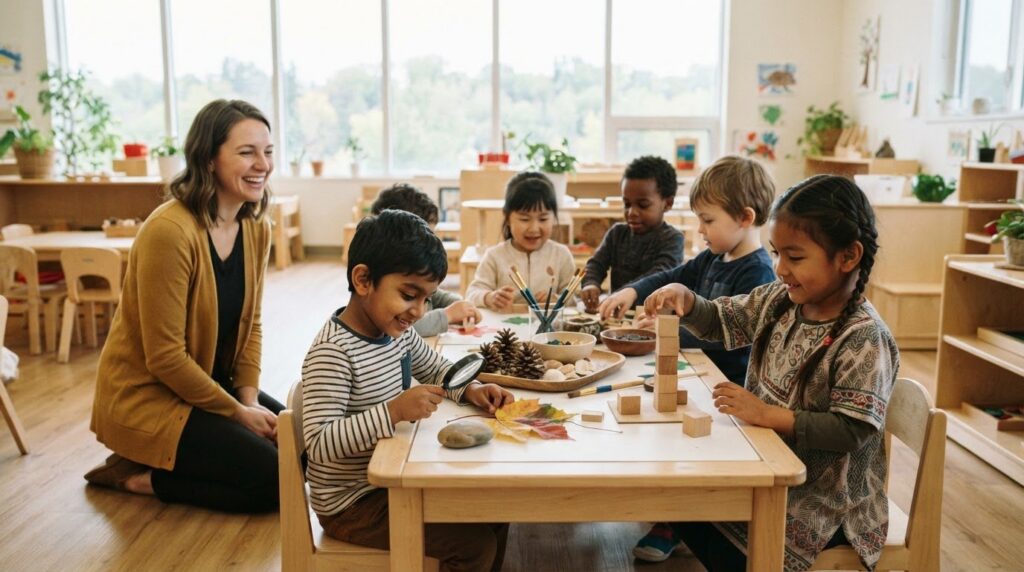
What if encouraging curiosity in young children isn’t about asking more questions, but making room for the questions and discoveries already taking shape? If your child asks few questions, moves on quickly, or seems unsure what to explore, that doesn’t mean their curiosity is missing. Small, responsive moments can help it grow without turning learning into pressure.
A University of Michigan study of 6,200 kindergartners found that children rated as more curious had higher reading and math achievement. You don’t need special materials or expert answers to nurture that drive. This article shares practical ways to follow a child’s interests, respond with language that builds confidence, and combine purposeful play with gentle guidance. Everyday exploration can help children test ideas, express observations, and trust their own thinking.
Key Takeaways
- Curiosity can appear as noticing, wondering, exploring, or testing an idea, even when a child doesn’t ask many questions.
- To encourage curiosity in young children, notice their interest, pause, describe what you see, then invite them to share an idea.
- Open prompts such as “What do you notice?” can spark exploration without making conversation feel like a quiz.
- Purposeful play, predictable routines, and gentle educator guidance can work together to support discovery and children’s confidence in expressing their thinking.
What Does Encouraging Curiosity in Young Children Really Mean?
Encouraging curiosity in young children doesn’t mean prompting them to ask question after question. Curiosity can begin with a pause: a child notices a shadow, wonders why a tower fell, or reaches for two objects to compare how they feel. These moments show an active mind at work, even when no words are spoken.
A curious moment is a child noticing something and exploring what it might mean; it’s one moment of learning, not a label for the child’s whole personality. Children don’t need to perform curiosity for adults or meet a target number of questions. Instead, make time and space for discovery without treating curiosity as a trait to train, assess, or compare.
Children develop in different ways and at different paces. A broad overview of the stages of child development can offer context, but it can’t tell you exactly how curiosity should look in your child. Pay attention to their individual signals, such as what they watch, touch, repeat, or return to.
How can you recognize curiosity beyond questions?
Look for what a child does, not only what they say. They might watch water move through a funnel, repeat a block-building action to see what happens, compare a smooth stone with a rough one, or test how far a toy rolls on different surfaces. Each is a small investigation: the child notices, tries something, and observes what follows.
Quiet attention counts, too. A child who watches before joining in may be taking in details and deciding what to try. Children show interest in different ways, and their energy can shift from one activity to another. Constant questions aren’t a requirement. Notice the moment, stay available, and let your child’s way of exploring lead.
How Can You Encourage Curiosity in Young Children Every Day?
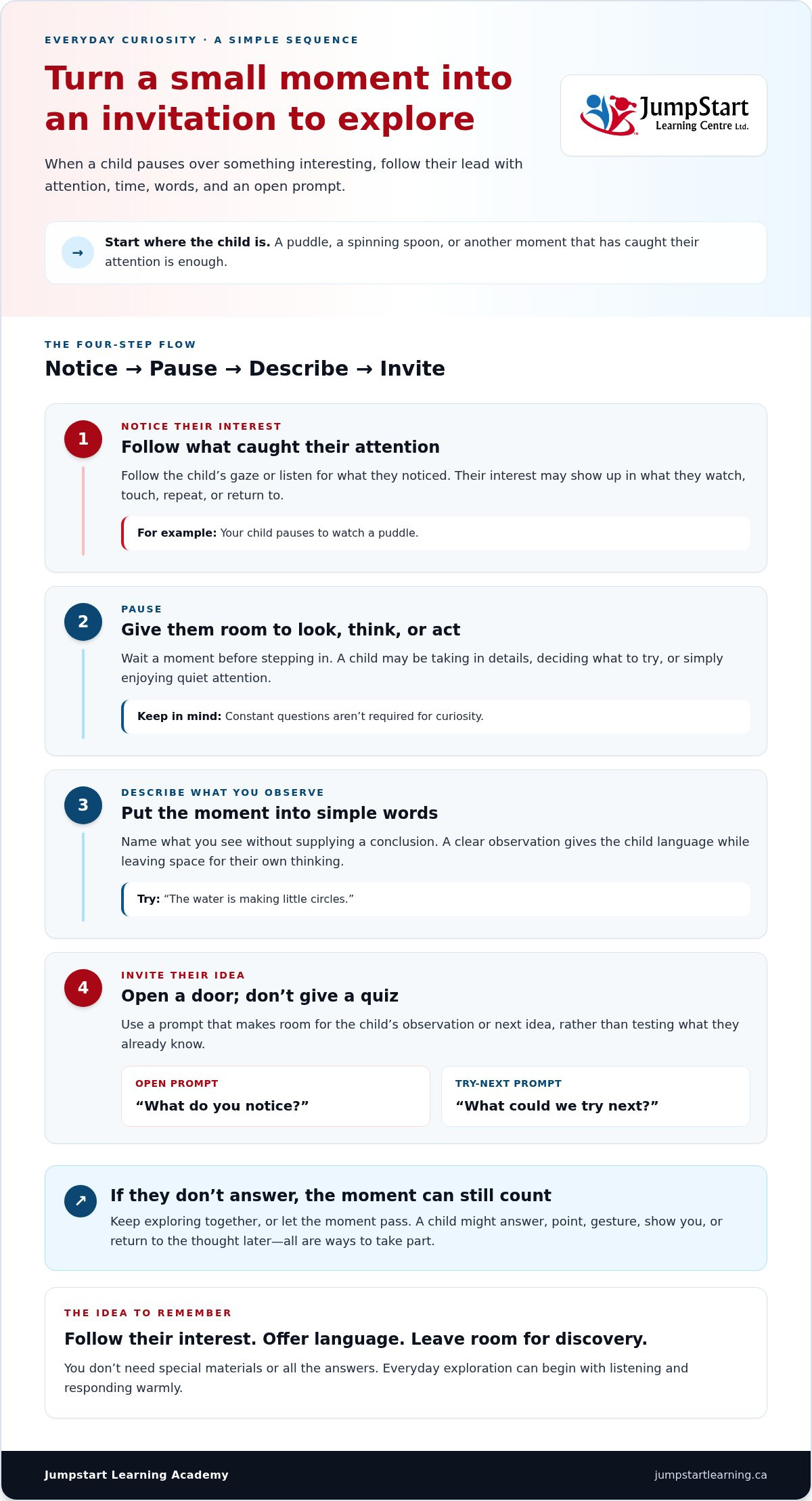
You don’t need a lesson plan to make an ordinary moment inviting. When your child pauses over a puddle or watches a spoon spin, try this simple sequence:
- Notice their interest. Follow their gaze or listen for what caught their attention.
- Pause. Give them a moment to look, think, or act before you step in.
- Describe what you observe. Say, “The water is making little circles,” without supplying a conclusion.
- Invite their idea. Ask, “What do you notice?” or “What could we try next?”
These prompts open a door rather than test what a child knows. If they don’t answer, keep exploring together or let the moment pass. Following a child’s current interest can turn an everyday pause into an invitation to explore, because the idea already matters to them.
What can adults say when a child wonders aloud?
Try “I wonder” language: “I wonder why the leaves are moving,” or “I wonder what will happen if we turn the page.” Pair your words with a simple observation, then wait. Your child might answer, point, gesture, show you, or return to the thought later. All are ways to take part.
Stories and songs can spark a wondering moment, as can a familiar object at mealtime or something you notice outdoors. You don’t need special materials or all the answers. A resource on fostering healthy child development also highlights caregivers’ role in supporting children’s growth. In practice, encouraging curiosity in young children can start with listening and responding warmly. For families seeking playful, guided learning in Edmonton, explore Jumpstart Learning Academy’s early learning programs.
How Does Guided Preschool Learning Make Room for Curiosity?
Curiosity doesn’t require every moment to be child-led. Predictable routines can help children feel settled, while an educator’s guidance gives them a starting point for exploration. A teacher might introduce a hands-on activity, model a useful word, then leave room for children to test an idea or share what they notice. Structure can support discovery, not shut it down. In similar ways, creative spaces like art workshops dubai illustrate how hands-on guidance and open-ended materials encourage learners to explore ideas and express themselves.
At JumpStart Learning Academy in Edmonton, purposeful play and hands-on activities are combined with guided instruction and explicit language modelling. During an activity, an educator can explain a concept in age-appropriate language, then encourage children to explore materials and express their own observations. This balance makes encouraging curiosity in young children part of a learning experience with direction as well as room to discover.
What should families look for in a curiosity-supporting learning environment?
Notice whether educators listen to children’s ideas, offer clear language models, and explain concepts in ways that suit their age. A helpful response might name what a child is doing, then give them time to add their own thought. These interactions support oral language and help children feel more confident expressing what they see, wonder, or want to try.
Play and guidance can also connect exploration with early academic learning. JumpStart’s programs include daily literacy and numeracy practice alongside oral language development, using purposeful play, songs, stories, games, movement, and hands-on activities. If you’re choosing the right preschool in Edmonton, consider how a program makes space for both learning routines and children’s ideas. JumpStart Learning Academy offers teacher-led early learning programs in Edmonton. Families can find enrollment information.
Let Small Discoveries Lead to What Comes Next
Curiosity doesn’t need to look dramatic to matter. A child’s quiet attention, an unexpected idea, or a wish to try again can become a starting point for confidence and deeper learning. Keep making room for those moments, and let your child’s interests guide what you explore together. Encouraging curiosity in young children is less about having the perfect answer and more about showing that their thinking is worth sharing.
For families looking for a supportive learning environment, JumpStart Learning Academy offers teacher-led early learning in Edmonton, Alberta, with purposeful play, guided instruction, clear language modelling, and age-appropriate explanations. Explore JumpStart Learning Academy and discover an approach that makes space for children to learn, wonder, and grow.
Frequently Asked Questions
Is curiosity natural in young children?
Yes, curiosity is a natural way young children engage with new experiences, though it won’t look the same every day or in every child. One child may seek something unfamiliar; another may prefer revisiting a familiar activity before trying a small variation. Rather than judging interest by how often your child speaks, notice what draws their attention and offer a comfortable chance to engage.
How can I encourage curiosity in my child without buying special toys?
No special toys are needed. Encouraging curiosity in young children can begin with ordinary routines: invite your child to match container lids, sort clean socks by pattern, or predict which grocery items will fit in a bag. On an Edmonton winter morning, they could compare how different mittens feel after coming indoors. Let them handle safe objects and adjust their guesses as they go.
Should I answer every question my young child asks right away?
No. You can acknowledge the question without rushing to provide a complete answer. Share what you know, ask what prompted the thought, or say you can look for the answer together. If the question involves immediate safety, respond clearly first. For other questions, it’s fine to return to the topic later. A warm response shows your child their wondering is welcome, even when you need time to think.
