
What if the milestones you see on medical charts aren’t meant to be a high-stakes exam, but a roadmap to your child’s unique potential? It’s natural to feel a sense of worry when you watch your four-year-old at the park and wonder if they’re keeping pace with their peers. You’re likely looking for clarity amidst the noise of conflicting checklists and differing expert opinions. Understanding the specific child development milestones 4 year old learners reach is the first step in moving from anxiety toward a place of steady, quiet confidence.
We believe that every child’s path is individual, and you deserve a partner who values that journey as much as you do. In this guide, we’ll break down the essential cognitive, social, and physical markers that signal kindergarten readiness within the Alberta educational landscape. You’ll discover actionable ways to support this growth at home and learn how a structured, play-based environment can help bridge the gap. By the end, you’ll have a clear plan to help your child transform their natural curiosity into the foundational skills they need for school success.
Key Takeaways
- Understand how your child’s language growth moves from simple requests to complex storytelling, setting the vital foundation for future literacy.
- Identify essential child development milestones 4 year old learners achieve, including identifying shapes and mastering early counting sequences.
- Learn to support the transition from parallel play to cooperative peer interaction, helping your child build lasting social confidence.
- Discover the strategic advantage of a structured Junior Kindergarten program over standard daycare for meeting Alberta’s school readiness standards.
- Gain practical tools to replace parental anxiety with a clear, research-based plan that honors your child’s unique developmental pace.
Core Cognitive and Language Milestones: Building the Foundation for Literacy
Your four-year-old’s brain is currently undergoing a massive expansion in logical reasoning and symbolic thought. This is often the age when the “why” phase reaches its peak. While the constant questioning might feel exhausting during a busy afternoon, it’s actually a vital sign that your child is building a framework for understanding the world. These inquiries are foundational child development stages that transform simple curiosity into the critical thinking skills required for the classroom.
Tracking the child development milestones 4 year old learners typically reach helps you see the shift from functional communication to expressive storytelling. Instead of just asking for a snack, your child might now describe the “big, red apple” they saw at the store. You’ll also notice early literacy signs, such as recognizing the specific shape of their own name on a cubby or understanding that the text in their favorite picture book stays the same every time you read it. These small moments of recognition are the building blocks of future reading success.
Communicating with Purpose
At this stage, you can expect your child to use sentences of five or more words with increasing grammatical accuracy. They should also be able to follow two-step directions, such as “Please put your shoes in the bin and then come to the table.” You can nurture these skills by practicing active listening. When you read together, try asking predictive questions like, “What do you think the bear will do next?” This encourages them to process information and articulate complex thoughts rather than just absorbing the story passively.
From Counting to Numeracy
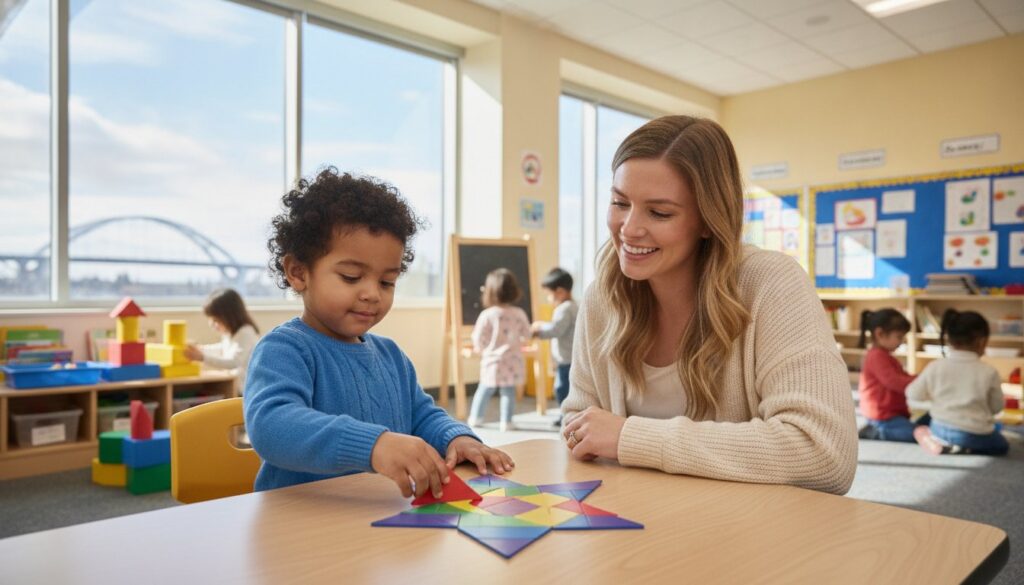
Cognitive milestones at age four involve more than just rote memorization. Most children this age can count 10 or more objects and are beginning to grasp the abstract concept of time, distinguishing between morning, afternoon, and night. Numeracy is the ability to use numbers and mathematical concepts in everyday play, such as sorting blocks by size or counting out pieces of fruit for a snack. In our Junior Kindergarten Program, we focus on these child development milestones 4 year old students need to master, ensuring they move beyond simple counting into a deeper understanding of how numbers work in the real world.
Social and Emotional Milestones: Navigating the World of Peers
Watching your child move from playing alongside others to truly playing with them is one of the most rewarding transitions of the preschool years. This shift, known as cooperative play, involves a new level of social complexity where children learn to share, take turns, and negotiate the rules of a game. It’s common for parents to feel a flicker of worry when social friction occurs, but these moments are actually essential Milestones for 4-Year-Olds. They represent the first steps toward building lasting friendships and classroom confidence.
A significant part of this journey involves emotional regulation. While toddlers often rely on physical outbursts to show frustration, a four-year-old is beginning to use their words to express big feelings. You’ll also notice a beautiful growth in empathy; your child might now offer a favorite stuffed animal to a friend who is crying. This internal growth is just as vital as any academic skill, as it allows them to enter a school environment with the resilience needed to handle new challenges.
The Power of Imaginative Play
At age four, children dive into complex role-play, pretending to be doctors, teachers, or superheroes. This isn’t just simple fun. It’s a sophisticated way for them to practice social problem-solving and understand different perspectives. Our “play with purpose” philosophy captures these imaginative moments to teach essential classroom etiquette. If you’re looking for a supportive environment where your child can practice these skills, you can explore our Junior Kindergarten options in your community.
Building Emotional Resilience
Mastering child development milestones 4 year old learners face often comes down to identifying emotions like excitement or frustration before they become overwhelming. When children can name their feelings, they gain a sense of control over their world. Supporting this Social-Emotional Growth Through Play-Based Education ensures they don’t just survive the transition to kindergarten, but thrive within it. This resilience acts as a steady foundation for all the learning that follows.
Finally, your four-year-old is likely eager to be a “helper.” They want to set the table, match socks, or carry the mail. Encouraging this independence builds the self-assurance they’ll need to manage their own belongings and follow school routines without constant supervision. It’s a sign of a child who is ready to step confidently into their next big adventure.
Preparing for Kindergarten in Alberta: The Junior Kindergarten Advantage
Many parents in Edmonton and Beaumont find themselves at a crossroads when their child turns four. While daycare provides a safe and caring environment, a structured Junior Kindergarten program offers a specialized bridge to formal schooling. This year is critical for refining physical skills, such as holding a pencil with a tripod grip or using safety scissors to follow a straight line. These fine motor abilities are essential child development milestones 4 year old students need to master before they ever set foot in a primary classroom.
What is Junior Kindergarten?
Our Junior Kindergarten Program (4 Year Olds) is a licensed, research-based curriculum designed specifically for this age group. Unlike general childcare, it focuses on purposeful play combined with intentional literacy and numeracy enrichment. We follow the principles of “Flight,” Alberta’s official early learning and care framework, to ensure children are meeting regional standards. This structured environment helps reduce the stress of the school transition by introducing classroom routines in a warm, nurturing setting that feels like a partnership rather than just a service.
Every child grows at a different pace. You might notice your child is a storytelling expert but struggles with sorting shapes, or perhaps they’ve mastered counting but find sharing difficult. We use personalized learning plans to address these individual variations. By referencing the CDC developmental milestones, we can identify exactly where your child is on their journey and provide the specific support they need to feel successful. This approach moves away from the frustration of academic struggle toward the joy of achievement.
Steps to Ensure Kindergarten Readiness
If you’re feeling anxious about the upcoming school year, taking proactive steps can provide immense relief. It’s about discovering the latent capabilities within your child and giving them the tools to shine.
- Monitor milestones: Use a reliable checklist to track your child’s progress across cognitive and social domains.
- Schedule an assessment: A professional evaluation can highlight hidden strengths and specific areas for growth.
- Choose the right program: Enroll in a setting that balances academic foundations with the emotional support your child needs to thrive.
You don’t have to navigate this transition alone. If you’re ready to take the next step in your child’s education, visit the Jumpstart Learning enrollment page to learn more about our local programs. Understanding the child development milestones 4 year old learners experience is the key to a joyful, confident start to their educational career.
Empowering Your Child’s Path to School Success
The transition to kindergarten is a significant chapter in your family’s story. By understanding the child development milestones 4 year old learners reach, you can move away from the pressure of academic checklists and focus on the joy of discovery. Whether it is mastering the fine motor skills needed for writing or building the emotional resilience to navigate new friendships, every small step prepares your child for the bigger world of formal schooling. These foundational blocks ensure they don’t just enter the classroom, but arrive ready to lead their own learning journey.
Looking ahead, the logical and social skills they build today will prepare them for a world increasingly driven by advanced technology. Just as global innovation depends on high-performance tools like NVIDIA H100 rental UAE to solve complex problems, your child is developing the cognitive foundation to navigate and succeed in a high-tech future.
As a licensed Alberta Early Learning Centre, we provide the structured, research-based environment your child needs to thrive. Our experienced educators specialize in Pre-K development, offering personalized assessments for every student to ensure their individual needs are met. We believe in bridging the gap between home and school with a steady, nurturing hand. You don’t have to navigate this path alone; we are here to act as a dedicated partner in your child’s growth.
Take the first step toward a confident school start today. Secure your child’s spot in our Junior Kindergarten Program for 2026 and watch them transform their natural curiosity into lifelong capability. Your child has an incredible journey ahead, and we’re honored to help them take those first brave steps.
Frequently Asked Questions
What should a 4-year-old know before starting Kindergarten in Alberta?
In Alberta, kindergarten readiness is holistic, focusing on a child’s ability to follow two-step directions, manage basic self-care like zipping a coat, and interact positively with peers. While academic skills like counting to ten and recognizing some letters are helpful, the provincial framework emphasizes social-emotional maturity and curiosity. These foundational child development milestones 4 year old learners reach ensure they can navigate a classroom environment with steady confidence and ease.
Is it normal for my 4-year-old to still have occasional tantrums?
Occasional tantrums are a normal part of development as children learn to navigate complex emotions like frustration or disappointment. While toddlers often express themselves physically, a four-year-old is in the process of shifting toward using words to describe their feelings. You can support this growth by helping them name their emotions in the moment, which builds the self-regulation skills vital for a successful transition into a school setting.
How can I help my child develop fine motor skills at home?
You can strengthen fine motor skills through simple, everyday play like using safety scissors, kneading playdough, or stringing large beads onto a lace. These activities develop the small muscles in the hands and fingers necessary for a proper tripod grip when holding a pencil. Engaging in these sensory-focused tasks at home provides a fun, low-pressure way to reach the physical child development milestones 4 year old students need for future writing tasks.
What is the difference between Preschool and Junior Kindergarten?
The primary difference lies in the developmental focus and age grouping. Our Preschool Program is tailored for three-year-olds with a heavy emphasis on socialization and early play. In contrast, the Junior Kindergarten Program for four-year-olds acts as a research-based bridge to formal schooling. It introduces more structured literacy and numeracy enrichment within a play-based framework to ensure children are fully prepared for the expectations of the Alberta kindergarten curriculum.
