

What if the very moments you step in to save your child from frustration are actually the moments they need most to grow? It’s natural to feel a pang of guilt when your little one faces a setback or to want to smooth the path to avoid a looming tantrum. You want them to feel successful and happy, yet you might worry about how much struggle is healthy for a preschooler. Building resilience in children isn’t about removing every obstacle; it’s about providing a safe space where they can learn to navigate challenges with confidence.
While resilience is often discussed in the context of older children, the building blocks are laid during the very first years of life. For families seeking specialized support for their youngest, you can explore Nursery Care (0-2 years) options to see how Snugglepot Childcare Centre creates a nurturing environment for early development.
We understand the delicate balance you’re trying to strike between being a protective parent and an empowering mentor. This article will show you why shielding your child from every small struggle can unintentionally hinder their emotional development and how to transform those difficult moments into opportunities for lasting grit through purposeful early learning. We’re going to debunk three common myths that hold children back and explore how the right Pre-K or Junior Kindergarten environment fosters the internal strength your child needs to handle life’s minor setbacks without a meltdown.
Key Takeaways
- Learn how resilience is a cognitive skill set that your child can develop through manageable, everyday challenges rather than an innate trait they’re born with.
- Discover why avoiding all failure can stunt emotional growth and how building resilience children involves embracing the “safe struggle” in a supportive environment.
- Identify the specific “emotional stamina” markers your child needs to successfully navigate the transition into a Kindergarten classroom.
- Understand how a “play with purpose” philosophy creates natural opportunities for preschoolers to practice grit and problem-solving.
- Gain confidence in choosing a Junior Kindergarten or Pre-K program that uses personalized learning to ensure challenges are perfectly balanced for your child’s needs.
The ‘Fragility Trap’: Why Avoiding Failure Stunts Resilience in Early Childhood
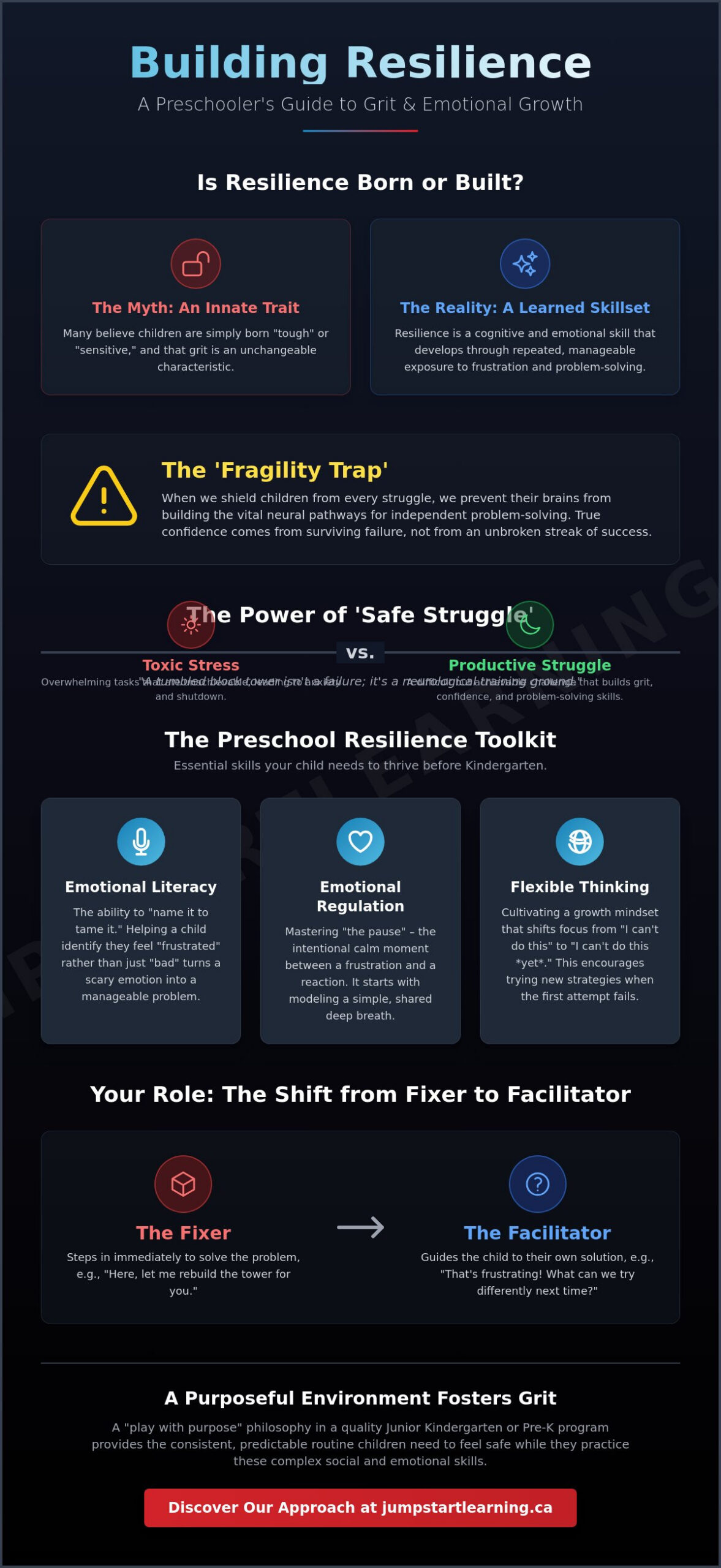
Many parents believe that some children are simply born with a “tough” temperament while others are naturally sensitive. This common myth suggests that grit is an unchangeable trait, but the reality is much more hopeful. Scientific research into psychological resilience reveals that it’s actually a cognitive and emotional skill set. Much like learning to read or count, building resilience children is a process of repeated, manageable exposure to frustration.
When we step in too quickly to solve every problem, we accidentally trigger what experts call the “fragility trap.” This happens when removing every obstacle prevents a child’s brain from mapping out the vital neural pathways needed for independent problem-solving. We must remember that true resilience is the capacity to navigate internal waves of frustration, not just the ability to endure external hardship. By allowing our children to feel the weight of a small challenge, we give them the tools to carry it.
The Role of ‘Safe Struggle’ in the Preschool Years
Ages three to five represent a critical window for developing executive function and emotional regulation. During these years, children need “productive struggle” rather than “toxic stress.” Productive struggle occurs when a task is difficult but achievable with effort. For instance, a child’s first tumbled block tower isn’t just a mess on the floor; it’s a neurological training ground where grit is forged. These moments teach the brain that frustration is temporary and solvable, creating a foundation for future academic success.
Myth-Busting: Does Protection Build Confidence?
It’s a counter-intuitive truth that real confidence comes from surviving failure, not from a streak of constant success. If a child never experiences a “safe” mistake, they never learn that they have the power to fix it. Alberta parents can support this growth by shifting from “fixers” to “facilitators” in their daily routines. Instead of rebuilding the tower for them, you might ask, “What can we try differently next time?” This simple shift helps in building resilience children by turning a moment of defeat into a powerful lesson in personal capability.
The Preschool Resilience Toolkit: 4 Skills Your Child Needs Before Kindergarten
Preparing for the transition to kindergarten in Edmonton involves much more than memorizing the alphabet or counting to twenty. While academic readiness is vital, educators are increasingly recognizing that “emotional stamina” is the true foundation of a successful start. This stamina allows a child to remain focused on a task even when the classroom gets loud or a peer accidentally knocks over their work. A Structured Academics Preschool in Edmonton provides the consistent, predictable routine that children need to feel safe while they practice these complex social skills.
Developing emotional literacy is a cornerstone of this process. Emotional literacy is the ability to name and tame big feelings before they escalate into an overwhelming meltdown. When children can identify that they feel “frustrated” rather than just “bad,” they can begin to look for solutions. This self-awareness is essential for building resilience in children, as it turns a scary emotion into a manageable problem.
Skill 1: Emotional Regulation and Self-Soothing
In a classroom setting, teachers often model “the pause.” This is the intentional moment of calm between a frustration and a reaction. When a child struggles with a zipper, a teacher might say, “Let’s take a breath together before we try again.” You can mirror this at home by narrating your own calm-down strategies. If you’re building resilience children at home, showing them how you handle your own minor setbacks is a powerful teaching tool.
Skill 2: Flexible Thinking and Problem Solving
Flexible thinking is the ability to move from “I can’t do this” to “I can’t do this yet.” This growth mindset is fostered when children are given tasks that are challenging but not impossible. Our Literacy and Numeracy Enrichment program is specifically designed to provide this “just right” difficulty level. It encourages children to try different strategies when their first attempt doesn’t work, building their confidence through actual achievement.
Skill 3: Peer-to-Peer Conflict Resolution
In a supervised “play with purpose” setting, children learn the art of negotiation. Instead of an adult immediately stepping in to settle a dispute over a toy, we guide the children through the process of finding a compromise. This builds social grit and teaches them that they can handle interpersonal friction without needing a constant rescue. If you’re ready to see your child develop this kind of independence, you can explore our enrollment options to find the right fit.
Skill 4: Task Persistence and Stamina
True resilience shows up when a child chooses to stick with a difficult puzzle or a complex drawing even when it gets hard. By gradually increasing the length and complexity of classroom activities, we help children build the “muscle memory” of persistence. When parents prioritize building resilience children, they’re ensuring their child has the internal strength to see a task through to the end, a skill that will serve them throughout their entire academic journey.
Building Grit in Edmonton: How Jumpstart Learning Academy Fosters Resilient Learners
At Jumpstart Learning Academy, we believe that every spilled glue bottle or challenging puzzle is a hidden opportunity for growth. Our “play with purpose” philosophy across our Edmonton and Beaumont locations creates natural moments where children can practice their coping skills in real time. We view the preschool years as a vital, low-stakes environment for high-stakes emotional learning. It’s the perfect time to let your child experience a small setback while they have the steady hand of a mentor nearby to guide them through the process of recovery.
To ensure these moments are productive, we utilize personalized learning plans that calibrate challenges to be “just right.” When a task is too simple, a child doesn’t learn to persevere; when it’s overwhelming, they may shut down. We find the middle ground where effort leads to genuine achievement. This intentional design is a hallmark of Choosing the Best Preschool in Edmonton, as a nurturing environment must also be one that encourages a child to stretch their latent capabilities. As you evaluate your options, understanding preschool costs in Edmonton and the available funding options can help you make a confident, informed decision for your family.
A Supportive Partnership for Edmonton Families
Our educators look far beyond academic milestones like letter recognition. We celebrate when a child tries a difficult task a second time or when they use their words to resolve a conflict with a peer. This holistic view of building resilience children requires a strong connection between the classroom and the home. We prioritize Parental Involvement so that the strategies we use to encourage grit are reinforced in your daily family routines. As the American Psychological Association suggests, building resilience in children is most effective when parents and teachers work as a unified team. You can read Jumpstart Academy testimonials from real Edmonton families to see how this partnership has helped local children develop lasting confidence and resilience.
Ready for the Next Step: Kindergarten and Beyond
The internal strength a child develops in our Pre-K or Junior Kindergarten programs sets the stage for their entire future. A resilient preschooler doesn’t just survive the transition to the Alberta school system; they thrive in it. They enter the classroom with the confidence to ask questions, the stamina to finish their work, and the emotional maturity to handle social changes. You can use our guide on Preparing for Kindergarten in Edmonton to see how these emotional skills align with academic readiness.
Ready to see your child blossom? Enroll today at Jumpstart Learning Academy.
Empowering Your Child’s Journey Toward Grit
Watching your child face a challenge can be difficult, but you now have the tools to turn those moments into lasting strength. We’ve explored how moving past the “fragility trap” allows your child to develop the emotional stamina they need for the future. By shifting from a “fixer” to a “facilitator,” you’re actively building resilience children need to thrive in Kindergarten and beyond. True confidence doesn’t come from a life without obstacles; it grows from the knowledge that those obstacles can be overcome.
At Jumpstart Learning Academy, we’re dedicated to this transformative journey. As a licensed early learning centre in Alberta, we use our research-based “Play with Purpose” curriculum and personalized assessments to ensure every child finds their own path to achievement. We’re here to partner with you in discovering your child’s latent capabilities in a supportive, expert-led environment. Secure your child’s spot for the 2026 school year at Jumpstart Learning Academy and watch them blossom into a confident, resilient learner. You’ve got this, and we’re here to help every step of the way.
Frequently Asked Questions
Is my child too young to learn resilience?
Your child isn’t too young; in fact, the preschool years are the ideal window for building resilience children through structured, age-appropriate challenges. Between ages three and five, a child’s brain is highly receptive to learning emotional regulation and problem-solving. Whether they’re in a Pre-K or Junior Kindergarten program, these early experiences with small setbacks help them develop the neurological pathways needed to handle bigger hurdles later in life.
How do I know if a preschool program focuses on emotional growth?
A program focused on emotional growth will prioritize “play with purpose” and have clear strategies for teaching social-emotional skills. You should look for educators who act as facilitators during peer conflicts rather than just referees. Ask if the curriculum includes personalized assessments that track emotional milestones alongside academic progress. A nurturing environment should feel like a partnership where your child’s internal growth is valued as much as their literacy and numeracy skills. Reviewing Jumpstart Academy testimonials from Edmonton parents can give you a firsthand look at how this balanced approach plays out in real families’ experiences.
What should I do when my child gets frustrated with a new task?
When frustration peaks, start by acknowledging your child’s feelings to help them feel heard and supported. Instead of finishing the task for them, ask a guiding question like, “What’s one small part we can try together?” This approach helps in building resilience children by teaching them that frustration is a temporary signal to try a new strategy. It transforms a potential meltdown into a successful moment of persistence and problem-solving.
Can resilience help with kindergarten readiness in Alberta?
Resilience is a vital part of kindergarten readiness because it provides the emotional stamina required to navigate a full day of learning. In the Alberta school system, children are expected to follow routines, work with others, and persist through new academic challenges. A resilient child can handle the social and mental demands of a 5 year old’s classroom without becoming overwhelmed by minor mistakes or changes in the daily schedule. When budgeting for your child’s early education, reviewing a comprehensive guide to preschool costs in Edmonton and available funding programs can help ensure financial considerations don’t stand in the way of finding the right environment for your child’s growth.
