
What if the very structure you fear might stifle your child’s creativity is actually the secret to unlocking their confidence before they ever reach grade one? As an Edmonton parent, you likely feel the weight of the 2023 Alberta Education curriculum updates and wonder if your little one is truly prepared for the transition. You want them to enjoy their childhood, yet the fear of them falling behind can be overwhelming. Choosing a structured academics preschool doesn’t mean replacing toys with boring lectures. Instead, it involves providing a predictable, evidence-based environment where your child’s curiosity is guided toward meaningful success.
We understand that the term “structured” can feel intimidating, but we’ve seen how a thoughtful balance of play and intentional instruction builds a vital foundation for literacy and numeracy. You deserve to feel certain about your child’s early education while replacing anxiety with a sense of hope. You’ll discover how these programs bridge the gap between play and kindergarten readiness, giving you total clarity on what a high-quality local program looks like. We’re going to separate common myths from the reality of modern early learning to ensure your child’s hidden potential is fully realized from day one.
Key Takeaways
- Understand how to navigate the debate between play-based and academic models to find a balanced environment that supports your child’s unique development.
- Discover how a structured academics preschool actually fosters creativity and confidence rather than causing stress, debunking common myths about early learning.
- Identify the specific literacy and numeracy milestones required for Edmonton kindergarten success, moving beyond simple counting to spatial awareness and patterning.
- Equip yourself with a practical parent’s checklist for touring local schools, including key questions about the Alberta Early Learning and Care Framework (FLIGHT).
- Learn how an evidence-based “Play with Purpose” philosophy can unlock your child’s hidden potential and provide a seamless, joyful transition to their future school years.
The Great Debate: What Does “Structured Academics Preschool” Actually Mean?
You’ve likely spent hours scrolling through local parenting forums or chatting at a park in Glenora or Terwillegar about the best start for your child. In Edmonton, the choice often feels like a tug-of-war between “letting them be kids” and “getting them ready for school.” This tension creates real anxiety for families. You want your child to thrive, not just survive their first years of learning. It’s natural to feel protective of their childhood while worrying about their future success.
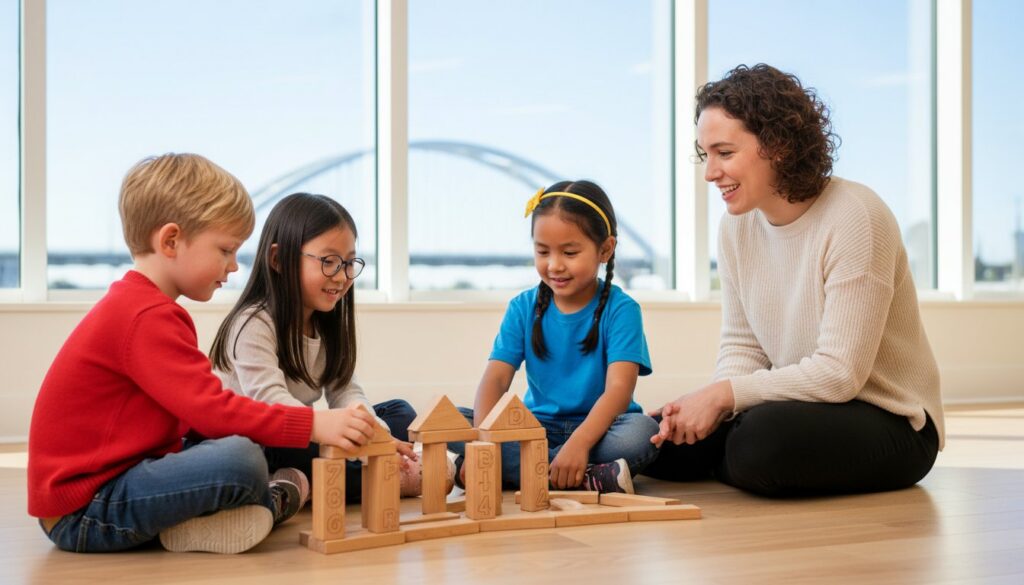
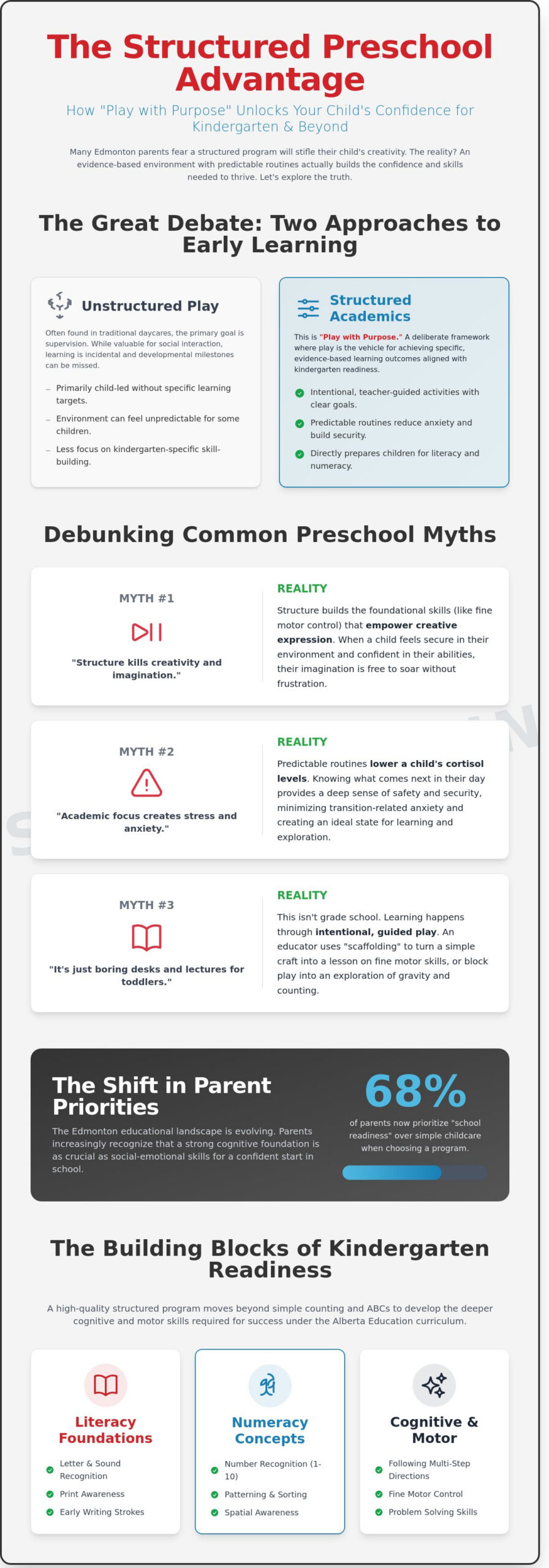
When we talk about a structured academics preschool in the context of Alberta’s pedagogical landscape, we aren’t talking about three-year-olds sitting at desks for six hours. Instead, it refers to a deliberate framework where play is the vehicle for specific learning outcomes. Within the broader field of early childhood education, structure means that every activity has a “why” behind it. It’s the difference between a child playing with blocks alone and a teacher guiding that child to understand balance, gravity, and counting through those same blocks.
We bridge the gap between free play and formal schooling through a concept called “scaffolding.” This is a proven method where educators provide temporary support to help a child reach a higher level of understanding than they could achieve alone. It turns a simple craft into a lesson on fine motor control and following multi-step directions. This approach honors the child’s need for movement while building the cognitive muscles they’ll need for kindergarten.
The Difference Between Rigid Schooling and Structured Learning
Structure provides safety. For a preschooler, a predictable routine reduces cortisol levels and minimizes transition-related anxiety. It’s not about homework or lectures; it’s about intentional, teacher-led moments that guide a child’s natural curiosity toward foundational literacy and numeracy. Unlike unstructured daycare environments where supervision is the primary goal, structured learning ensures no developmental milestone is left to chance. Children don’t feel pressured; they feel empowered because they know what’s coming next in their day.
Why Edmonton Parents are Shifting Toward “Play with Purpose”
The educational landscape in Edmonton is becoming increasingly competitive. With the popularity of specialized programs like Cogito in the Edmonton Public School system, parents recognize that social-emotional readiness must pair with cognitive skills. Recent local feedback suggests that roughly 68% of parents now prioritize “school readiness” over simple childcare. They’re looking for an environment that unlocks their child’s hidden potential early on. If you’re weighing these options, our guide on Choosing the Right Preschool in Edmonton offers a deeper look at what fits your family’s unique needs. This shift isn’t about rushing childhood; it’s about ensuring every child has the tools to enter Grade 1 with confidence and a genuine love for discovery. For a deeper look at how child-led exploration fits into this picture, our comparison of play-based learning in Edmonton versus structured academics for 2026 can help you weigh the evidence and make the most informed choice for your family.
Myth-Busting the Top 3 Misconceptions About Structured Learning
Choosing the right early education path in Edmonton can feel overwhelming. We often hear from parents who worry that a structured academics preschool might be too rigid for their little ones. It’s a common concern. You want your child to be happy, creative, and free to be a kid. Structure isn’t about restriction; it’s about providing a reliable framework where your child can safely explore their potential.
Myth #1: Structure Limits a Child’s Creativity
Parents often fear that rules and routines stifle a child’s imagination. In reality, the opposite is true. When a child masters fine motor control through guided practice, they gain the physical tools to express what they see in their minds. A “free play” art session might result in a mess that frustrates a child who cannot yet control a paintbrush. A structured lesson teaches them the “how” of the medium, which then empowers their “what.” Creativity thrives when a child feels secure in their environment and confident in their foundational skills. By removing the anxiety of the unknown, we give them the mental space to innovate.
Myth #2: Preschool Academics Lead to Early Burnout
The fear of “too much, too soon” is valid, but burnout usually stems from frustration, not learning. Research shows that early success in literacy builds long-term school enjoyment. At Jumpstart, we replace high-pressure testing with multisensory discovery. This success-based learning ensures children feel capable rather than overwhelmed. According to the Center on the Developing Child at Harvard University, early childhood program effectiveness depends on creating stable, responsive environments. Studies indicate that children in predictable settings show a 20% increase in task persistence. This emotional stability prevents the exhaustion often associated with academic pressure.
Myth #3: It’s Only About Flashcards and Drills
People often imagine rows of desks and silent drills. That isn’t how a high-quality structured academics preschool operates. Our literacy lessons utilize the Orton-Gillingham approach, which means children are moving, singing, and using their senses to learn letter sounds. A “drill” becomes a game of jumping on the correct letter or tracing shapes in sand. We also integrate vital social skills into every routine.
- Turn-taking is practiced during group phonics games.
- Active listening is modeled during story-based numeracy lessons.
- Conflict resolution happens naturally within the clear boundaries of the classroom.
If you’re curious about how these routines can transform your child’s confidence, you can explore our preschool programs to see the balance for yourself. Parents who want to understand how play-based learning compares to structured academics in Edmonton will find a thorough, evidence-based breakdown that clarifies which approach best supports their child’s long-term success.
Why Structured Literacy and Numeracy are Essential for Kindergarten Readiness
The transition to a formal classroom can feel like a giant leap for a four year old. You might worry if your child will keep up or if they’ll feel overwhelmed by the new expectations. In Edmonton, schools look for specific literacy milestones, such as the ability to recognize their own name, identify several letter sounds, and follow two step instructions. A structured academics preschool provides the gentle framework needed to master these skills before the first bell rings. This isn’t about pressure; it’s about providing a predictable environment where your child feels safe to take risks and grow.
Numeracy in these early years goes far beyond rote counting to ten. True mathematical thinking involves recognizing patterns, understanding spatial awareness, and developing number sense. When a child understands that the number “3” represents three physical blocks, they’re building a concrete foundation for future logic. Research shows that academic momentum is vital. Without it, children can experience a “summer slide,” where they lose months of developmental progress during breaks. Consistent, structured learning keeps their minds active and ready for the next challenge. Applying proven summer camp selection tips to find an Edmonton program that maintains this momentum during the school break can make a significant difference in preventing that seasonal learning loss.
Structure also plays a critical role in developing “Executive Function.” Think of this as the air traffic control system of the brain. It helps children manage focus, follow rules, and control impulses. By participating in a daily routine that balances play with intentional instruction, children learn how to switch gears between activities. This self regulation is just as important as knowing the alphabet when it comes to long term school success. Enrolling your child in specialized kindergarten readiness programs in Edmonton can give them the structured support they need to develop these executive function skills before their first day of school.
The Science of the Developing Brain
Between the ages of 3 and 5, the brain is in a “golden window” of neuroplasticity. This is the peak time for language acquisition and cognitive growth. During this phase, the brain is exceptionally efficient at forming new neural pathways. By introducing structured phonological awareness, like rhyming and syllable counting, we can actually prevent many reading struggles before they start. This early linguistic focus is a key component in preparing students for bilingual primary education, such as the programs offered at Meridian Private Primary School. Kindergarten Readiness in the Alberta context means a child has the social and cognitive foundations defined by Alberta’s early childhood education standards to thrive in a Grade 1 preparatory environment.
Literacy vs. Numeracy: The Two Pillars of Success
The literacy track in a structured academics preschool moves intentionally from simple letter recognition to early phonics. Children learn to connect sounds to symbols, which is the “code” for reading. Meanwhile, the numeracy track focuses on logical reasoning. This includes sorting objects by attribute, understanding “more versus less,” and identifying shapes in the world around them. These skills don’t happen by accident; they’re the result of a multisensory approach that engages a child’s sight, hearing, and touch. Understanding how a well-designed preschool curriculum in Edmonton builds toward kindergarten readiness can help you evaluate whether a program’s scope and sequence truly matches your child’s developmental needs. For students who show early signs of giftedness or those who need a bit more time, literacy and numeracy enrichment ensures the curriculum is tailored to their specific pace. This personalized attention unlocks their hidden potential and builds the confidence they need to lead.
Evaluating Preschool Programs in Edmonton: A Parent’s Checklist
Choosing a structured academics preschool feels like a monumental task because it sets the foundation for your child’s entire educational journey. When you walk through the doors of an Edmonton facility, you’re looking for more than just bright colors; you’re looking for a launchpad for their potential. Start your tour by observing the environment. A high-quality program will feel organized and purposeful, not chaotic. Look for low shelves with clearly labeled, multisensory materials that children can access independently. This structure isn’t about restriction; it’s about creating an environment where a child knows exactly where to go to find the tools they need to succeed. Knowing what to look for in a preschool before you begin touring can help you ask the right questions and recognize the hallmarks of a truly high-quality program.
Ask the director specifically how they integrate the Alberta Early Learning and Care Framework (FLIGHT). This provincial standard isn’t just a document; it’s a philosophy that views children as mighty learners. You want to see evidence that teachers are co-researchers in your child’s discovery. For families with diverse learners, inquiry about Program Unit Funding (PUF) is essential. Alberta Education provides these supports for children with identified needs, and a reputable school will have a clear, transparent process for accessing these resources. They should be able to explain how they’ve supported students with speech delays or motor skill challenges during the 2023 school year. To fully understand what these provincial standards require of licensed programs, our guide to Alberta early learning standards for Edmonton families in 2026 breaks down the latest ELCC Act updates in plain language so you can evaluate programs with confidence.
Local Edmonton Factors to Consider
Location matters more than most parents realize. A commute from Edmonton South to a program in Beaumont might look short on a map, but during a winter morning in January, it can add 45 minutes to your child’s day. That time is often better spent on rest or play. Always verify that the program is licensed under the Alberta Child Care Licensing Act. Licensed programs undergo regular inspections to ensure safety and quality standards are met. Don’t hesitate to ask about teacher credentials. In Alberta, a Level 3 Child Development Supervisor certification indicates the highest level of provincial training, ensuring your child is guided by an expert mentor.
The “Vibe Check”: Balancing Warmth and Wisdom
Observe the interaction between teachers and students. You’re looking for empathy paired with a steady routine. Are the children focused on their tasks, or are they simply being compliant? True engagement looks like a child who is so absorbed in a literacy activity that they don’t notice you’ve entered the room. This level of focus is often the result of Personalized Learning Plans that meet each child at their specific developmental stage. When a teacher can explain the why behind a structured routine, you know you’ve found a partner who values both the science of learning and the heart of the child. Staying connected to that partnership beyond drop-off is equally important, and understanding effective parental involvement preschool strategies for Edmonton families can help you remain an active contributor to your child’s progress throughout the year.
The Jumpstart Way: Where Structured Academics Meets “Play with Purpose”
At Jumpstart Learning, we recognize that the word “structure” can sometimes feel intimidating to parents. Our philosophy is built on the belief that a structured academics preschool shouldn’t be rigid or cold. Instead, we use an empathy-led, evidence-based framework that provides children with the predictability they need to feel safe while they take risks in their learning. we call this “Play with Purpose.” It’s a method that balances high-level educational authority with the warmth of a nurturing partner.
A typical day for a Jumpstart student in Edmonton is active and intentional. It begins with a calm transition into the classroom, where educators greet each child with a focus on their emotional readiness. From there, students rotate through multisensory stations. You won’t see rows of silent desks. You’ll see children engaged in hands-on tasks that build literacy and numeracy through movement and touch. By the time they head home, they’ve gained more than just facts; they’ve gained the quiet confidence that comes from mastering a new skill through a predictable, supportive routine.
Unlocking Hidden Potential Through Individualized Care
We don’t believe in a one-size-fits-all approach. Our educators tailor the curriculum to match your child’s specific developmental pace, ensuring they’re neither bored nor overwhelmed. We use the Orton-Gillingham approach, a multisensory system that has helped students since the 1930s. This helps children connect sounds to letters through sight, hearing, and touch. For families looking for the most comprehensive preparation, our Junior Kindergarten Program serves as the ultimate track to ensure your child enters Grade 1 with a significant head start. We focus on the individual journey, making sure every child feels seen and supported.
Join the Jumpstart Family in Edmonton
We’re more than just a school; we’re a dedicated advocate for your child’s future. We want you to move away from the frustration of academic uncertainty and toward the joy of achievement. Seeing a child realize they can read or solve a puzzle they once found difficult is why we do this work. It’s about the relief you feel knowing your child is prepared for the years ahead. Our team is here to guide you through every milestone, acting as a steady, optimistic partner in your child’s growth.
Don’t let the anxiety of “what if” hold you back. We invite you to see the Jumpstart difference in person and witness how a structured academics preschool can empower your child. Take the first step today by booking an assessment. It’s time to unlock your child’s hidden potential and replace educational stress with a clear, proven path forward. You’ll find that once the right structure is in place, your child’s natural curiosity will do the rest.
Empowering Your Child for a Confident Start in Edmonton
Choosing the right foundation for your child’s education shouldn’t feel like a guessing game. We’ve explored how a structured academics preschool provides the essential framework for lifelong literacy and numeracy. By debunking common myths, it’s clear that intentional learning doesn’t replace play; it enhances it through a purposeful, evidence-based approach. Our research-based curriculum specifically targets Edmonton Kindergarten standards to ensure every child feels confident and prepared for their next big step. For families looking ahead to the 2026 school year, our comprehensive guide on preparing for kindergarten in Edmonton provides detailed timelines and skill checklists to eliminate registration stress.
As a Licensed Early Learning Centre in Alberta, Jumpstart Learning has spent 10+ years refining a multisensory model that helps local families replace academic anxiety with the joy of achievement. We focus on unlocking your child’s hidden potential while maintaining a warm, nurturing environment where they feel safe to grow. You don’t have to navigate these early milestones alone. Our team acts as a dedicated advocate for your child’s growth and emotional well-being, providing a clear path forward for your family.
Book a Tour and Experience Our “Play with Purpose” Philosophy Today
Your child’s journey toward academic success and self-assurance starts with a single, supported step.
Frequently Asked Questions
Is a structured preschool too much for a 3-year-old?
No, a structured academics preschool is designed to provide security through routine rather than academic pressure. At age three, children thrive on predictability and clear boundaries. Instead of long hours at desks, we utilize 15 to 20 minute instructional blocks tailored to short attention spans. Research from the Alberta Early Learning and Care Framework shows that consistent routines reduce cortisol levels in toddlers, creating a calm environment where they can learn through guided discovery.
How do I know if my child is ready for an academic-focused preschool?
Readiness is often signaled by a child’s natural curiosity about letters, numbers, and their ability to follow simple two-step instructions. You might notice your child asking what signs say or trying to count their snacks during lunch. If your child can sit for a 10 minute story or shows interest in “doing work” like their older siblings, they’re likely ready. Our educators assess each child’s individual starting point to ensure the transition from home feels safe and encouraging.
What is the difference between play-based and structured academics in Edmonton?
While play-based programs are child-led and open-ended, a structured academics preschool in Edmonton uses intentional, teacher-directed lessons to reach specific developmental milestones. Play-based centers often prioritize social exploration without a set sequence. In contrast, we use evidence-based methods like the Orton-Gillingham approach to turn play into a learning tool. This ensures that by the time your child enters Kindergarten, they’ve mastered the 26 letter sounds and basic number sense through multisensory activities. For a comprehensive side-by-side analysis, our guide on play-based learning in Edmonton and how it compares to structured academics for 2026 provides the evidence-based clarity you need to make a confident decision.
Do structured preschools in Alberta follow a specific provincial curriculum?
Yes, all licensed preschools in Alberta align with the “Flight: Alberta’s Early Learning and Care Framework” while adding their own specialized academic components. While the provincial framework provides the core philosophy for childcare, we enhance these standards with rigorous literacy and numeracy targets. We track progress against 45 specific developmental markers throughout the school year. This alignment ensures your child meets provincial expectations while gaining the competitive edge of a specialized preschool curriculum that unlocks their full potential.
Can my child still learn social skills in a structured academic program?
Social skills are a core component of a structured environment, as children learn to cooperate, take turns, and communicate within a clear social framework. Structure actually provides the safety net children need to practice social interactions. Our students engage in collaborative multisensory projects that require teamwork and empathy. By following a consistent daily schedule, children feel less anxious, which leads to fewer behavioral conflicts. We dedicate 30% of our daily schedule to guided peer interaction.
What happens if my child struggles with the academic pace?
If a child finds a specific concept challenging, we immediately pivot to a tailored, multisensory approach to match their unique learning style. We understand that every child’s journey is different. Our educators use small group instruction, often with a 1 to 6 teacher-to-student ratio, to provide extra support where it’s needed. We don’t move forward until the child feels successful. This prevents the frustration of falling behind and instead builds a sense of mastery and confidence.
How does Jumpstart Learning Academy handle “Play with Purpose”?
Jumpstart Learning Academy defines “Play with Purpose” as the intentional use of games and tactile activities to reinforce specific evidence-based learning goals. We don’t just put toys out; we select tools that build fine motor skills or phonemic awareness. For example, using kinetic sand to trace letters combines sensory play with literacy instruction. This multisensory method ensures that 90% of our students meet or exceed their grade-level expectations. It’s a joyful way to transform standard playtime into academic growth.
Are there registration fees for structured preschools in Edmonton?
Most private and structured preschools in Edmonton require a non-refundable registration fee, which typically ranges from C$50 to C$200 per child. These fees cover administrative costs and secure your child’s spot in the program. In Alberta, parents may also be eligible for the provincial childcare subsidy, which can reduce monthly tuition by up to C$225 for qualifying families. We recommend checking the Alberta Government website for the latest 2024 subsidy rates to see how these funds apply to your family. To avoid missing critical deadlines and to understand exactly how fees, grants, and subsidies work together, our step-by-step guide to the Jumpstart Academy registration process walks Edmonton parents through every stage of enrollment for the 2026 school year.
