
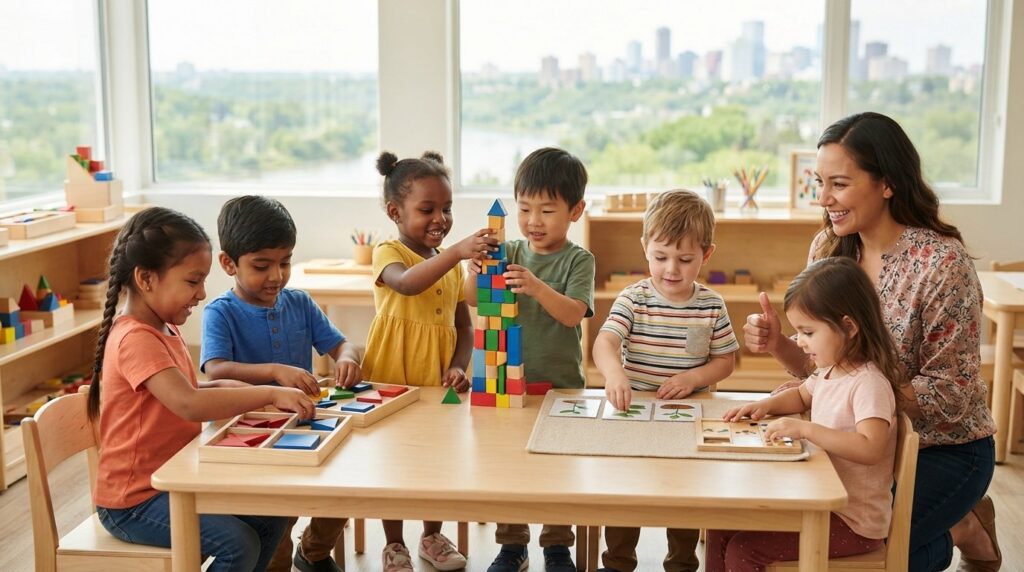
Did you know that over 80% of kindergarten teachers believe self-regulation and attention stamina are more important for school success than a child’s ability to count to twenty? As an Edmonton parent, it’s natural to feel a heavy weight of academic pressure as you look toward those upcoming kindergarten assessments. You want to ensure your child is ready, yet you often wonder if simple afternoon play is truly enough to build a strong foundation. We believe that the most effective cognitive development activities for preschoolers aren’t found in rigid worksheets, but in “Play with Purpose” that strengthens the brain’s neural architecture. This guide will show you how to transform everyday interactions into research-based milestones that prepare your child for the classroom with confidence. We will explore five proven activities that build executive function and ensure your child is on the right track.
Key Takeaways
- Learn why the ages of 3 to 5 represent a critical window for neural pathway formation and how intentional play builds lasting thinking skills.
- Discover practical cognitive development activities for preschoolers, such as the Sorting Challenge and Story-Mapping, that you can easily implement at home using everyday items.
- Understand the vital role of executive function and problem-solving in long-term academic success, moving beyond simple rote memorization.
- Gain confidence in identifying when your child is ready for a structured kindergarten environment by monitoring key social-emotional and cognitive milestones.
Understanding Cognitive Development: The Power of Play with Purpose
Cognitive development describes the growth of your child’s ability to think, reason, and solve problems. While it might look like your preschooler is simply stacking blocks or pretending to be a chef, their brain is actually hard at work building the foundation for future academic success. The ages of three to five represent a critical window for neural pathway formation. During this stage, the brain creates billions of connections based on daily experiences. By exploring various theories of cognitive development, we see that children aren’t just passive observers; they actively build knowledge through their environment.
At Jumpstart Learning Academy, we embrace a philosophy called “Play with Purpose.” This approach honors your role as your child’s first and most influential educator. By providing a nurturing, stimulating environment, you can turn simple moments into powerful cognitive development activities for preschoolers. These intentional activities target specific brain functions while keeping the experience joyful and stress-free.
The Three Pillars of Preschool Cognitive Growth
To support your child’s journey, we focus on three core components of early brain development. These pillars are the foundation for all cognitive development activities for preschoolers we recommend:
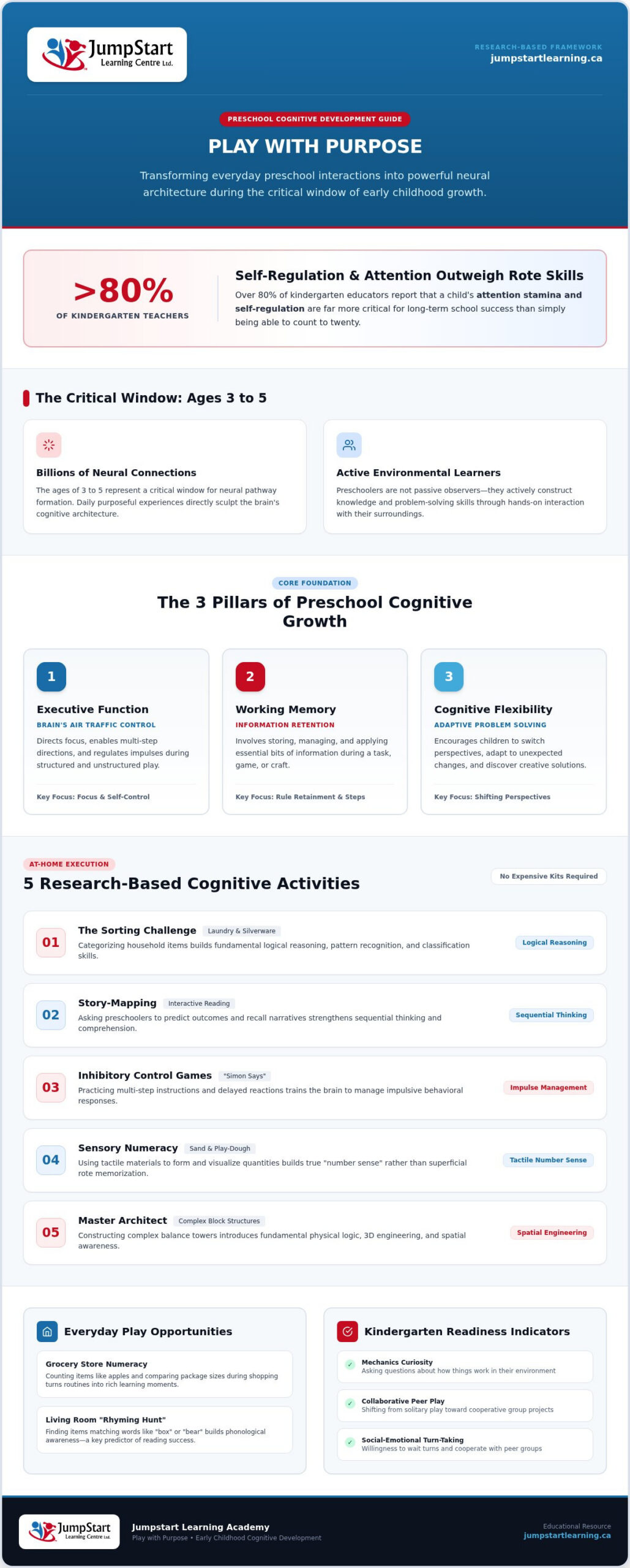
- Executive Function: This acts as the brain’s air traffic control system. It helps kids focus, follow multi-step directions, and manage impulses during play.
- Working Memory: This involves retaining and using small bits of information during a task, such as remembering the rules of a game or the steps of a craft.
- Cognitive Flexibility: This encourages kids to shift gears and look at problems from different perspectives. It’s the root of creative problem-solving and adaptability.
5 Research-Based Cognitive Development Activities for Preschoolers
Engaging in cognitive development activities for preschoolers doesn’t require expensive kits or high-pressure drills. You can start with the “Sorting Challenge” using laundry or silverware to build logical reasoning and categorization skills. Similarly, “Story-Mapping” transforms reading time by asking your child to predict what happens next, which sharpens sequential thinking. Including inhibitory control games like “Simon Says” helps them practice managing impulses and following multi-step rules. These are excellent activities to build executive function while keeping the experience joyful and stress-free.
Sensory Numeracy uses tactile materials like play-dough or sand to help children visualize quantities. This builds a deeper “number sense” than rote counting alone. For physical logic, the “Master Architect” game involves building complex block structures, which improves spatial awareness and introduces basic engineering concepts. Each activity provides a structured remedy for the academic anxiety many parents feel as kindergarten assessments approach. These simple shifts in play can uncover latent capabilities and build a child’s confidence.
Literacy and Numeracy Enrichment Through Daily Play
Daily life offers endless opportunities for growth. A simple trip to an Edmonton grocery store becomes a numeracy lesson when you count apples or compare package sizes. Our approach to literacy and numeracy enrichment uses this research-based model to bridge the gap between home play and school readiness. Try a “rhyming hunt” in your living room. Finding objects that rhyme with “box” or “bear” builds phonological awareness, a vital predictor of reading success. If you’re looking for a guided path for your child, you can view our program options to see how we support local families.
Transitioning from Home Activities to Kindergarten Readiness
Moving from home-based cognitive development activities for preschoolers to a formal classroom is a significant milestone for any Edmonton family. You might notice your child becoming more curious about how things work or showing a desire to play more collaboratively with peers. These are clear signs they’re ready for a structured preschool program. Monitoring the CDC developmental milestones for four-year-olds can help you track progress in areas like language and problem-solving. This data provides a steady baseline for understanding your child’s growth.
While home play builds the foundation, social-emotional growth often flourishes best in a group setting. Learning to wait for a turn or cooperate on a project is just as vital for cognitive success as learning numbers. Professional assessments offer a clear roadmap, relieving the anxiety of wondering if your child is on track. Integrating these activities into a consistent routine that mirrors a school environment helps build the stamina required for the upcoming transition to kindergarten.
Personalized Learning Plans and Alberta Standards
At Jumpstart, we use personalized learning plans to ensure every child receives the specific support they need. These plans align with Alberta’s early learning standards, ensuring a smooth transition into local kindergarten classrooms. We understand that every child’s cognitive journey is unique, requiring a thoughtful balance of patience and professional guidance. By moving from home discovery to expert-led instruction, you provide your child with a sense of order and a clear path forward. This steady progression ensures they enter the classroom with the quiet confidence of a student who’s ready to thrive.
Empowering Your Child’s Path to Success
You’ve discovered how intentional play transforms everyday moments into vital brain-building milestones. By focusing on executive function and social-emotional growth, you’re giving your child the tools they need for a smooth transition to the Alberta classroom. While home-based cognitive development activities for preschoolers are a wonderful start, a professional environment offers the structure and peer interaction necessary for full kindergarten readiness.
As a licensed Alberta Early Learning Centre, we provide personalized assessments for every child and a play-with-purpose curriculum designed by local educators. We’re here to be your partner in this journey, moving away from academic anxiety toward the joy of discovery. Secure your child’s spot in our research-based Preschool programs today. Your child has incredible latent capabilities waiting to be uncovered, and we’re ready to help them shine.
Frequently Asked Questions
What are the main cognitive milestones for a 3-year-old?
For a 3-year-old, cognitive milestones include the ability to sort objects by shape or colour and complete simple puzzles. These cognitive development activities for preschoolers help them begin to follow two-step instructions and copy basic shapes like circles. At Jumpstart, we use personalized assessments to track these specific markers, ensuring your child feels confident as they explore new concepts in our Edmonton classrooms.
How much time should my preschooler spend on learning activities each day?
Preschoolers typically thrive with 15 to 30 minutes of structured learning, but this should be broken into short, five-minute bursts. Their natural attention stamina at this age is limited, so forced academic time can lead to frustration. Instead, we recommend cognitive development activities for preschoolers that are woven into sensory exploration and active movement throughout the day rather than sitting at a desk. For parents seeking structured ways to strengthen focus and working memory, platforms such as mybrainlab.com offer targeted cognitive training programs that complement daily routines.
Can screen time help with cognitive development in preschoolers?
High-quality, educational programming can supplement learning, but the American Academy of Pediatrics recommends limiting digital media to one hour per day for children aged two to five. It’s most effective when co-viewed with a parent to encourage conversation. Passive consumption shouldn’t crowd out the interactive, sensory-focused foundations that build real-world problem-solving skills and executive function in a classroom setting.
What is the difference between play-based learning and academic learning?
Traditional academic learning often relies on rote memorization and worksheets, while play-based learning uses a child’s natural curiosity to teach complex concepts. Our research-based curriculum bridges this gap by using Play with Purpose. This method ensures children master literacy and numeracy through hands-on exploration, which feels like fun but is actually meeting rigorous Alberta early learning standards for kindergarten readiness.
