

The fastest way to help a young child hold a pencil properly is often to take the pencil away. In developing fine motor skills for writing, meaningful progress never starts with repetitive tracing worksheets. Instead, it begins with shoulder stability, finger dexterity, and purposeful sensory play.
If your child’s hand cramps during colouring, tires easily, or leaves you wondering whether to correct their grip, that concern is completely understandable. Watching them struggle can make upcoming kindergarten expectations feel daunting. You don’t need frustrating drills to unlock their natural coordination. In this guide, you will discover proven, play-based strategies to build hand strength, foster an effortless pencil grasp, and inspire writing confidence. We will explore normal developmental milestones, engaging screen-free motor activities, and practical ways to prepare your young learner for the classroom with calm assurance.
Key Takeaways
- Discover why developing fine motor skills for writing begins with shoulder stability and tactile exploration rather than repetitive pencil drills.
- Learn how vertical surface activities like easel painting naturally position the wrist for fluid, fatigue-free pencil control.
- Explore screen-free play ideas using everyday tools like tweezers and clothespins to strengthen the precise pincer grasp required for early writing.
- Recognize when hand fatigue reflects typical developmental pacing and how structured early learning environments balance sensory play with kindergarten readiness.
Understanding Why Fine Motor Skills Precede Early Writing Success
When a child resists colouring or drops their pencil in frustration, parents often worry about academic readiness. That concern is valid, but the resistance rarely signals defiance. Rather, it reflects physical fatigue. True fine motor skill development relies on the precise coordination of small muscles in the fingers, hands, and wrists. Yet these delicate muscles cannot function efficiently in isolation.
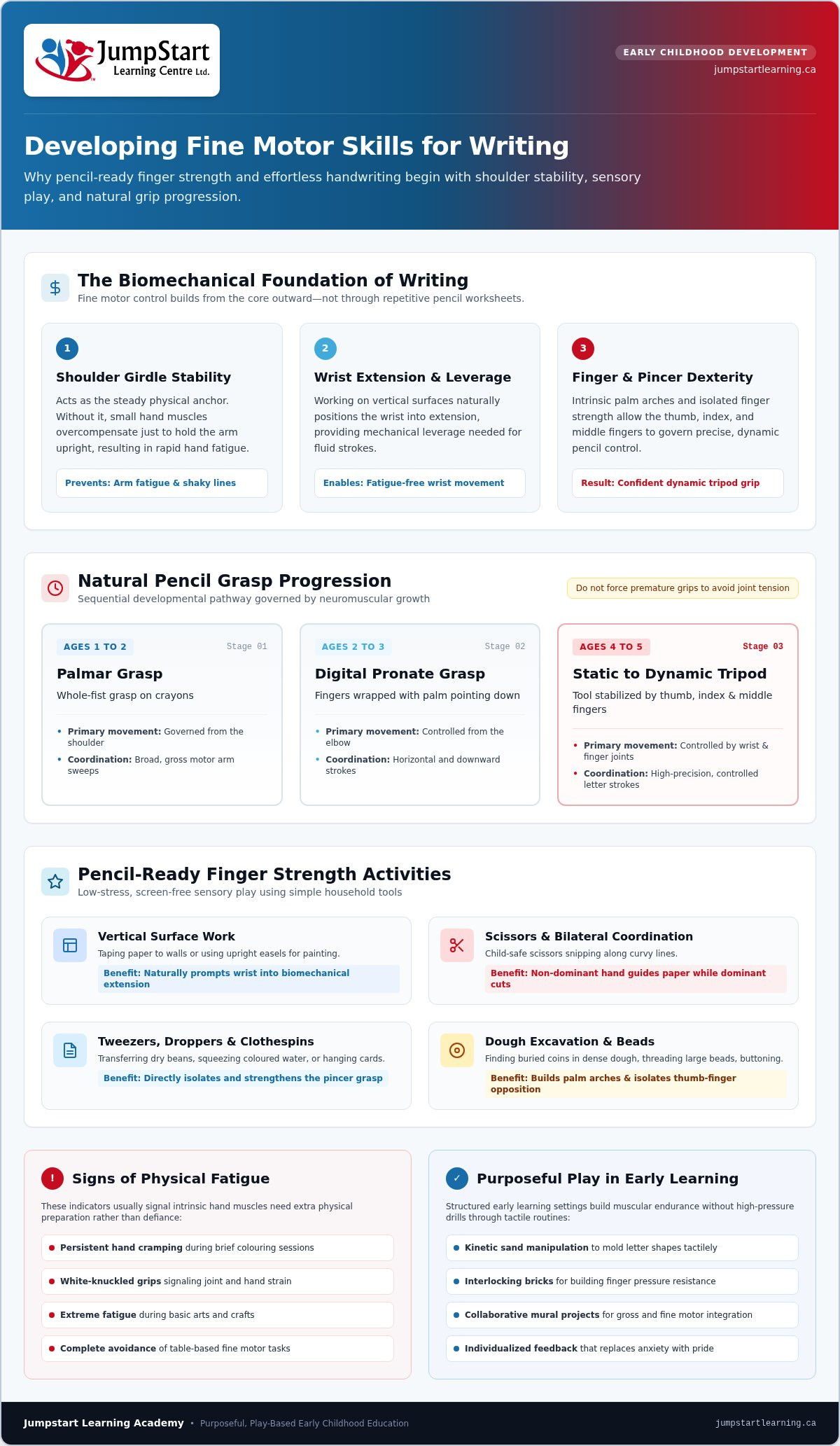
Developing fine motor skills for writing actually starts at the core and shoulders. Without solid shoulder girdle stability, a child must recruit their small hand muscles just to keep their arm upright. This quickly leads to cramping, shaky lines, and tears over simple worksheets. Gross motor stability creates the essential, steady anchor that frees the wrist and fingers for fluid, fatigue-free pencil control.
The Developmental Progression from Fisted Grasp to Tripod Grip
Grip maturation follows a natural, sequential pathway governed by neuromuscular growth:
- Palmar grasp (ages 1 to 2): Toddlers use their whole fist to grasp crayons, moving primarily from the shoulder.
- Digital pronate grasp (ages 2 to 3): Fingers wrap around the tool with the palm pointing down, controlled from the elbow.
- Static to dynamic tripod grip (ages 4 to 5): Children begin stabilizing the tool between the thumb, index, and middle fingers, moving with the wrist and finger joints.
Forcing a mature dynamic tripod grip prematurely creates joint tension and awkward compensatory habits. Allowing hands to build strength naturally ensures confident pencil control when kindergarten begins.
Practical Everyday Activities That Build Pencil-Ready Finger Strength
You don’t need expensive therapeutic equipment to build writing endurance. Simple household items offer brilliant opportunities for developing fine motor skills for writing through low-stress sensory play.
Taping paper to a wall or upright easel prompts the wrist into natural extension, giving children the biomechanical leverage needed to make controlled strokes without hand fatigue. At the kitchen table, transferring dry beans with tweezers, squeezing coloured water using eyedroppers, or hanging cards with clothespins directly targets the pincer grasp. Introducing child-safe scissors to snip along curvy lines develops bilateral coordination, teaching the non-dominant hand to guide the paper while the dominant hand cuts. As highlighted in Research on Fine Motor Development, early physical manipulation directly underpins later academic writing efficiency.
Targeted Sensory Play to Strengthen Hand Arches and In-Hand Manipulation
Rolling, squeezing, and flattening dense modelling clay builds the palm arches that support long writing sessions. For an engaging challenge, hide small buttons or coins inside a ball of dough and ask your child to excavate them using only their thumb and pointer finger. Threading large beads onto laces and fastening jacket buttons similarly isolate thumb-finger opposition.
Engaging in these daily games ensures that developing fine motor skills for writing remains joyful rather than exhausting. You can find similar hands-on ideas in our guide to preschool enrichment activities, or take the next step to enroll in our purposeful, play-based early learning programs.
Supporting Fine Motor Milestones in a Structured Early Learning Environment
A balanced early learning setting doesn’t rely on rigid pencil drills to achieve academic milestones. Instead, licensed educators weave sensory discovery together with literacy goals, developing fine motor skills for writing through natural, low-pressure classroom exploration. This purposeful structure removes anxiety, helping children build muscular endurance without feeling overwhelmed.
Trained teachers also recognize developmental red flags early. Persistent hand cramping, extreme fatigue during basic art projects, white-knuckled grips, or complete avoidance of table tasks usually signal that intrinsic hand muscles need extra physical preparation. Gentle, individualized feedback helps children navigate these hurdles, transforming anxiety into pride as they discover what their hands can accomplish.
How Purposeful Play Prepares Edmonton Learners for Kindergarten Readiness
Every child develops at a unique pace, which is why personalized learning plans are essential. In thoughtful group settings, developing fine motor skills for writing happens effortlessly through community play. Children mold letters in kinetic sand, manipulate interlocking bricks, and collaborate on mural projects. These tactile routines reinforce hand muscles while showing children that learning is a shared, joyful adventure.
For Edmonton and Beaumont families, building this physical foundation early eases the transition into elementary routines. Consider exploring our early preschool registration to give your young learner a supportive head start toward lifelong writing confidence.
Inspiring Early Writing Confidence Through Playful Steps
Developing fine motor skills for writing is an unfolding developmental journey rooted in shoulder stability, tactile play, and patient encouragement. When we replace rigid pencil drills with playful sensory exploration, we protect our children’s natural curiosity while building lasting muscular endurance. Every squeeze of dough and vertical brushstroke strengthens their hands for future classroom success.
At Jumpstart Learning Academy, we partner with Edmonton and Beaumont families through a research-based early childhood curriculum and individualized learning plans that foster kindergarten academic and motor readiness. You don’t have to navigate these early milestones alone. Schedule a tour and explore programs at Jumpstart Learning Academy to discover how purposeful play transforms early writing challenges into genuine achievement.
Frequently Asked Questions
At what age should my child develop a proper pencil grip?
Most children transition from whole-hand grasps to a mature dynamic tripod grip between ages 4 and 6. Around age 3, holding tools with fingers pointed downward is completely normal. In Edmonton early learning classrooms, educators focus on natural developmental progression rather than rigid mechanics, ensuring finger muscles are sufficiently mature before expecting prolonged, formal handwriting control.
What are the best household activities to build fine motor strength?
Everyday home routines offer rich opportunities for developing fine motor skills for writing without expensive gear. Peeling stickers, squeezing spray bottles while watering plants, and tearing scrap paper build wrist and hand stamina. You can also invite your child to sort buttons, roll play dough into tiny beads, or thread dry pasta onto yarn to target crucial finger muscles. Parents seeking structured home projects can also explore Vagrant Learning for printable activity packs that encourage hands-on motor development.
How do I know if my child has fine motor delays?
Watch for consistent task avoidance, extreme hand cramping, or difficulty snipping paper and managing buttons by age 4. If your child tires after just moments of colouring or struggles to coordinate both hands together, early guidance helps. Edmonton educators and pediatric specialists can assess developmental pacing and introduce playful sensory interventions that rebuild physical confidence.
Should I use pencil grips to correct my preschooler’s grasp?
Commercial pencil grips are rarely necessary for preschoolers unless specifically recommended by an occupational therapist. Developing fine motor skills for writing requires building hand arches and shoulder stability first, rather than forcing finger placement. Simply snapping standard crayons into one-inch pieces naturally prompts a functional three-finger grasp without causing discomfort or frustration for your child.
