
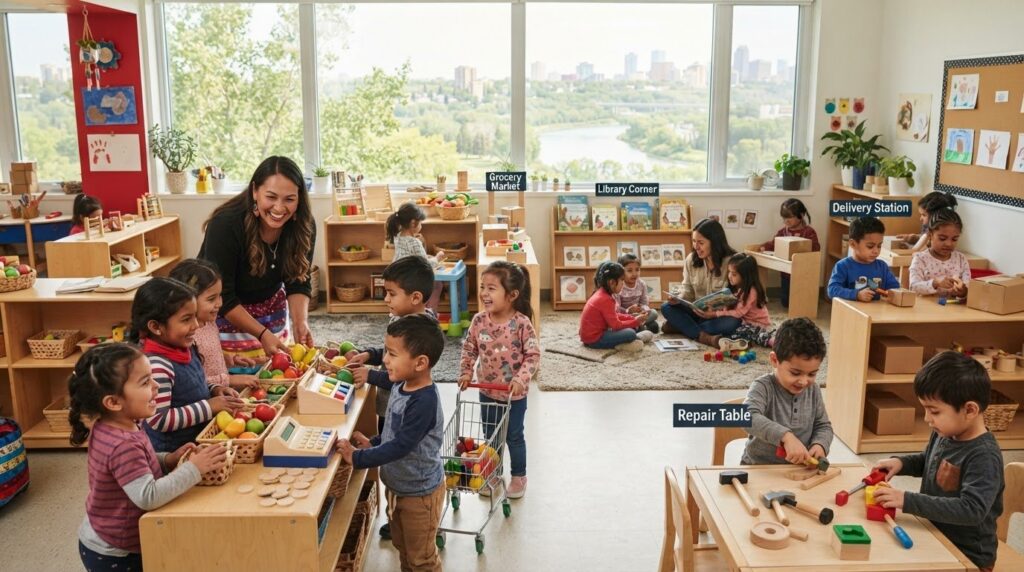
A pretend grocery store can teach more than the names of foods. It gives preschoolers a chance to notice how neighbours contribute, practise conversation, and make sense of familiar routines. Finding community helper theme ideas for preschool that hold children’s attention, build real learning, and reflect different family experiences can feel like a lot to balance.
Helper-themed crafts can feel disconnected when they don’t lead into a conversation or a chance to play. Children learn through purposeful play when they act out meaningful roles, ask questions, and connect ideas to people they see every day. This guide shares adaptable activities built around familiar places and a wide range of community contributors. You’ll find ways to support social understanding and belonging without assuming every child has the same experiences.
Key Takeaways
- Start with community roles children recognize, then introduce new ones through pictures, books, or play.
- Explore community helper theme ideas for preschool with simple setups and a clear learning focus, such as sorting, counting, or conversation.
- Adjust props and prompts to match children’s interests, confidence, and preferred ways of participating.
- Use books, pictures, or dramatic play to explore community roles when visitors or outings aren’t practical.
Why Community Helper Themes Help Preschoolers Make Sense of Their World
A community helper is someone whose work supports people or the places they share. Exploring these roles gives preschoolers a familiar starting point for noticing how a community works. A trip to the library, a delivery at the door, or a visit to a shop can prompt children to observe, ask questions, and build vocabulary such as “librarian,” “deliver,” and “repair.” Ask what the person is doing, what tools or materials they use, and who benefits from their work. These everyday connections make Early childhood education feel relevant: children link new ideas to experiences they can see and talk about.
Purposeful play can deepen that learning. When children take on roles and describe what a helper might do, they practise communication, cooperation, and perspective-taking alongside new words. Strong community helper theme ideas for preschool also show that communities depend on many kinds of contributions, not just the most familiar jobs.
Start With the Helpers Preschoolers Already Know
Invite children to share who helps them at home, at school, or in their neighbourhood. Their answers may include family members, educators, crossing guards, shop workers, or people who care for shared spaces. Listen without assuming every child has the same experiences. If a role is unfamiliar, explain it simply and invite questions. In Edmonton, children might also talk about people they see while visiting local shops, parks, or libraries.
Keep examples broad and welcoming. People of different genders and backgrounds can contribute in every kind of role. Rather than assigning jobs based on stereotypes, focus on what each person does and how that work helps others. This supports a sense of belonging while helping children see community life as a shared effort.
Community Helper Theme Ideas for Preschool: Activities That Build on Play
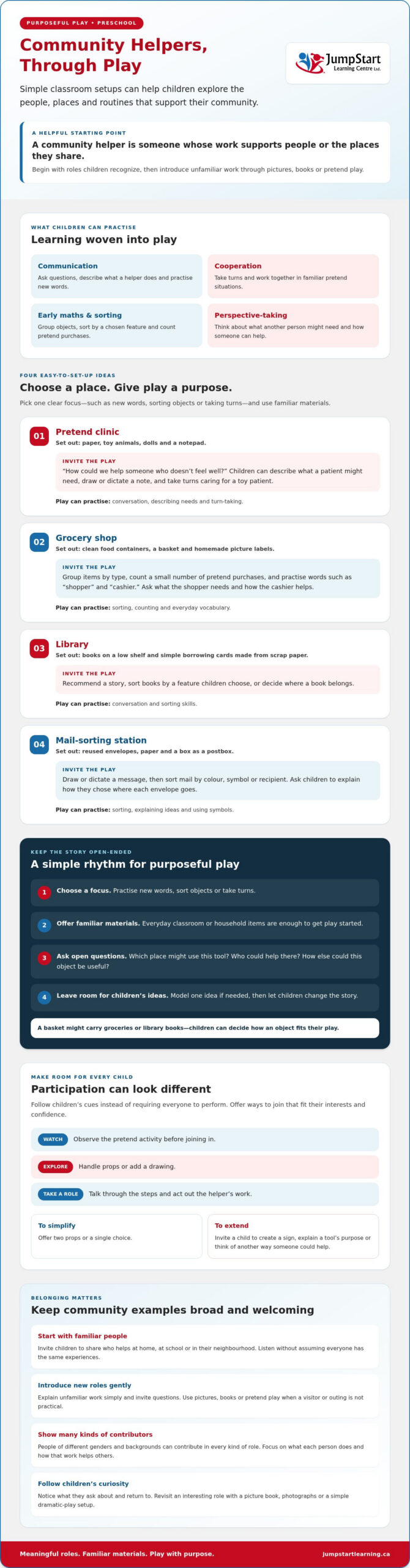
Keep the setup simple and give the play a clear purpose. Choose one focus, such as practising new words, sorting objects, or taking turns. A few familiar materials can turn a classroom corner into a place to explore language, early maths, cooperation, and how people help one another.
- Pretend clinic: Set out paper, toy animals, dolls, and a notepad. Ask, “How could we help someone who doesn’t feel well?” Children can describe what a patient might need, draw or dictate a note, and take turns caring for a toy patient.
- Grocery shop: Use clean food containers, a basket, and homemade picture labels. Invite children to group items by type, count a small number of pretend purchases, and practise everyday words such as “shopper” and “cashier.” Ask what the shopper needs and how the cashier helps.
- Library: Arrange books on a low shelf and make simple borrowing cards from scrap paper. Children can recommend a story, sort books by a feature they choose, or decide where a book belongs, building conversation and sorting skills.
- Mail-sorting station: Reuse envelopes, paper, and a box as a postbox. Children can draw or dictate a message, then sort mail by colour, symbol, or recipient. Invite them to explain how they decided where each envelope should go.
Turn Each Helper Theme Into Purposeful Play
Offer open-ended prompts rather than a single “right” match. Ask which place might use a tool, who could help there, and how else that object might be useful. A basket could carry groceries or library books. If children are unsure how to begin, model one idea, then leave room for them to change the story. This flexible approach supports problem-solving and respects children’s different ideas. These community helper theme ideas for preschool don’t require special materials; familiar classroom or household items are enough to get play started.
When comparing early learning settings, consider how play connects with children’s language, problem-solving, and social learning. For more ideas about what to look for, read this preschool selection guide, or explore preschool enrolment.
How to Adapt Community Helper Activities for Every Preschooler
Children may join a pretend activity in different ways. One might enjoy taking a role and talking through each step; another may prefer to watch, handle the props, or add a drawing. Follow their cues instead of requiring everyone to perform. To simplify, offer two props or a single choice. To extend the play, invite a child to create a sign, explain a tool’s purpose, or think of another way someone could help.
Notice what children ask about and return to. If they’re curious about a role, revisit it with a picture book, photographs, or a simple dramatic-play setup. A guest or outing isn’t essential for meaningful learning. Books and images can introduce unfamiliar work, while pretend play lets children explore it at a comfortable pace. You can also note a child’s questions and use them to choose the next story or play invitation.
Make the Theme Inclusive, Safe, and Easy to Extend
Show people of different backgrounds and genders in a range of community roles. Avoid suggesting that a job belongs to one kind of person. Instead, focus on what the person does and how that contribution supports others. This helps every child imagine themselves as capable of helping.
If a guest visit is practical, plan it with family-appropriate boundaries, educator supervision, and permission in advance. Before and after the visit, invite children to share questions or draw what they noticed. Their ideas can guide the next book, conversation, or classroom-play invitation.
Adaptable community helper theme ideas for preschool make room for different interests, communication styles, and levels of confidence. Jumpstart Learning Academy combines structured academics with purposeful play to support children’s intellectual and social growth. Families in Edmonton who want to learn about this approach can explore preschool enrolment.
Turn Everyday Curiosity Into Meaningful Learning
Community helper theme ideas for preschool work best when they grow from children’s real experiences and leave room for imaginative play. A familiar role can prompt new vocabulary, early learning, and conversations about how people contribute. Simple props and flexible prompts help children join in at their own pace, while inclusive examples show that everyone can make a difference.
That same balance of structure and discovery guides Jumpstart Learning Academy’s research-based curriculum. Its preschool program is designed for 3-year-olds and combines structured academics with purposeful play, personalized learning, and assessment to support each child’s growth.
Explore preschool enrolment to learn more about the program. Small moments of play can help children feel curious, capable, and connected to the people around them.
Frequently Asked Questions
What are community helpers for preschoolers?
Community helpers are people whose work supports others or the places they share. For preschoolers, familiar examples such as educators, grocery store workers, librarians, mail carriers, and sanitation workers make the idea easier to grasp. Talking about what each person does helps children connect everyday observations with community roles, learn new words, and understand that different contributions help neighbourhoods function.
What are some community helper activities for preschool?
Community helper theme ideas for preschool can use simple, familiar materials. Set up a pretend clinic with dolls and paper, a grocery shop with clean food containers, a library with books to sort, or a mail station with envelopes. As children take on roles, they can practise conversation, sorting, counting, turn-taking, and problem-solving through purposeful play.
How do you teach preschoolers about community helpers?
Start with people children already notice, then introduce new roles through conversation, pictures, books, and pretend play. Invite children to name helpers they see around Edmonton, at school, or in their neighbourhood. Ask what those people do and how they help. Welcome questions, explain unfamiliar jobs simply, and follow children’s curiosity as the theme develops.
How can I make a community helper theme inclusive for preschoolers?
Show people of different backgrounds and genders in a wide range of roles, and avoid suggesting that any job belongs to one kind of person. Let children choose or observe roles without pressure. Their family and community experiences may differ, so explain unfamiliar examples with care and make room for each child’s ideas, questions, and comfort level during play.
