
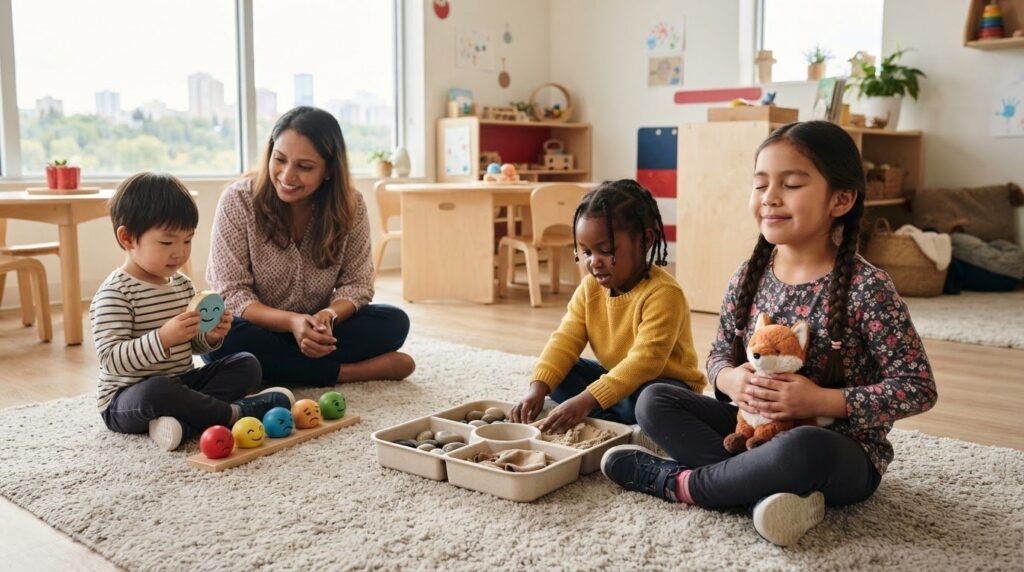
What if the most vital skill your child needs for kindergarten isn’t their ABCs, but the ability to handle a sudden change in plans without a meltdown? It’s exhausting to watch your little one struggle with big feelings, and it’s natural to worry they might be falling behind socially. You aren’t alone in feeling overwhelmed by intense preschooler outbursts or wondering how to explain a concept as abstract as staying calm. We’ve found that the most effective emotional regulation activities for 4 year olds aren’t academic drills, but intentional, play-based moments that build resilience from the inside out.
You’ll discover research-backed, sensory-focused tools to help your 4-year-old navigate their emotions and develop the self-regulation skills essential for school success. We will explore how simple games and play with purpose strategies can transform your home into a more peaceful environment while unlocking your child’s natural potential.
Key Takeaways
- Understand the biological difference between the “upstairs” and “downstairs” brain to respond more effectively to your child’s big feelings.
- Discover research-backed emotional regulation activities for 4 year olds that use sensory input to ground their nervous system during times of stress.
- See how developing these internal capabilities directly supports your child’s success with Alberta’s kindergarten literacy and numeracy curriculum.
- Replace the frustration of daily meltdowns with a proactive, play-based approach that fosters lasting social-emotional resilience.
Understanding the 4-Year-Old Brain: Why Emotional Regulation Matters
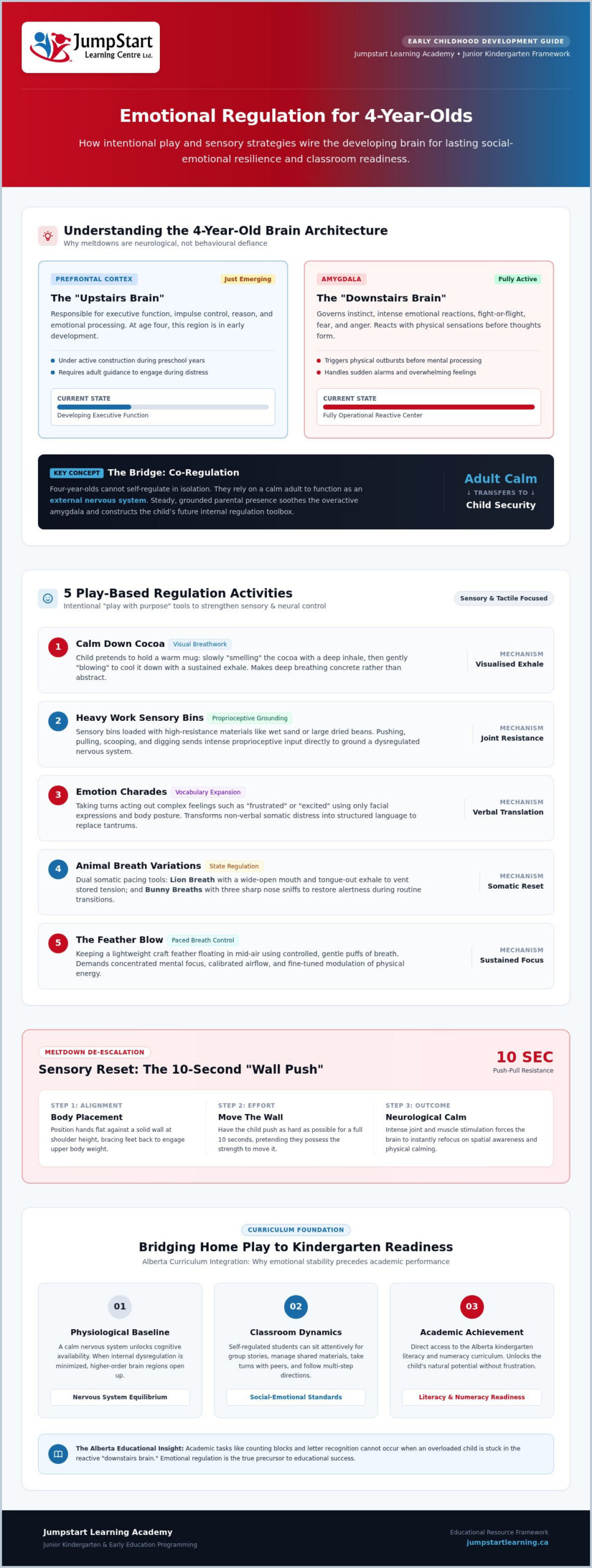
At age four, your child’s brain is undergoing a massive construction project. We define emotional self-regulation as the ability to monitor and manage energy levels, intense emotions, and sudden impulses. It isn’t just about “behaving.” It’s a complex neurological process. In four-year-olds, the “downstairs brain,” or amygdala, is fully operational, handling big reactions like fear and anger. However, the “upstairs brain,” known as the prefrontal cortex, is just beginning to bloom. This is the transition age where executive function starts to emerge. Because this area is still under construction, children often react with their bodies before they can process with their minds. Using intentional emotional regulation activities for 4 year olds helps strengthen the neural pathways between these two brain regions.
The Crucial Role of Co-Regulation in Early Development
A common misconception is that children should simply know how to calm down on their own. In reality, four-year-olds cannot self-regulate in isolation yet. They require a calm adult to act as an external nervous system, providing the stability they lack internally. When you stay grounded during a tantrum, your steady presence helps soothe their overactive amygdala. This process, known as co-regulation, is a vital pillar of our Junior Kindergarten curriculum. Co-regulation is the bridge that allows a child to eventually build their own internal regulation toolbox. By modeling these skills, you help them prepare for the social-emotional standards expected in Alberta schools. This support ensures they feel safe enough to explore their latent capabilities. If you’re looking for an environment that nurtures this growth, you can enroll in our specialized programs today.
5 Play-Based Emotional Regulation Activities for 4-Year-Olds
While worksheets might seem educational, four-year-olds learn best through their hands and bodies. We focus on “play with purpose” because tactile engagement helps bridge the gap between a big feeling and a calm response. Here are effective emotional regulation activities for 4 year olds that you can try at home today.
- Calm Down Cocoa: Have your child pretend to hold a mug of hot chocolate. They slowly “smell” the cocoa (deep inhale) and then “blow” on it to cool it down (long exhale). This visual focus makes deep breathing less abstract.
- Heavy Work Sensory Bins: Fill a bin with materials that provide resistance, like wet sand or large dried beans. Pushing, pulling, and digging provides proprioceptive input that grounds a dysregulated nervous system.
- Emotion Charades: Take turns acting out “frustrated” or “excited” using only faces and bodies. It builds the emotional vocabulary needed to replace physical outbursts with words.
- Animal Breath Variations: Use a “Lion Breath” with a big tongue-out exhale to release tension, or “Bunny Breaths” with three quick sniffs to help them regain focus during transitions.
- The Feather Blow: Practice breath control by trying to keep a craft feather in the air using only gentle puffs. This requires focus and steady, regulated energy.
Sensory Strategies for Immediate De-escalation
Sometimes, a child needs a physical “reset” to move out of a meltdown. A “Sensory Break” involves push-pull movements that help the brain refocus on the body’s position in space. One of the simplest emotional regulation activities for 4 year olds is the “Wall Push.” Ask your child to try and “move the wall” with their hands for ten seconds. This intense muscle engagement provides instant calming input. When choosing the best preschool in Edmonton, look for programs that prioritize these sensory-based social-emotional tools. Our Junior Kindergarten educators use these methods daily to ensure every student feels supported. You can see these techniques in action when you enroll in our upcoming term.
Bridging the Gap: From Home Activities to Kindergarten Readiness
A child’s ability to sit still for a story or count blocks depends entirely on their internal state. When their nervous system is calm, they can finally access the regions of the brain needed for literacy and numeracy. We’ve found that academic success in Alberta classrooms is built on a foundation of emotional stability. If a child is overwhelmed, their brain simply isn’t available for learning complex new concepts. It’s why we view these internal skills as a “latent capability” that must be unlocked before academic achievement can truly soar.
Classrooms demand high-level social skills like sharing materials, taking turns, and following multi-step directions. Integrating emotional regulation activities for 4 year olds into daily routines helps bridge the gap between home and school. At Jumpstart Learning Academy, our “play with purpose” philosophy ensures children don’t just learn academic facts. They also learn how to navigate the social friction inherent in a group setting, turning potential conflicts into moments of connection.
How Junior Kindergarten Programs Foster Social-Emotional Mastery
Structured Junior Kindergarten environments in Edmonton act as safe practice grounds for growing minds. Here, children encounter real-world social challenges under the guidance of educators with over 12 years of experience. We use personalized learning plans to identify each child’s unique emotional triggers, providing them with specific emotional regulation activities for 4 year olds to reset before a meltdown occurs. This proactive approach transforms potential frustration into a sense of achievement and prepares them for the rigours of the Alberta curriculum. Enroll your child in our Junior Kindergarten program to build these essential skills.
Empowering Your Child for Kindergarten Success
Guiding a four-year-old through intense emotional shifts requires patience and the right tools. By integrating intentional emotional regulation activities for 4 year olds into daily routines, you actively build the neural pathways needed for lifelong resilience. This internal growth forms the true foundation for all future academic achievements, allowing children to focus and absorb new information easily.
At Jumpstart Learning Academy, our licensed Alberta educators are here to partner with your family. We combine a research-based Play with Purpose curriculum with personalized assessments for every student to ensure your child thrives socially and academically. You don’t have to navigate these preschool years alone. Let us help unlock your child’s latent capabilities in a supportive environment. Secure your child’s spot in our Junior Kindergarten program today and watch them step confidently into a bright educational future.
Frequently Asked Questions
Is it normal for a 4-year-old to still have frequent meltdowns?
It’s completely normal for four-year-olds to experience frequent meltdowns because their prefrontal cortex is still under heavy construction. At this age, children navigate intense feelings without the full neurological capacity to manage them alone. While they’re starting to show empathy, they still rely heavily on co-regulation. Practicing emotional regulation activities for 4 year olds provides the necessary structure to build lasting resilience.
How long does it take for a child to learn emotional regulation?
Learning to regulate emotions is a long-term developmental journey that continues well into young adulthood. You’ll likely see gradual improvements over several months as your child practices specific sensory strategies. It isn’t a skill they’ll master overnight. Consistent exposure to “play with purpose” activities in a Junior Kindergarten setting helps solidify these habits. Every child’s timeline is unique, so we focus on individual progress.
What is the difference between discipline and teaching emotional regulation?
Discipline typically focuses on setting boundaries and correcting outward behavior, whereas teaching emotional regulation addresses the internal state behind that behavior. Instead of just stopping an outburst, you’re giving them tools to manage the underlying frustration. We use emotional regulation activities for 4 year olds to help them identify triggers. This proactive approach builds a child’s internal capability to choose a calm response.
Are there specific signs that my child is not emotionally ready for Kindergarten?
Key indicators of kindergarten readiness in Edmonton schools include the ability to follow multi-step directions and manage minor setbacks without total dysregulation. If a child consistently struggles to separate from caregivers or cannot share materials with peers, they might need additional support. Our personalized assessments help parents identify these gaps. We focus on social-emotional mastery to ensure every student feels confident before entering a formal classroom.
