
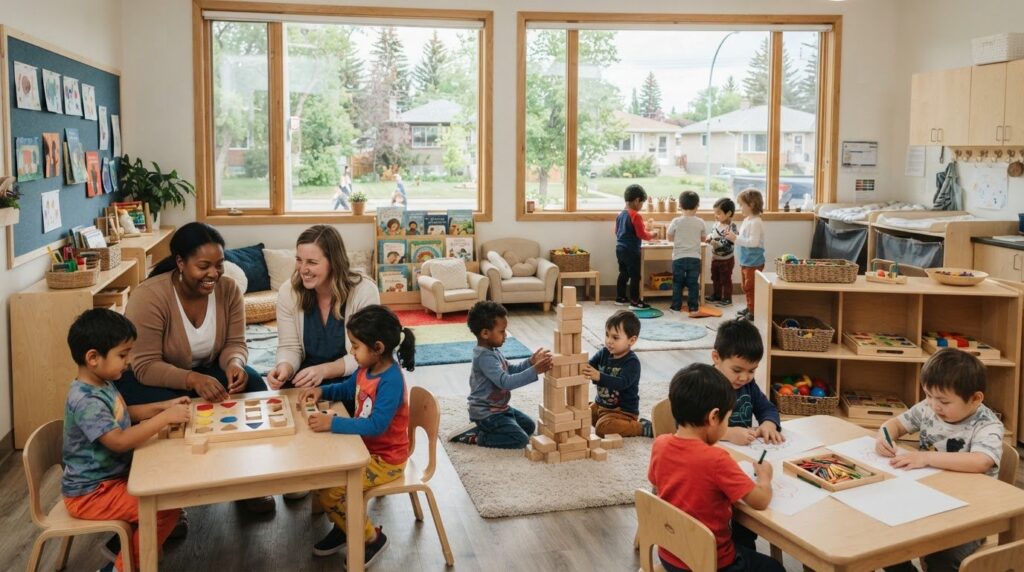
What if the right choice isn’t about which program sounds more academic, but what your child and family need each day? The day care vs preschool decision can feel confusing because the labels don’t always explain how a program balances supervision, play, and intentional learning. Start by considering whether your priority is a schedule that supports your family’s day, guided opportunities to build foundational skills, or a combination of both.
This guide explains the typical differences in purpose, routine, and learning, so you can compare options based on what children experience rather than labels alone. You’ll find practical points to weigh, including your schedule, your child’s comfort with group activities, and the transition to kindergarten. At Jumpstart Learning Academy in Edmonton, preschool combines structured academics with purposeful play, creating guided opportunities for children to develop skills and confidence.
Key Takeaways
- In the day care vs preschool comparison, focus on a program’s purpose and daily experience, not its label alone.
- Weigh your family’s schedule, your child’s temperament, and the kind of learning you want to support.
- Compare routines, educator interaction, play, and guided learning against your child’s needs.
- Jumpstart Learning Academy’s Edmonton preschool blends purposeful play, structured academics, personalized plans, and assessments to support early learning.
Day Care vs Preschool: How Their Main Purposes Differ
Choosing between day care and preschool can seem like choosing between care and learning, but the distinction isn’t always clear-cut. Day care generally centres on supervising and caring for children during the hours families need support. Preschool is typically organized around intentional early learning, with experiences that can support development and help children become familiar with classroom routines. In practice, programs can share activities and priorities.
Both settings may include play, social interaction, snacks or meals, rest, and predictable routines, depending on the program. A care-focused day can give children meaningful opportunities to explore, communicate, and practise new skills as part of everyday activities. A preschool can provide nurturing supervision while guiding children through stories, creative activities, early literacy or numeracy concepts, and group experiences. The Preschool Wikipedia article offers a broad overview of the term, though names and arrangements can vary by region and program.
Day care’s primary purpose is to provide care across the family’s needed schedule; preschool’s primary purpose is to guide early learning, even when both include play and care. This distinction is more useful than relying on a program’s name alone.
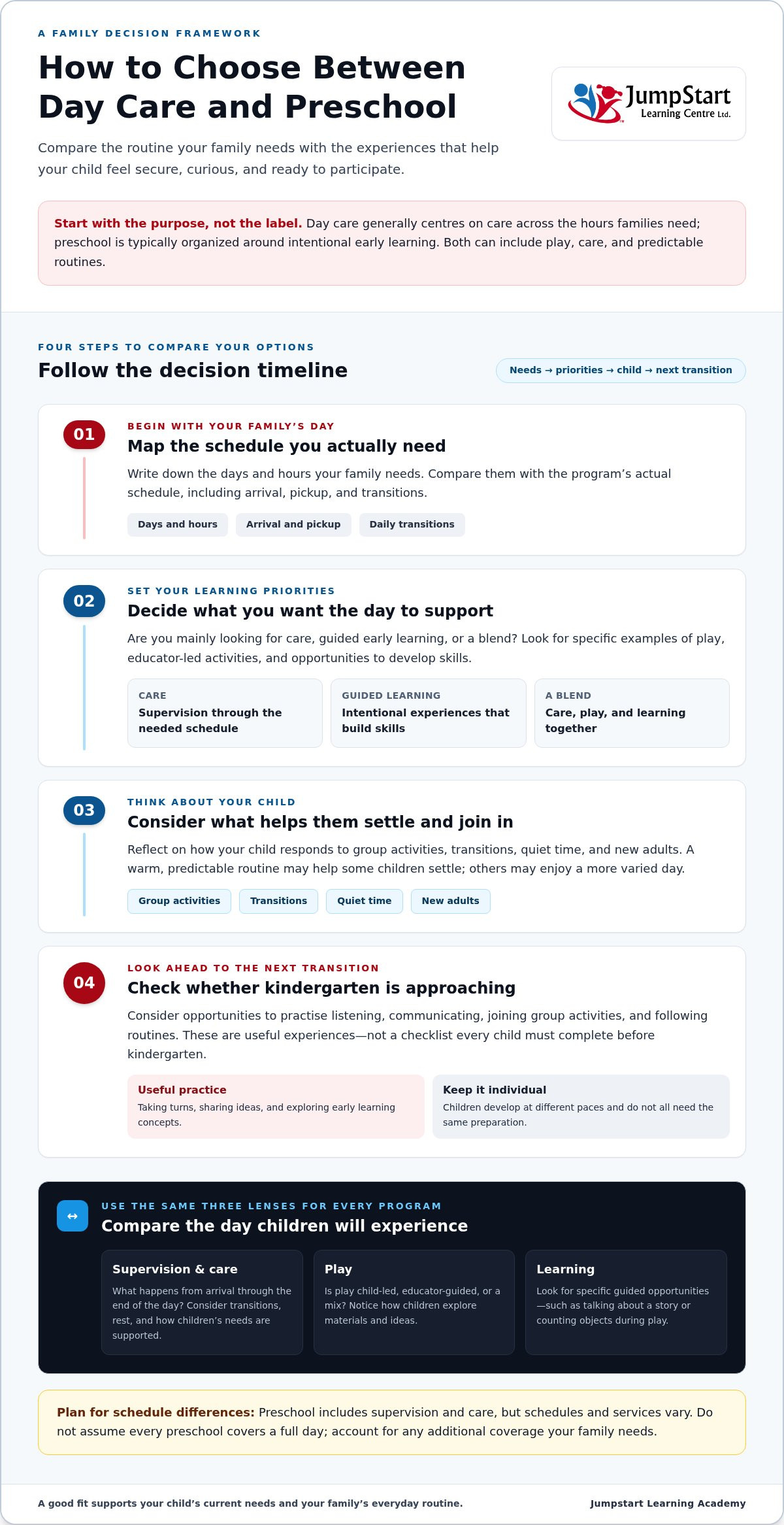
When comparing programs in Edmonton, look for how the daily experience reflects its main purpose:
- Supervision and care: What does the routine look like from arrival through the end of the day? Consider transitions, rest periods, and how children’s needs are supported.
- Play: Is play mainly child-led, guided by educators, or a mix? Notice whether children have opportunities to explore materials and ideas in different ways.
- Learning: Are there intentional opportunities to build skills through stories, exploration, or group activities? Look for specific examples, such as talking about a story or counting objects during play.
Can a preschool also provide care?
How to Choose Between Day Care and Preschool for Your Family
The best fit depends on more than a program label. Consider your family’s day-to-day needs alongside what helps your child feel secure, curious, and ready to participate. Use this framework to compare options:
- Start with your schedule. Write down the days and hours your family needs. Compare that with the program’s actual schedule, including how arrival, pickup, and transitions fit into your day.
- Clarify your learning priorities. Decide whether you’re mainly looking for care, guided early learning, or a blend. Look for concrete examples of how the program makes room for play, educator-led activities, and developing skills.
- Consider your child’s temperament. Think about how your child responds to group activities, transitions, quiet time, and new adults. A warm, predictable routine may help some children settle in; others may enjoy a more varied day.
- Think about the next transition. If kindergarten is approaching, consider opportunities to practise listening, communicating, joining group activities, and following routines. These are useful experiences, not a checklist every child must complete before kindergarten.
Compare actual routines and educator interactions, not just program names. For example, note whether children have time for open-ended play as well as guided activities, and how the day moves from one experience to another. For more ideas on evaluating a program, Rasmussen University’s guide on Daycare vs. Preschool offers a broader overview of schedules, settings, and terminology.
Which option fits a child approaching kindergarten?
Guided group activities can give children a comfortable place to practise taking turns, sharing ideas, following a routine, and exploring early learning concepts. These experiences may support a smoother transition, but children develop at different paces and don’t all need the same preparation. A good fit supports your child’s current needs while working with your family’s everyday routine.
Jumpstart Learning Academy’s preschool and junior kindergarten programs combine structured academics with purposeful play. Personalized learning plans and assessments help educators understand each child’s progress and shape learning experiences. Families considering a learning-focused option can explore preschool enrollment options.
Exploring Preschool in Edmonton: A Learning-Focused Next Step
For Edmonton families looking for guided early learning and kindergarten preparation, Jumpstart Learning Academy offers preschool for three-year-olds and junior kindergarten for four-year-olds. Its research-based approach combines structured academics with purposeful play, giving children opportunities to explore foundational skills through educator-guided activities and play. Personalized learning plans and assessments help educators understand each child’s development and inform learning experiences. They are tools for supporting progress, not promises of a particular outcome.
Preschool has an educational purpose, so consider how its schedule fits your family’s day when comparing it with day care. The day care vs preschool decision becomes clearer when you identify whether guided early learning is a priority and how it fits into your child’s routine.
What can families expect from a learning-focused preschool?
Educators can support early literacy and numeracy through age-appropriate experiences such as sharing stories, exploring language, counting, and noticing patterns. Purposeful play also creates opportunities to practise communication, cooperation, and taking turns. Children develop over time and may engage with activities in different ways. A learning-focused setting offers encouragement and guidance without expecting every child to reach the same milestones at the same pace.
For Edmonton families, consider local program details alongside Alberta’s early learning context to build a clearer picture of what a preschool experience may involve. Jumpstart Learning Academy’s approach combines purposeful play with structured learning, literacy and numeracy instruction, and personalized plans. Review the preschool enrolment information to explore the program. A thoughtful fit can support your child’s curiosity and your family’s plans.
Take the Next Step With Confidence
You don’t need to find a perfect label to make a thoughtful choice. Treat the day care vs preschool decision as a chance to notice what helps your child feel comfortable, curious, and ready to participate. Before deciding, write down the routines that matter most to your family and the experiences you want your child to have. Then compare those priorities with the program’s schedule, daily activities, and approach to learning.
If guided early learning feels aligned with your priorities, consider how Jumpstart Learning Academy’s Edmonton preschool could fit your child’s next stage. Its combination of structured academics and purposeful play offers children opportunities to explore foundational skills in a supportive setting.
Explore preschool enrolment at Jumpstart Learning Academy and take a hopeful next step in your child’s learning journey.
Frequently Asked Questions
Is preschool the same as day care?
No. In the day care vs preschool comparison, the main distinction is the program’s focus, though activities can overlap. A child in a care setting may enjoy stories, puzzles, and creative play, while preschool may include supervision and comfort routines alongside guided learning. Look at the daily schedule and the experiences educators plan for children to understand the difference.
Can a child attend preschool and day care?
Yes. A family might arrange preschool on certain days and use a separate care arrangement to cover work or other schedule needs. When planning two settings, account for travel time, handoffs, and whether your child has time to rest between them. Sharing relevant routine or support information between caregivers can also help make the day feel more predictable.
At what age should a child start preschool in Alberta?
There isn’t one starting age that suits every child or program. Jumpstart Learning Academy offers a preschool program for three-year-olds, with age eligibility based on the program’s criteria. Families can also consider whether their child seems comfortable spending time in a group, communicating basic needs, and trying activities with educator support. Readiness develops differently for each child.
Does preschool prepare children for kindergarten?
Preschool can help children become familiar with experiences they may encounter in kindergarten, such as learning in a group, moving between activities, and sharing ideas with peers. It can also introduce foundational concepts in a supportive setting. These experiences can build familiarity and confidence, but children don’t need to master a fixed list of skills before starting kindergarten.
