
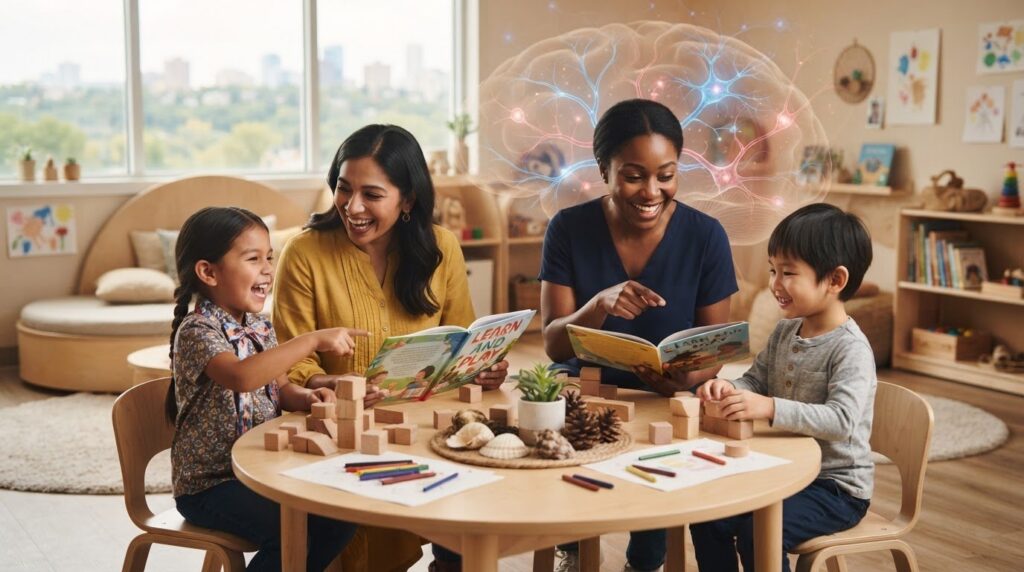
A young child’s brain grows through relationships, repeated experiences, and opportunities to explore, not pressure to reach milestones early. If you’ve heard that a “critical window” is closing, it’s understandable to wonder whether everyday choices are shaping your child’s future. The most useful early childhood brain development facts are reassuring: warm, responsive interactions and engaging experiences matter, while children still develop at their own pace.
This article explains how young brains build skills, why back-and-forth moments such as talking, listening, and play support learning, and how purposeful experiences can nurture development without turning childhood into a race. You’ll find practical ideas for home and early learning, along with guidance on understanding developmental variation. The goal isn’t to accelerate every milestone. It’s to give your child room to grow, with caring adults beside them.
Key Takeaways
- Learn key early childhood brain development facts, including how neural connections form, strengthen, and are refined over time.
- Use daily moments, such as sharing a story or talking about what you see on a walk, to give children meaningful chances to practise language and attention.
- Make room for movement, play, and predictable routines without turning every activity into a lesson.
- See how purposeful preschool learning and educators’ observations can shape age-appropriate activities around each child’s interests and emerging skills.
Early childhood brain development facts: how young brains grow
Brain development is an ongoing process shaped by biology and experience. A child’s genes help guide growth, while relationships, surroundings, health, and opportunities to explore influence how the brain builds and adjusts its networks. These early childhood brain development facts can sound abstract, but the processes have everyday parallels.
Neurons communicate through connections called synapses. As children take in information and practise skills, some connections become stronger. Myelination is the gradual coating of nerve fibres with a fatty layer that helps signals travel more efficiently, a little like insulation around a wire. Pruning is the brain’s way of refining connections it uses less often, much as a gardener trims a plant so its growth is easier to manage. These processes support learning, but they don’t mean every experience needs to become a lesson.
In the first few years of life, a child’s brain forms more than one million neural connections every second, according to Harvard University’s Center on the Developing Child.
That striking rate describes rapid connection-building, not a countdown for parents. For a broader overview of cognitive, emotional, and language growth, see this guide to early childhood development.
Do the first years determine a child’s entire future?
No. Early experiences matter, but they don’t lock a child’s abilities or future into place. The brain has plasticity, meaning it can adapt as people learn and encounter new experiences throughout life. Some skills have sensitive periods when particular kinds of input are especially helpful. A sensitive period is not an irreversible deadline; it signals an opportunity, not a point of no return. Learning continues through preschool, school years, and adulthood, so there is room for growth well beyond infancy.
Everyday ways to support early childhood brain development
Supporting development doesn’t require a packed schedule or a teaching moment in every activity. Children benefit from familiar experiences they can revisit: hearing a story, helping stir pancake batter, taking a walk, or building the same block tower again. These moments let them practise attention, language, movement, and problem-solving at a comfortable pace. Follow your child’s interest, offer time to try, and focus on connection rather than perfect performance.
Warm, responsive interaction paired with time to explore gives children a steady foundation for learning. Harvard University’s overview of brain architecture explains how early experiences contribute to the brain’s developing systems.
How responsive back-and-forth interaction supports learning
“Serve and return” describes a simple exchange: a child offers a cue, and an adult notices and responds, leaving space for another turn. If a preschooler points to a bird, you might say, “You spotted a bird. It’s hopping!” Then pause. A look, sound, gesture, or shift in attention can all be a child’s turn. You don’t need to respond perfectly every time; ordinary moments of shared attention count.
Try weaving these ideas into routines:
- Conversation: Describe what your child is doing, then listen for a reply, a gesture, or another cue.
- Shared stories: Pause to talk about a picture, or let your child choose what happens next.
- Movement and play: Dance, roll a ball, or pretend together, following your child’s interest.
- Predictable routines: Use familiar steps for getting ready or tidying up, giving children chances to anticipate what comes next and participate.
These early childhood brain development facts point to a reassuring approach: repeat engaging experiences, but let play remain play. In Edmonton, purposeful preschool learning can bring language, movement, and exploration together. Jumpstart Learning Academy offers preschool and kindergarten-readiness programs where structured academics and purposeful play support children’s learning.

How purposeful preschool learning supports a growing brain
Preschool can extend learning through experiences that bring together play, conversation, and gentle structure. A child sorting blocks by shape, for example, can practise noticing similarities, using descriptive words, and trying a new strategy when a tower wobbles. A story followed by a related drawing or pretend-play activity gives children another way to revisit ideas. Varied experiences let children explore emerging skills without expecting everyone to learn in the same way or at the same pace.
Supportive early learning brings caring relationships, open-ended exploration, and repeated chances to practise together.
What a nurturing preschool environment can offer
Purposeful play and structured activities can complement one another. A small-group activity may introduce counting or listening for sounds; later, children can explore those ideas through games, building, or conversation. Educators can observe how children approach an activity, what interests them, and where they may benefit from a different level of challenge. They can then adapt materials or offer another prompt, supporting each child’s learning journey without promising a particular result.
A responsive approach can also nurture confidence and social connection. An educator might encourage a hesitant child to choose a role in a pretend-play game, or help children find words to share materials and solve a disagreement. For Edmonton families considering preschool, this Edmonton preschool guide explains what to look for in a learning environment.
At Jumpstart Learning Academy, preschool and kindergarten-readiness learning combines purposeful play with structured academics, personalized learning plans, and assessments. These early childhood brain development facts offer a helpful lens for understanding why responsive teaching matters: educators can notice children’s interests and adapt learning experiences as they grow. Families can explore preschool enrollment information to learn about program options.
Make room for your child’s next step
Understanding early childhood brain development facts can shift the focus from watching the clock to noticing what helps your child feel curious, connected, and ready to try. You don’t need to plan every moment. A calm response, a shared activity, or a chance to explore can make everyday learning feel safe and enjoyable.
For families considering preschool, a supportive learning environment can offer opportunities to discover interests and practise emerging skills alongside caring educators. Jumpstart Learning Academy is a licensed early learning centre serving Edmonton and Beaumont, with a research-based curriculum that combines structured academics and purposeful play.
Explore preschool enrollment at Jumpstart Learning Academy to learn about program options and take the next step for your child. Every child’s path unfolds in its own time, and your steady support can help them meet what comes next with confidence.
Frequently Asked Questions
When is a child’s brain fully developed?
There isn’t a single age when the brain becomes fully developed; different brain systems mature on different timelines, and learning continues throughout life. For parents, this means early childhood is an important stage, not a final deadline. A preschooler’s ability to focus, plan, or manage big feelings will keep changing with experience, practice, and support as they grow.
Can everyday activities support early childhood brain development?
Yes. Everyday experiences can support early childhood brain development without special equipment or formal lessons. Invite your child to make a simple choice, such as which book to bring along, or ask what they think might happen when a toy rolls down a slope. These small invitations give children a chance to make decisions, test ideas, and share their thinking.
Does screen time affect a young child’s brain development?
Screen use can affect a child’s day if it regularly takes the place of sleep, active play, or face-to-face time. The content and context matter too. If you watch something together, pause to talk about what’s happening or connect it to a real experience. For example, after seeing a bird on screen, notice birds outside. Keep media use intentional and balanced.
Should I worry if my child reaches a milestone later than other children?
Not necessarily; children develop at different rates, and one later skill by itself doesn’t diagnose a problem. Still, if you have a concern, you don’t need to wait for it to resolve on its own. Write down what you notice and when, then discuss it with your child’s doctor or another qualified health professional in Edmonton. They can help decide whether follow-up is appropriate.
