
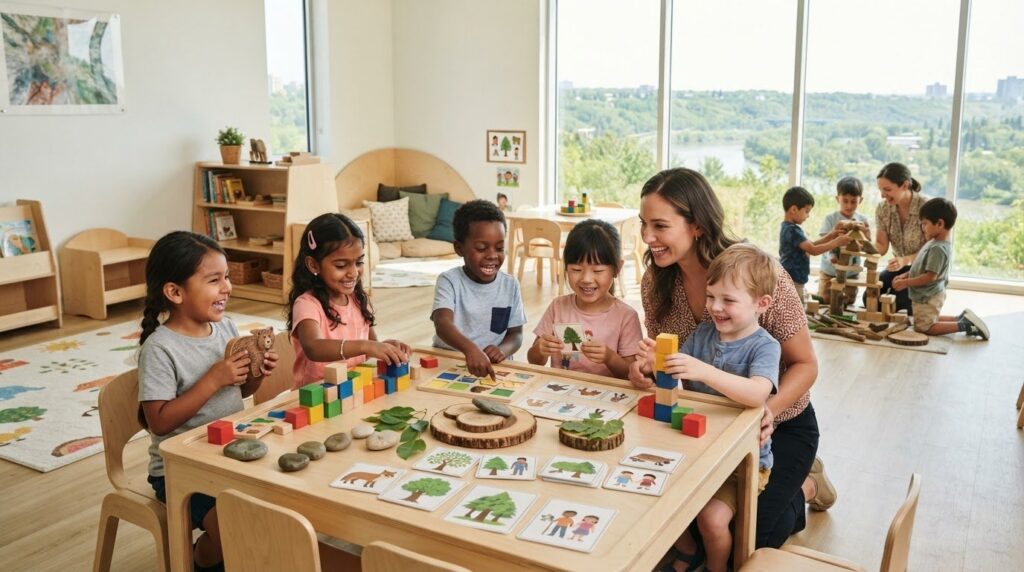
What if summer camp could keep learning alive without making the break feel like another school day? The educational benefits of summer camp are clearest when children get purposeful play alongside clear, age-appropriate guidance. If you’re weighing whether camp offers more than a way to fill the summer calendar, look for regular opportunities to use language, practise early literacy and numeracy, and take part in group routines.
A thoughtfully structured program can give children chances to build oral language and confidence through everyday activities. In this article, you’ll learn what children can practise academically and socially, and how guided learning and play can work together. We’ll also look at Jumpstart Learning Academy’s Edmonton summer options, including its Enriched School Readiness Program and Enriched Preschool Camps with Weekly Themes, so you can compare their schedules and consider which format suits your child.
Key Takeaways
- The educational benefits of summer camp can include academic practice alongside opportunities to practise communication, cooperation, and independence.
- Stories, songs, games, movement, and hands-on activities give children different ways to engage with ideas.
- Guided learning and purposeful play can work together, with clear language models helping children take part.
- JumpStart Learning Academy’s Enriched School Readiness Program and Enriched Preschool Camps with Weekly Themes include daily literacy and numeracy practice, oral language development, and classroom routines.
What Educational Benefits Can Children Gain from Summer Camp?
For preschool-age children, learning isn’t limited to letters, numbers, or worksheets. A shared game can involve listening and taking turns. Setting up an activity can give children a reason to plan, solve a small problem, or ask for help. These everyday experiences provide opportunities to practise academic foundations alongside social and practical skills. A broad educational benefits of summer camp overview also describes camps as settings for learning through educational, athletic, and cultural activities.
Group experiences give young children real reasons to communicate. They might explain what they need, listen to a friend’s idea, or wait for a turn with materials. With supportive guidance, these moments let children practise cooperation and expressing themselves as part of an activity, rather than focusing only on completing a task.
How summer camp can support learning beyond the classroom
Trying an unfamiliar activity or following a new routine gives a child a chance to participate in a different way. They might watch at first, then join in, and later take a more active role. Children respond differently, so progress may look like speaking up, waiting patiently, or asking for support. Camp creates opportunities to practise, but it can’t guarantee the same outcome for every child.
Independence can be practised through manageable choices and everyday participation, such as choosing materials, tidying up, or following a familiar sequence of activities. Look for a setting where routines are clear and children have age-appropriate support as they take part.
In short, camp can turn everyday play into opportunities to practise skills, connect with others, and discover what a child can do. The educational benefits of summer camp vary with each child, the activities, and the guidance they receive.
How Purposeful Play and Guided Learning Build Skills at Camp
Play becomes a learning opportunity when children have room to explore and an inviting way into the activity. A story can introduce new words, a song can invite children to notice patterns, and movement games can practise listening and following directions. Hands-on activities give children a chance to sort, count, compare, and describe what they notice. An educator’s guidance can connect these experiences to ideas children are practising.
Clear language models help children understand how to take part. An educator might model a phrase such as “I notice,” “Can I have a turn?” or “Let’s count together,” then give children time to try it in context. This makes language useful within the activity without taking the fun out of it.
What learning looks like during a summer camp day
A simple activity can bring several kinds of practice together. While building with blocks, children might name colours and shapes, count pieces, listen to a peer’s idea, and take turns adding to a structure. An educator can focus attention with a question or model a useful word, while children explore through play.
A useful teaching sequence is simple:
- Introduce an idea. Share a story, demonstrate a counting strategy, or model a new word.
- Explore it together. Invite children to talk, move, handle materials, and ask questions with guidance.
- Practise through play. Offer another chance to use the idea in a game, song, or hands-on activity.
Repeated chances to hear and use words, count objects, listen, and follow classroom routines provide practice, not a promise of a particular result. Children learn differently, and skills develop over time. This balance of purposeful play and explicit teaching is central to the educational benefits of summer camp. Families can review summer program enrollment information to compare JumpStart Learning Academy’s Edmonton summer options.
How Jumpstart’s Edmonton Summer Programs Put Learning into Practice
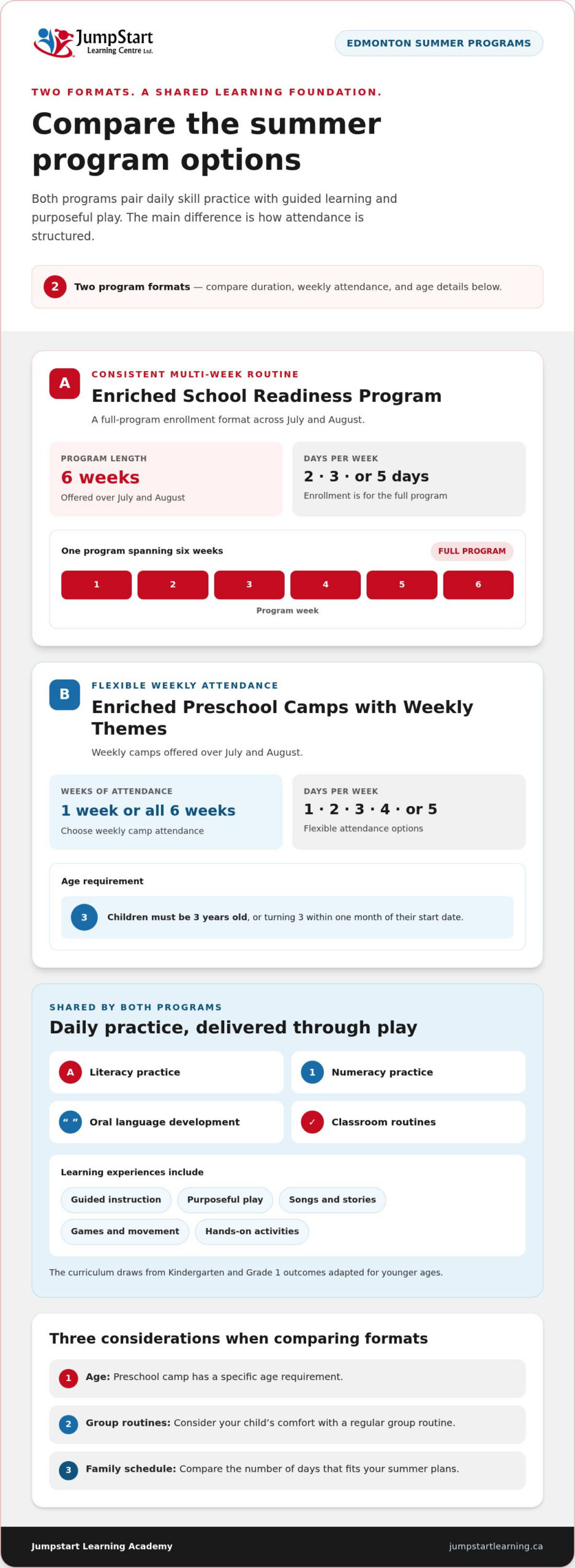
JumpStart Learning Academy’s Edmonton summer programs combine structured learning with playful activities. Families can choose between the Enriched School Readiness Program and Enriched Preschool Camps with Weekly Themes, with schedules that make it possible to compare a consistent multi-week program with flexible weekly camp attendance.
Both summer options include daily literacy and numeracy practice, oral language development, and classroom routines. The curriculum draws from Kindergarten and Grade 1 outcomes adapted for younger ages. Children engage with guided instruction, purposeful play, songs, stories, games, movement, and hands-on activities. These experiences offer practice with foundational skills without suggesting that every child will progress in the same way.
Which summer program format may suit your child?
The Enriched School Readiness Program is a 6-week program offered over July and August. Enrollment for the full program must be in a 2-day, 3-day, or 5-day per week format. This option may suit families looking for a regular summer learning routine across the program.
Enriched Preschool Camps with Weekly Themes are weekly camps offered over July and August. Children may attend for 1 week or all 6 weeks, with flexible attendance of 1, 2, 3, 4, or 5 days per week. For these preschool camps, children must be 3 years old, or turning 3 within one month of their start date.
To compare the formats, consider your child’s age, comfort with group routines, and the number of days that fits your family’s summer schedule. The educational benefits of summer camp can take shape through regular practice and playful participation. Review summer program enrollment details to explore the available formats and choose a next step.
Give Summer Learning a Meaningful Next Step
Choosing a summer experience is an opportunity to support the kind of growth that matters to your child, at a pace that feels right for your family. The educational benefits of summer camp can reach beyond academic practice when children have space to explore, try activities, and take part in guided learning.
At JumpStart Learning Academy in Edmonton, summer programs pair structured learning with playful activities. Children have daily opportunities to practise literacy and numeracy, develop oral language, and become familiar with classroom routines. The Enriched School Readiness Program and Enriched Preschool Camps with Weekly Themes offer two formats to consider when planning your child’s summer.
Explore the program options and compare the schedules to find a format that fits your child and family. Explore JumpStart’s summer learning programs and take the next step toward a summer of purposeful learning and play.
Frequently Asked Questions
Can summer camp help prevent summer learning loss?
Summer camp can give children opportunities to keep practising familiar skills, but it can’t guarantee that learning loss will be prevented. Look for regular, low-pressure chances to use early reading and number concepts, such as talking about a story or counting items during an activity. The educational benefits of summer camp depend on each child’s needs and experience. Consistent practice can support learning continuity without turning the break into school at home.
Can a shy child benefit from summer camp?
A shy child may appreciate time to feel comfortable and participate at their own pace. They might begin by watching a group, then join a partner activity or take on a small role. Before camp, talk through what joining a group might feel like and practise a simple phrase for taking part. Children differ in how quickly they warm up, so consider whether the program’s group activities and routines feel like a good fit.
How can parents extend summer camp learning at home?
Keep it simple and weave practice into routines you already share. Ask your child to describe the day in sequence, spot letters on a grocery list, or help count napkins before a meal. Give them time to answer and show interest in their ideas rather than correcting every mistake. These short, relaxed conversations can keep language and early number thinking active without adding worksheets or pressure.
