
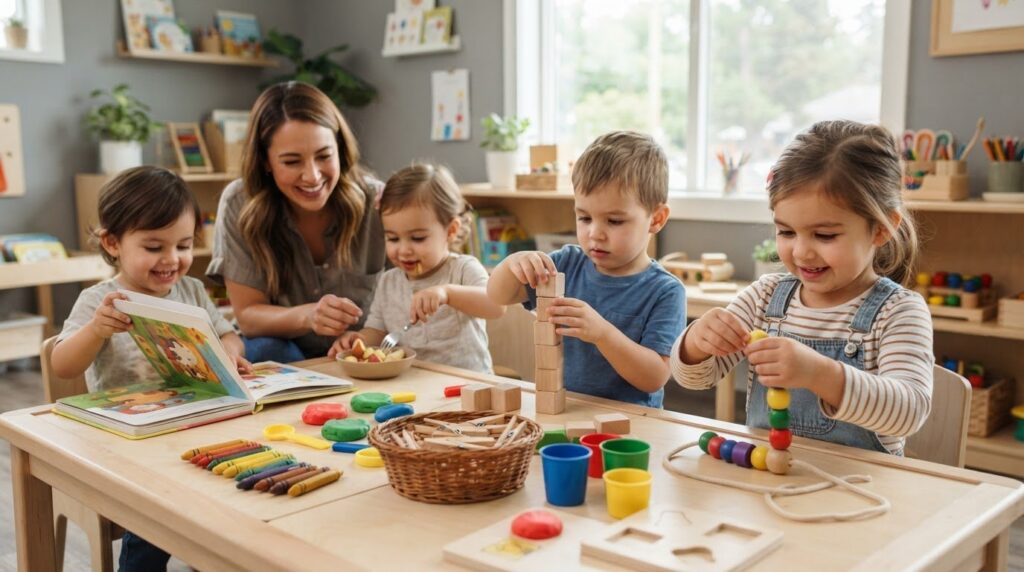
Some of the best fine motor skills activities for 3 year olds fit naturally into snack time, dress-up, and everyday play. At three, small tasks such as turning pages, stacking blocks, and using a fork give children meaningful practice with hand control. If a task is tricky at first, that’s simply a chance to offer a little support and try again another day.
Simple, familiar materials can support growing coordination without worksheets, elaborate setups, or pressure to keep pace with other children. The ideas below move from easy grasping to more precise movements, with practical ways to adapt each activity. You can also weave hand practice into routines, helping your child build confidence and independence through small successes.
Key Takeaways
- Notice how grasping, releasing, hand-eye coordination, and using both hands appear in ordinary play and self-care.
- Try fine motor skills activities for 3 year olds with familiar materials, adapting the task to your child’s comfort and interest.
- Build brief practice into dressing, snack preparation, crafts, and clean-up instead of setting aside a separate lesson.
- Offer choices, demonstrate a first step, and praise effort; simplify or pause if frustration starts to grow.
What fine motor skills look like at age three, and how play can help
Fine motor skills are the small, controlled movements of the hands and fingers that help children handle toys, draw, eat, and manage everyday tasks.
At three, these skills are still developing through practice. A child may grasp a crayon, release a block onto a tower, or guide a toy piece into place using hand-eye coordination. Turning a page or opening an easy container can involve both hands: one steadies the object while the other moves it. These everyday actions help children practise control as they explore and take on more tasks independently.
How hand skills show up in everyday play
Drawing, turning pages, handling toys, and opening containers give children chances to explore fine motor skills in familiar, meaningful ways. If a crayon mark wanders or a lid needs help, the attempt still offers practice. For fine motor skills activities for 3 year olds, focus on making the activity inviting, not on producing a neat picture or completing a task perfectly.
Children don’t all develop at the same pace, and one difficult task doesn’t define a child’s progress. Offer activities as opportunities, not tests. Your child might enjoy turning pages today and show more interest in drawing another day. Participation, curiosity, and willingness to try matter more than matching someone else’s timeline.
Purposeful play gives children room to repeat movements, experiment, and gradually discover what their hands can do. In a preschool environment, structured learning alongside play gives children different ways to practise and explore. At home, a relaxed invitation and time to try are a good place to begin.
Fine motor skills activities for 3-year-olds using everyday materials
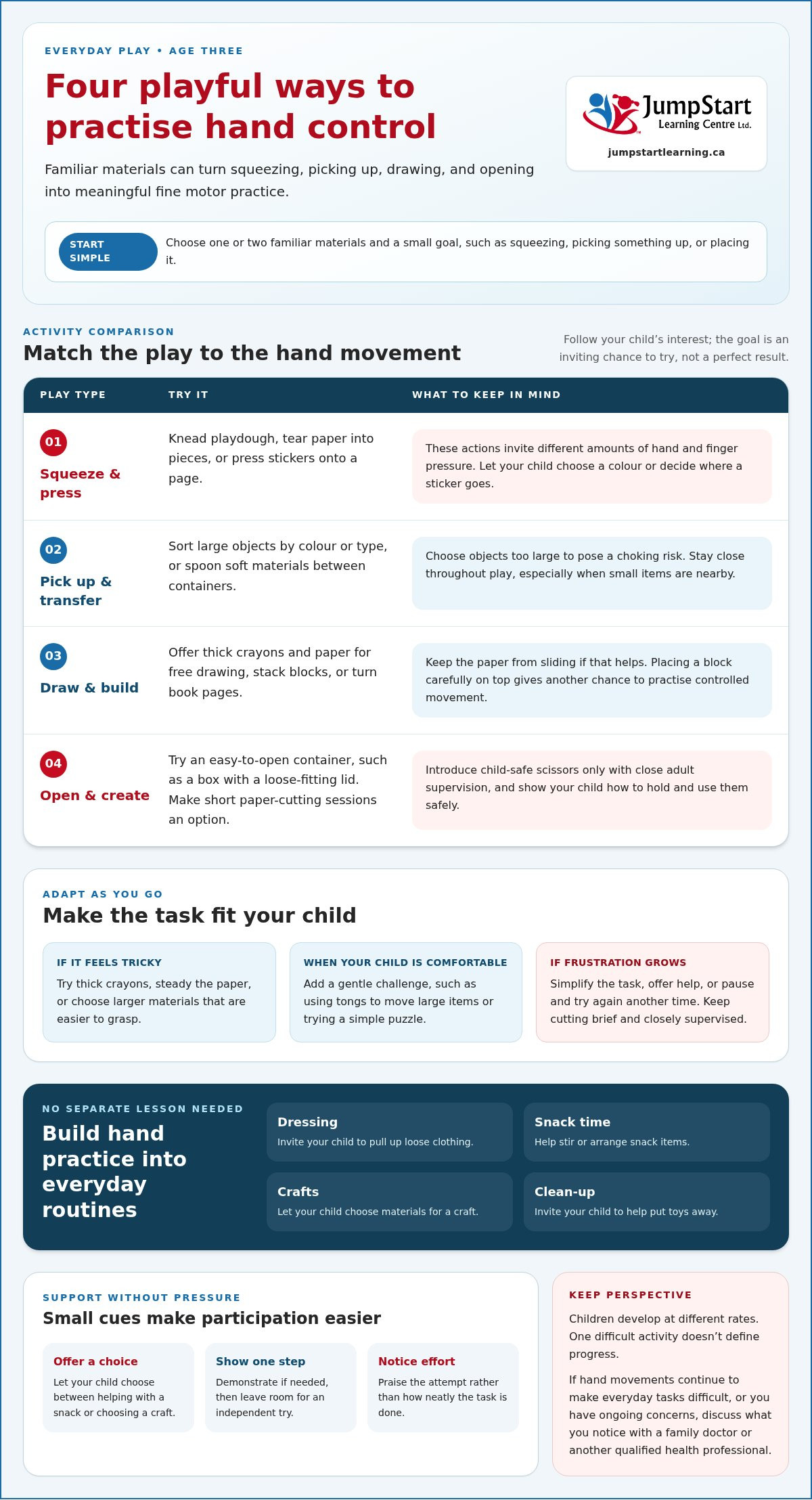
You don’t need a special kit to make hand practice playful. Start with one or two familiar materials and a simple goal, such as squeezing, picking up, or placing something. If your child can do the task easily, add a small challenge; if they lose interest or get frustrated, make it simpler or try again later. These fine motor skills activities for 3 year olds practise different movements through play:
- Squeeze and press: Knead playdough, tear paper into pieces, or press stickers onto a page. These actions invite children to use their hands and fingers with different amounts of pressure. Let your child choose the colour or where a sticker goes to keep the activity engaging.
- Pick up and transfer: With supervision, sort large objects by colour or type, or spoon soft materials between containers. Choose objects too large to pose a choking risk, and stay close throughout play, especially when small items are nearby.
- Draw and build: Offer thick crayons and paper that stays in place for free drawing, or let your child stack blocks and try to place one carefully on top. Turning book pages also gives fingers a chance to practise controlled movements.
- Open and create: Let your child try easy-to-open containers, such as a box with a loose-fitting lid. With close adult supervision, introduce child-safe scissors and short paper-cutting sessions, showing how to hold and use them safely.
Michigan State University Extension shares more activities for developing fine motor skills with young children.
Make each activity easier, harder, or more engaging
When small movements feel frustrating, change one part of the task: try thick crayons, keep the paper from sliding, or choose larger materials that are easier to grasp. When your child is comfortable, add a gentle challenge, such as using tongs to move large items or trying a simple puzzle. Keep any cutting activity brief and closely supervised. Follow your child’s cues rather than aiming for a finished product.
Each playful repetition gives your child another chance to explore, practise, and gain control of small hand movements. Jumpstart Learning Academy’s three-year-old preschool program combines purposeful play with structured learning. Learn about the three-year-old preschool program.
How to build fine motor play into routines and preschool learning
Hand practice doesn’t need a separate lesson. Invite your child to take part in small ways during everyday routines: pull up loose clothing while dressing, help stir or arrange snack items, choose materials for a craft, or put toys away. Give just enough support to keep the task manageable, then leave room for your child to try independently.
Choice helps children feel involved. You might ask, “Would you like to help with snack or choose a craft?” Demonstrate one step if needed, then praise the effort rather than how neatly it’s done. If your child becomes frustrated, simplify the task, offer help, or pause. A calm finish matters more than pushing through.
Follow your child’s interests and notice small steps
Notice what your child reaches for and which movements they enjoy. If they’re drawn to art, building, or helping with everyday jobs, use that interest to shape the next opportunity. Look for small changes, such as trying a step independently or staying engaged a little longer. These observations can help you choose fine motor skills activities for 3 year olds that feel inviting rather than imposed.
Purposeful play can bring exploration together with educator-guided learning. At Jumpstart Learning Academy, the three-year-old preschool program combines purposeful play with structured learning, personalized learning plans, and assessments to support each child’s learning journey. For families in Edmonton, preschool program enrollment is a next step to explore.
Children progress at different rates, so avoid using a single activity as a test. If hand movements continue to make everyday tasks difficult, or you have ongoing concerns about your child’s development, discuss what you’re noticing with your family doctor or another qualified health professional. Specific examples of what feels difficult can help guide the conversation.
Make everyday play a confident next step
Small moments can support growing hand control. Choose fine motor skills activities for 3 year olds that fit your child’s interests, and let dressing, crafts, play, and clean-up offer relaxed opportunities to practise. Demonstrating a step, offering choices, and celebrating effort can help make each try feel positive. Progress looks different for every child, so focus on curiosity and confidence rather than comparison.
For Edmonton families looking for a supportive learning environment, Jumpstart Learning Academy offers a preschool program designed for three-year-olds. Its research-based curriculum combines purposeful play with structured learning, while personalized learning plans and assessments support each child’s learning journey.
Explore Jumpstart Learning Academy and learn about its preschool program for three-year-olds.
Frequently Asked Questions
What fine motor skills should a 3-year-old be practising?
At three, children are often developing skills such as using a fork, threading large beads with supervision, drawing a circle after seeing an example, and managing simple toys or clothing fasteners. These are general examples, not a checklist or deadline. Children develop at different paces, so notice how your child participates and gains confidence over time.
What are easy fine motor activities for a 3-year-old at home?
Easy fine motor skills activities for 3 year olds can use familiar items: squeeze playdough, press stickers onto paper, turn book pages, stack blocks, or draw with thick crayons. Your child can also spoon soft materials between containers or sort large objects with you nearby. Supervise closely, especially around small items and child-safe scissors.
How often should I do fine motor activities with my 3-year-old?
There’s no required schedule. Offer brief, relaxed chances to use their hands during routines such as getting dressed, preparing a snack, making art, or tidying toys. Follow your child’s interest and stop or simplify if frustration grows. In Edmonton, Jumpstart Learning Academy’s preschool program offers another setting for purposeful play alongside everyday opportunities at home.
When should I be concerned about my 3-year-old’s fine motor skills?
Consider discussing your concerns with your child’s family doctor or another qualified health professional if hand-use difficulties persist and regularly interfere with tasks such as eating, playing, drawing, or dressing. Share specific examples of what feels difficult and how your child responds. If your child attends preschool in Edmonton, their educator may also offer useful observations from classroom activities.
