

The first day goes more smoothly when your child has practised a few everyday skills beforehand. A first day of preschool checklist for parents should cover getting dressed, using the bathroom and washing hands, putting on shoes and a jacket, and following a simple morning routine. These small steps build confidence, not perfection.
It’s natural to wonder whether your child will feel ready and how you can help. This guide shares practical ways to practise at home, prepare belongings and routines, and use orientation to introduce your child to the classroom and teachers. A calm plan can make the transition more manageable for both of you.
Key Takeaways
- Turn everyday routines into low-pressure practice so your child can build confidence with clothes, bathroom steps, and shoes.
- Prepare a calm start by organizing belongings, keeping routines familiar, and making drop-off predictable.
- Use orientation to help your child get comfortable with the classroom and give teachers helpful insight into their needs and personality.
- If your child is ready for a structured early learning setting, Jumpstart Learning Academy’s Preschool Program (3 Year Olds) can support their learning and social growth.
Practising independence with dressing, bathroom use, and shoes
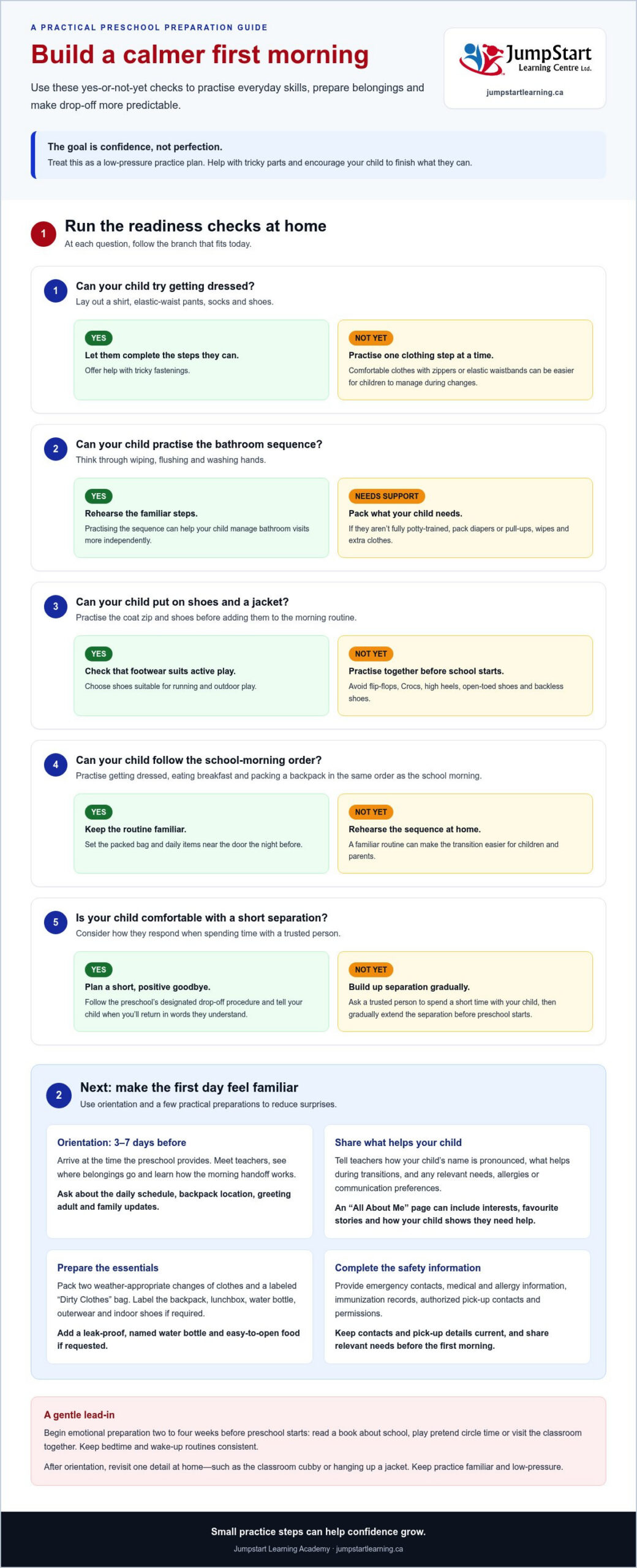
Use this first day of preschool checklist for parents as a practice plan, not a test. Lay out a shirt, elastic-waist pants, socks, and shoes, then let your child try each step. Help with tricky fastenings while encouraging them to finish what they can.
A first day of preschool checklist for parents can include a bathroom rehearsal: practise wiping, flushing, and washing hands. Rehearsing this familiar sequence can help your child manage bathroom visits more independently. Pack diapers or pull-ups, wipes, and extra clothes if your child isn’t fully potty-trained.
- Pack two weather-appropriate changes of clothes and a labeled “Dirty Clothes” bag, so soiled outfits stay separate.
- Choose comfortable clothing with zippers or elastic waistbands, which children can manage during changes.
- Practise putting on shoes and a jacket, including zipping the coat, before adding those steps to the morning routine.
- Select shoes suitable for running and outdoor play; avoid flip-flops, Crocs, high heels, open-toed shoes, and backless shoes.
- Rehearse getting dressed, eating breakfast, and packing a backpack in the same order as the school morning.
- Ask a trusted person to spend a short time with your child, then gradually extend the separation before preschool starts.
- At drop-off, follow the preschool’s designated procedure and use a short, positive goodbye. Tell your child when you’ll return in words they understand.
- Keep the first-day bag focused on useful belongings; leave unsuitable footwear and items the preschool’s instructions exclude at home.
Preparing parents and carers for a child starting nursery
Before starting, complete the preschool’s forms for emergency contacts, medical and allergy information, immunization records, authorized pick-up contacts, and permissions. Share relevant needs or challenges so teachers can review your child’s records before the first morning.
For safety, make sure emergency contacts and authorized pick-up details are current, and provide clear information about allergies or other needs. Teachers should have access to contact lists and permission forms, as well as emergency procedures and evacuation information.
- Pack with your child: Choose a child-sized backpack your young learner can carry, then label it, the lunchbox, water bottle, outerwear, and indoor shoes if required.
- Keep essentials manageable: Add a leak-proof water bottle marked with your child’s name, plus easy-to-open food if the preschool asks families to pack meals or snacks.
- Prepare for the weather: Edmonton conditions can change, so pack outdoor gear suited to the season, such as a sun hat or warm mittens.
- Set up the morning: Place the packed bag and daily items near the door the night before. A familiar routine can make the school-year transition easier for children and parents.
Begin preparing emotionally two to four weeks before preschool starts. Read a book about school, play pretend circle time, or visit the classroom together. A consistent bedtime and wake-up routine can help your child adjust to the new morning.
At pick-up, ask what your child enjoyed, such as a story, song, or play area. One specific question can open conversation without making the early childhood learning experience feel like a test. For families preparing for preschool, preschool enrollment information can help with the next step.
Orientation and meeting teachers
Preschool orientation is often scheduled 3-7 days before a child’s first day. Use that visit to make the classroom feel familiar before the new routine begins.
Arrive at the time the preschool provides. Expect to meet teachers, see where belongings go, and learn how the morning handoff works. Ask where to leave a backpack and which adult will greet your child.
- Ask the teacher to describe the daily schedule, including arrival, play, snack, and group activities.
- Share how your child’s name is pronounced and what helps during transitions, such as a clear goodbye or a familiar comfort item.
- Explain relevant needs, allergies, or communication preferences so teachers can support your child’s preschool experience.
- Ask how the curriculum balances guided learning, play, reading, and opportunities to practise independence.
- Find out how teachers share updates with families and who to approach with questions after the first day.
A simple “All About Me” page can give teachers useful context. Include your child’s interests, favourite stories, and the ways they show they need help. For example, knowing your child loves animal books gives a teacher an easy conversation starter.
After orientation, revisit one detail at home. Talk about the classroom cubby or practise walking in and hanging up a jacket. These small, familiar steps can build confidence without turning the visit into a test.
For a clearer next step after meeting teachers, review preschool enrollment details.
Jumpstart Learning Academy: Preschool Program (3 Year Olds)
Jumpstart Learning Academy’s Preschool Program (3 Year Olds) gives families a structured early learning option as children prepare for preschool routines and classroom experiences. Its research-based curriculum combines purposeful play with early academic and social growth, supporting skills that complement the independence practised at home.
Consider this program if your child is approaching preschool age and you’re looking for guided learning alongside opportunities to build social confidence. Jumpstart Learning Academy also offers Junior Kindergarten Program (4 Year Olds) and Kindergarten Program (5 Year Olds), providing options for later stages of early education. Each child’s readiness develops at an individual pace, so consider the setting and learning approach that best fits your family’s needs.
To explore whether the Preschool Program suits your child, contact Jumpstart Learning Academy or review its preschool enrollment information.
Let Confidence Grow Beyond the First Day
Your first day of preschool checklist for parents can be a flexible guide, not a test your child must pass. Readiness grows through small chances to try, make mistakes, and ask for help. Notice what your child manages with growing confidence, then keep practising at a comfortable pace.
If you’re considering a supportive next step in early learning, Jumpstart Learning Academy offers a Preschool Program (3 Year Olds), a Junior Kindergarten Program (4 Year Olds), and a Kindergarten Program (5 Year Olds). These programs provide options as your child moves through early learning stages.
Explore the program that fits your family’s plans, or contact Jumpstart Learning Academy to learn more. Your calm preparation and steady encouragement can help your child approach this new beginning with curiosity and confidence.
Frequently Asked Questions
How can parents prepare a child emotionally for their first day of preschool?
Help your child name their feelings and talk through what starting preschool may be like. Try saying, “You might feel excited or unsure, and that’s okay.” Invite them to draw what they imagine the classroom will look like, then talk about the picture. Keep explanations truthful and specific, and avoid promising exactly how the day will go.
What should parents tell preschool staff about allergies, medications, and special needs?
Share relevant details in the preschool’s medical and allergy forms, then tell staff about any changes. Describe known allergy triggers, what a reaction may look like, and any response instructions from your child’s healthcare provider. For medication, provide the prescribed instructions and explain any support your child needs with communication, movement, sensory experiences, or daily routines.
What are Canadian preschool rules for lunches, snacks, and food allergies?
Food arrangements and allergy guidelines vary by preschool, so ask about the centre’s policy before packing a meal or snack. Find out whether food is provided, which ingredients or items are restricted, and how staff manage allergy information. If you’re sending food, choose something your child can manage and follow the centre’s instructions for containers and labelling.
What are typical preschool drop-off and pick-up procedures in Canada?
Follow the preschool’s designated drop-off procedure and keep goodbye short, positive, and consistent. Tell your child when you’ll return in words they understand. At pick-up, ask what they enjoyed, such as a story, song, or play area.
How early should families arrive on the first day of preschool, and what should they expect?
Arrive at the time the preschool provides and follow its drop-off instructions. Expect to meet teachers, see where belongings go, and learn how the morning handoff works; orientation is often scheduled 3-7 days before the first day.
