
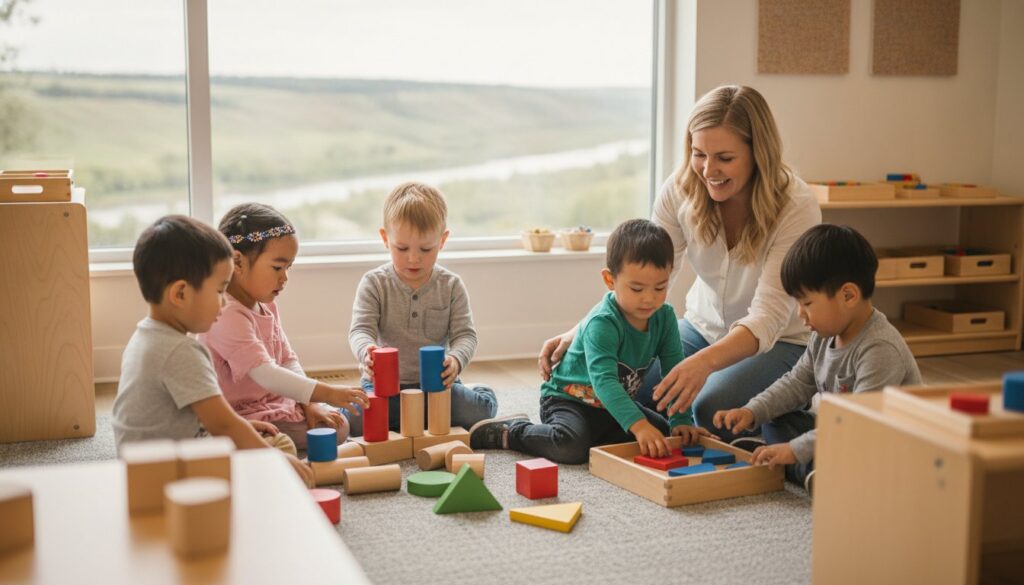
If your child can count to twenty, you might think they’re fully prepared for the mathematical challenges of kindergarten. However, true readiness isn’t just reciting numbers; it’s understanding the logic and quantity behind them. It’s natural to feel anxious as the 2026/27 school year approaches, especially with new mandatory numeracy screenings across Alberta. You don’t need expensive, generic toys to bridge this gap. By focusing on purposeful preschool numeracy activities Edmonton families can integrate into daily life, you can transform simple routines into powerful learning moments.
We understand the pressure to balance academic rigour with the joy of play. This guide shares research-based, sensory-focused strategies that move beyond rote memorization to build a lasting mathematical mindset. You’ll discover how to support your child’s individual journey, ensuring they meet milestones with confidence and quiet certainty.
Key Takeaways
- Learn why developing “number sense” is more vital for kindergarten readiness than simple rote counting, helping your child understand the logic behind quantities.
- Discover how to integrate purposeful preschool numeracy activities Edmonton parents can use to turn everyday routines into meaningful, sensory-focused learning moments.
- Explore the “Play with Purpose” philosophy, which uses tactile experiences to help children visualize and feel mathematical concepts for deeper comprehension.
- Understand how specialized Junior Kindergarten programs use personalized learning plans to identify specific numeracy gaps and bridge the transition to formal schooling.
Understanding Preschool Numeracy: More Than Just Counting to Ten
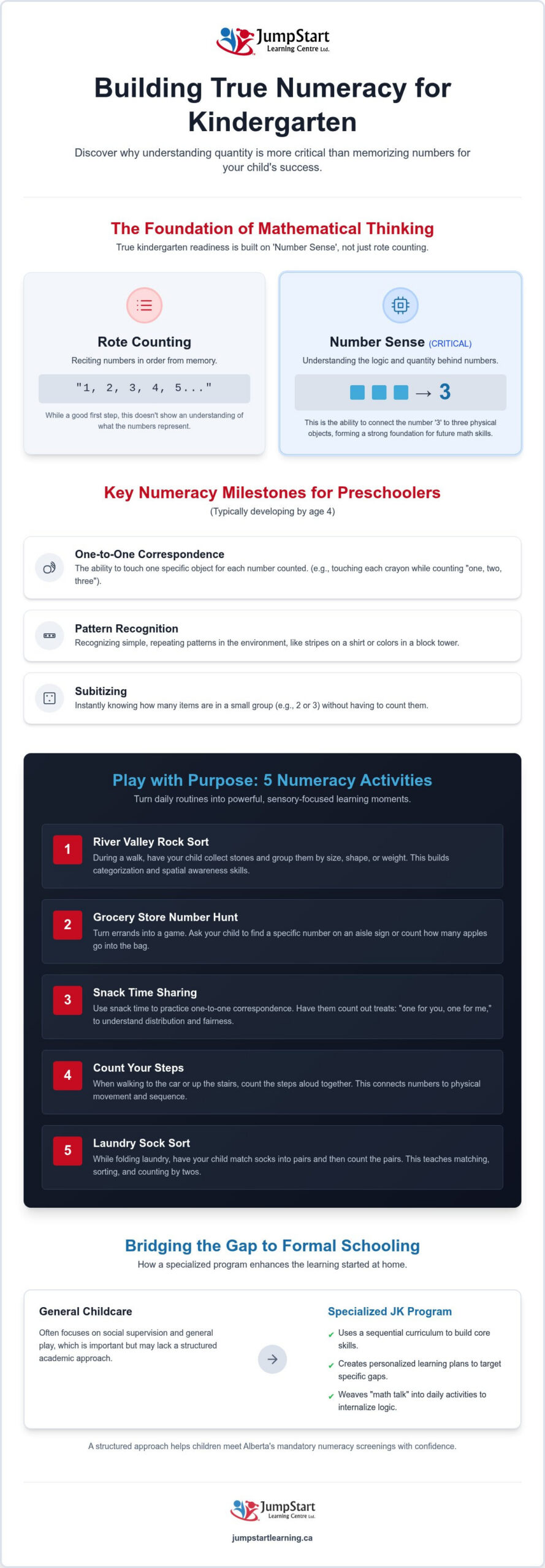
Many parents feel a sense of accomplishment when their child recites numbers one through ten. While this is a great start, true Understanding Preschool Numeracy involves the ability to apply these concepts in real-world situations. We call this “number sense.” It’s the difference between a child memorizing a sequence and actually understanding that the number three represents three physical objects. Developing this logic through preschool numeracy activities Edmonton families can do at home creates a sturdy bridge to future academic success.
Research suggests that early mathematical exposure is a powerful predictor of later school achievement. In the Alberta school system, children who enter kindergarten with a solid foundation in number relationships often feel more confident and less overwhelmed by new concepts. If you’re worried your child isn’t “getting it” yet, take a deep breath. Numeracy develops at different rates for every child. Some may master patterns quickly while others take more time to grasp the concept of quantity. Your child’s pace doesn’t define their potential; it simply reflects their personal learning journey.
Key Numeracy Milestones for Edmonton Preschoolers
By age four, many children begin to understand one-to-one correspondence. This is the act of touching one specific object for every number counted. They also start recognizing simple patterns in their daily environment. A critical skill to watch for is subitizing. This is the ability to see a small group of items, like three crackers on a plate, and know there are three without counting them individually. Engaging in preschool numeracy activities Edmonton programs recommend, like sorting socks or counting steps, builds these foundational skills naturally. Identifying these milestones is a helpful step when Choosing the Best Preschool in Edmonton to ensure the curriculum aligns with your child’s developmental stage.
5 Purposeful Numeracy Activities for Edmonton Families
Transforming your daily routine into a learning environment is simpler than you might think. Our “Play with Purpose” philosophy encourages you to view ordinary moments as chances to build preschool numeracy activities Edmonton children can enjoy anywhere. By focusing on sensory-focused foundations, such as feeling the rough texture of a wooden block or the smooth curve of a plastic number, you help your child visualize abstract concepts. You don’t need to be a strict instructor; you’re an expert mentor guiding their natural curiosity. Research from ZERO TO THREE shows that these playful interactions are the most effective way to help your child develop early math skills without causing academic stress.
Step-by-Step Math Games to Play at Home
Using Edmonton’s beautiful natural spaces makes math feel like an adventure. During a walk through the River Valley, try a “Rock Sort.” Have your child collect stones and group them by size, shape, or weight. This builds categorization skills and spatial awareness. When you’re running errands, turn the grocery store into a “Number Hunt.” Ask your child to find the digit ‘4’ on aisle signs or count how many apples go into the bag. Finally, use snack time for one-to-one correspondence. If they’re sharing treats with a sibling, have them count out “one for you, one for me.” These small, intentional acts are excellent preschool numeracy activities Edmonton parents can use to provide academic rigour while keeping the experience joyful. If you’re looking for more structured support, our Junior Kindergarten program provides a perfect bridge for these home-based lessons.
How Specialized Preschool Programs Enhance Mathematical Thinking
While home-based preschool numeracy activities Edmonton parents lead are foundational, a specialized academic environment provides the structure needed for long-term success. Unlike general childcare, which often focuses on social supervision, a research-based program uses a sequential curriculum to build core competencies. At Jumpstart Academy, we use personalized learning plans to identify exactly where a child might be struggling, whether it’s recognizing patterns or understanding quantity. Our educators act as mentors, weaving “math talk” into every conversation. By using precise language during play, they help children internalize mathematical logic as a natural part of their world.
This structured approach is particularly important for the transition to formal schooling in Alberta. As the province introduces mandatory numeracy screenings for the 2026/27 school year, having a child who is already comfortable with these concepts provides immense relief for families. Our Junior Kindergarten and Kindergarten programs act as a bridge, moving away from the frustration of academic struggle toward the joy of genuine achievement.
The Jumpstart Advantage: Literacy and Numeracy Enrichment
Our programs don’t treat math as a separate subject; we integrate it into art, music, and physical movement. Whether your child is counting beats in a song or measuring sand in a sensory bin, they’re building vital skills through sensory-focused foundations. We encourage families to enroll in our preschool or JK programs now to secure a spot for the 2026 term. Early assessments are a hallmark of our approach, ensuring a smooth transition to either the Edmonton Public or Catholic school boards. These evaluations give you the quiet confidence that your child isn’t just “getting by” but is truly flourishing.
Preparing Your Child for a Bright Mathematical Future
Building a child’s number sense doesn’t require complex tools or high-pressure drills. By integrating sensory-focused preschool numeracy activities Edmonton families can enjoy during daily routines, you’re laying the groundwork for real academic confidence. Whether you’re sorting stones in the River Valley or counting grocery items, these intentional moments transform how your child understands the logic of the world around them. These small steps move your family away from the anxiety of kindergarten readiness and toward the relief of steady achievement.
We’re here to help you navigate this journey with a licensed, research-based curriculum and personalized learning assessments led by experienced local educators. Secure Your Child’s Spot for 2026: Enroll at Jumpstart Learning Academy to ensure a smooth transition to formal schooling. Your child has incredible latent capabilities waiting to be discovered. With the right guide and a purposeful, playful approach, the path to mathematical success is filled with joy.
Frequently Asked Questions
What is the difference between counting and numeracy?
Counting is the ability to recite numbers in order, while numeracy is the functional understanding of how those numbers work in the real world. It’s the difference between saying “one, two, three” and knowing that “three” represents three physical objects. True numeracy involves logic, patterns, and spatial awareness. Our preschool numeracy activities Edmonton focus on building this deeper “number sense” to ensure long-term academic success.
How do I know if my child is ready for a numeracy-focused preschool program in Edmonton?
If your child shows curiosity about how many items are on their plate or enjoys sorting toys by size, they’re likely ready. Most children in Edmonton enter our programs at age three or four. Readiness isn’t about what they already know; it’s about their developmental stage. We provide personalized learning assessments to meet every child where they are, regardless of their starting point.
Can play-based learning really teach my child math?
First, remember that every child develops at their own unique pace. If they’re struggling, shift the focus from visual recognition to sensory-focused foundations. Try tracing numbers in sand or using physical blocks to represent quantities. For more structured tactile learning, platforms like Maker & Coder offer modular hardware that introduces STEM concepts through hands-on play. If you’re concerned, a specialized Junior Kindergarten program can provide a personalized learning plan to identify specific gaps. These interventions ensure your child feels supported rather than overwhelmed.
