
What is Social-Emotional Growth and Why Does it Matter in Edmonton?
Social-emotional growth is the process through which children learn to understand and manage their emotions, feel and show empathy for others, establish positive relationships, and make responsible decisions. For parents in Edmonton preparing their children for kindergarten in 2026, this is not just a “soft skill” — it’s the essential foundation upon which all future academic learning is built. A child who can regulate their emotions is a child who can focus during a literacy lesson. A child who can navigate social situations is one who thrives in a bustling classroom in Chappelle or Beaumont.
- Defining social-emotional development as the foundation for all future learning.
- Why Edmonton parents are prioritizing these skills for 2026 school entries.
- The direct connection between emotional regulation and academic focus in the classroom.
- How social growth impacts a child’s ability to adapt to new environments and routines.
The Three Pillars of Emotional Maturity
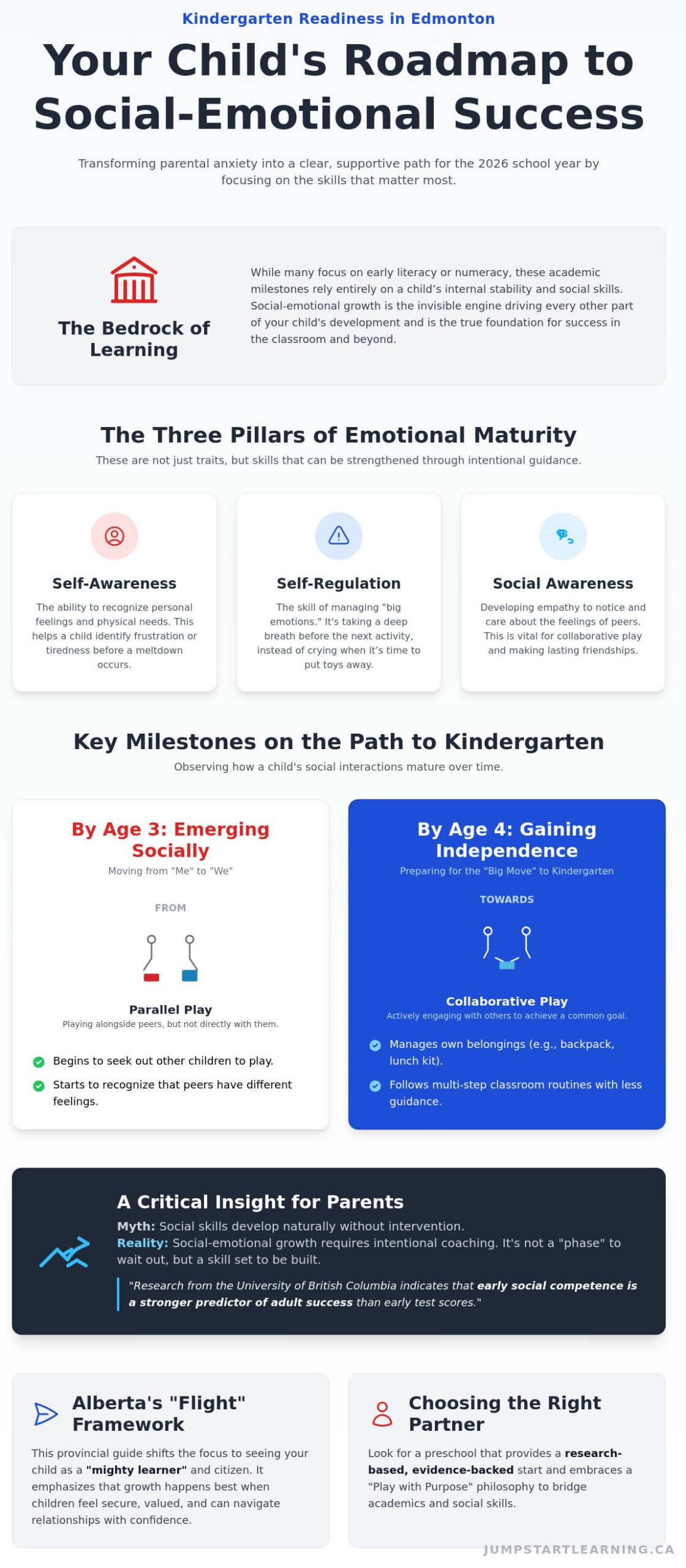
To succeed in a structured school environment, children need to develop three core capacities. These pillars are what we intentionally nurture in our programs to ensure a smooth and successful transition to kindergarten.
According to What is Social-Emotional Growth?, this is a well-documented area of ongoing research and practical application.
- Self-awareness: The ability to recognize one’s own feelings and needs, and understand how they impact others in a group setting.
- Self-regulation: The skill of managing big emotions during challenging moments, such as transitions between activities or disagreements with peers.
- Social awareness: The capacity to develop empathy and understand the perspectives of others in a diverse Edmonton classroom.
Why “Soft Skills” are the Hardest to Teach
Many believe that social skills simply develop on their own, but this is a common myth. Like reading or math, social-emotional skills require intentional guidance, practice, and a supportive environment. The effort invested now has a profound long-term impact, influencing success in high school and beyond. As a parent, you are your child’s first and most important emotional coach, and a high-quality preschool program acts as your dedicated partner in this critical work.
To be an effective coach, parents must also prioritize their own regulation and health, as well as their child’s ongoing development; for instance, Thrive Teen Therapy Alberta offers specialized mental health support for youth across the province to help maintain the social-emotional foundation established in early childhood.
Key Milestones: What Social Maturity Looks Like in Alberta Preschoolers
While some programs focus on open-ended play, we believe that for children aged three and up, a more structured, teacher-led experience is essential for kindergarten readiness. Our approach is designed to guide children through the Alberta kindergarten curriculum expectations, ensuring they are not just ready, but ahead of the curve. This involves tracking key social and emotional milestones that signal a child is prepared for the structure of formal schooling. It also helps us identify when a child might benefit from extra support through PUF or other specialized plans.
- Understanding the social expectations for 3-year-olds in a structured preschool environment.
- Tracking key milestones for Junior Kindergarten (4-year-olds) as they prepare for the big move to EPSB or ECSD.
- Recognizing signs that your child might need extra support through PUF funding or personalized learning plans.
Age-Specific Social Markers (3 to 5 Years)
In our teacher-led activities, we look for clear indicators of social-emotional growth that are critical for a successful kindergarten experience:
Research published by Key Milestones: What Social Maturity Looks Like shows that this is a well-documented area of ongoing research and practical application.
- Sharing and turn-taking: Moving from the natural “mine!” stage to understanding and participating in collaborative, purposeful play.
- Following multi-step directions: Listening to and carrying out instructions from a teacher in a classroom of 10-15 peers.
- Initiating play with others: Confidently approaching peers to join or start a game without needing constant adult intervention.
The Emotional Readiness Checklist for Edmonton Schools
Is your child ready for the classroom door? Here are a few key emotional skills we help develop for a seamless transition into schools in communities like Chappelle and Beaumont:
- Separation confidence: The ability to say goodbye to a caregiver at the classroom door with minimal anxiety, trusting the new environment.
- Problem-solving with words: Using language to express needs and resolve disagreements during playground disputes, rather than resorting to physical actions.
- Resilience: Resilience on an Alberta winter playground is the ability to get back up with a smile after a slip on the ice, ready to try the slide again.
The “Play with Purpose” Philosophy: Balancing Academics and Social Skills
We are an academically structured program that intentionally incorporates a structured play component. Our “Play with Purpose” philosophy is the bridge between academic rigour and social-emotional development. This isn’t unsupervised free time; it’s a series of carefully designed, teacher-led activities where social skills are actively taught and practiced in the context of learning. This multisensory approach ensures that as children learn literacy and numeracy, they are also learning how to be patient, collaborative, and confident members of a classroom community, fully preparing them for the transition to Edmonton Public Schools (EPSB).
- Why Jumpstart Learning Academy combines structured numeracy/literacy with guided social play.
- The science of multisensory learning: How social interaction cements academic concepts.
- How “Play with Purpose” differs from the unstructured environments found in many daycares.
Structured Academics as a Social Tool
Every part of our academic curriculum is an opportunity to build social-emotional skills. We don’t see academics and social growth as separate; we see them as intertwined parts of a journey toward kindergarten readiness.
Research published by The "Play with Purpose" Philosophy shows that this is a well-documented area of ongoing research and practical application.
- How group literacy lessons teach essential skills like patience and active listening.
- Using numeracy games to foster healthy competition, cooperation, and good sportsmanship.
- The role of “circle time” in building a strong sense of community, belonging, and public speaking confidence.
Unlocking Potential Through Tailored Learning
Every child develops at their own pace. Our commitment is to provide a learning plan that respects each child’s unique emotional and academic journey, ensuring they feel supported, not overwhelmed. This personalized approach is a cornerstone of choosing the best preschool in Edmonton for your family.
- Personalized learning plans that respect a child’s unique emotional pace.
- How small class sizes in our Beaumont and Edmonton locations facilitate deeper social bonds and individualized attention.
- The importance of evidence-based pedagogy in creating a curriculum that truly prepares children for success.
Practical Strategies to Foster Social-Emotional Growth at Home
Your partnership is key to your child’s success. The skills learned at our academy are most powerful when they are reinforced at home. Here are some practical, Edmonton-focused strategies you can use to support your child’s social-emotional growth every day.
- Create a “feelings-first” environment during daily routines, where all emotions are named and validated.
- Use local Edmonton parks, libraries, and community centres as real-world social training grounds.
- Model resilience during common stressors, like finding a parking spot at the grocery store or dealing with a cold winter morning.
- Practice “active listening” to validate your child’s preschool experiences, showing them their stories and feelings matter.
Daily Routines that Build Confidence
Consistency is the bedrock of a child’s emotional security. Weaving these small habits into your daily life can have a huge impact on their confidence and self-regulation.
- The “Morning Check-In”: Before leaving the house, ask, “How are you feeling about today?” to set a positive emotional intention.
- Bedtime reflections: Talk about the social “wins” and “challenges” of the day, helping them process their experiences.
- Encourage independence through small, age-appropriate household chores like setting the table or putting away their toys.
Navigating Social Conflict: A Parent’s Script
When conflicts arise, having a plan helps you stay calm and coach your child effectively. Here are a few simple scripts to guide you through common challenges.
- When they struggle to share at an Edmonton playground: “I see you both want the red swing. How can we solve this problem so you both get a turn?”
- Helping them “reset” after a meltdown: “That was a big feeling. Let’s take three deep breaths together and then we can talk about what happened.”
- Teaching a child to say “I am mad” instead of hitting gives them power over their feelings, a foundational skill known as “naming it to tame it.”
Choosing the Right Partner for Your Child’s Journey in Edmonton
Selecting a preschool is about more than academics; it’s about finding a partner who understands and prioritizes your child’s social-emotional well-being as the key to unlocking their potential. At Jumpstart, our nurturing educators and research-based methods are designed to prepare both children and their families in Beaumont and Edmonton for a confident and successful transition to kindergarten. We invite you to learn more about our 2026 programs and take the next step from assessment to enrollment.
The Role of the Educator as a Mentor
An experienced educator does more than teach letters and numbers; they model patience, empathy, and positive social interaction every single day. They are mentors who create a safe and nurturing atmosphere where children feel comfortable taking social risks and learning from their mistakes.
- Why experienced, certified teachers are vital for effective social-emotional modeling.
- The importance of consistent parent-teacher communication in tracking your child’s growth.
- How Jumpstart Academy fosters a “warm, nurturing partner” atmosphere for every family.
Touring an Academy Near You
The best way to understand our approach is to see it in action. During a tour, you can observe the classroom dynamic, the quality of teacher-student interactions, and the joy of children engaged in purposeful learning.
- What to look for during a tour of our Chappelle or Beaumont locations.
- Key questions to ask about social-emotional support, curriculum structure, and PUF funding.
- Book a tour today at one of our Edmonton or Beaumont locations and see how we prepare children for kindergarten and beyond.
Frequently Asked Questions
- What is the most important social skill for kindergarten readiness in Alberta?
While many skills are important, the ability to follow multi-step instructions from a teacher in a group setting is crucial. It demonstrates listening skills, self-regulation, and respect for the classroom structure, which are all foundational for academic learning. - How does Jumpstart Academy handle children who are socially shy or anxious?
Our small class sizes and personalized approach are ideal for shy or anxious children. We create a safe, nurturing environment and use gentle, structured activities to help them build confidence at their own pace, never pushing them before they are ready. - Can a structured academic program actually help with social-emotional growth?
Absolutely. A structured program provides the perfect context for teaching social skills. Group lessons require listening and turn-taking, partner activities encourage cooperation, and academic challenges build resilience. Our “Play with Purpose” philosophy ensures these skills are developed hand-in-hand. - How do I know if my child needs PUF funding for social-emotional support?
If you have concerns about your child’s emotional regulation, ability to interact with peers, or significant struggles with transitions, they may be eligible. We can guide you through the assessment process and help determine if Program Unit Funding (PUF) is the right option to provide targeted support. - How does ‘play with purpose’ compare to traditional play-based learning for social skills?
Traditional play-based learning is often child-led and unstructured. Our “Play with Purpose” is teacher-led and intentionally designed to achieve specific academic and social-emotional outcomes. It provides the guidance and structure that children over age 3 need to prepare for the kindergarten curriculum. - What happens if my child isn’t meeting social milestones by age 4?
This is exactly why a high-quality Junior Kindergarten program is so valuable. Our experienced educators can identify specific areas for development and implement a personalized plan with targeted strategies to help your child build the skills they need to catch up and thrive. - How can I support my child’s social growth if they aren’t in preschool yet?
You can do a lot at home! Focus on naming feelings, reading books about friendship and emotions, arranging short playdates in environments like local Edmonton libraries, and modeling positive social behaviours in your own interactions.
