
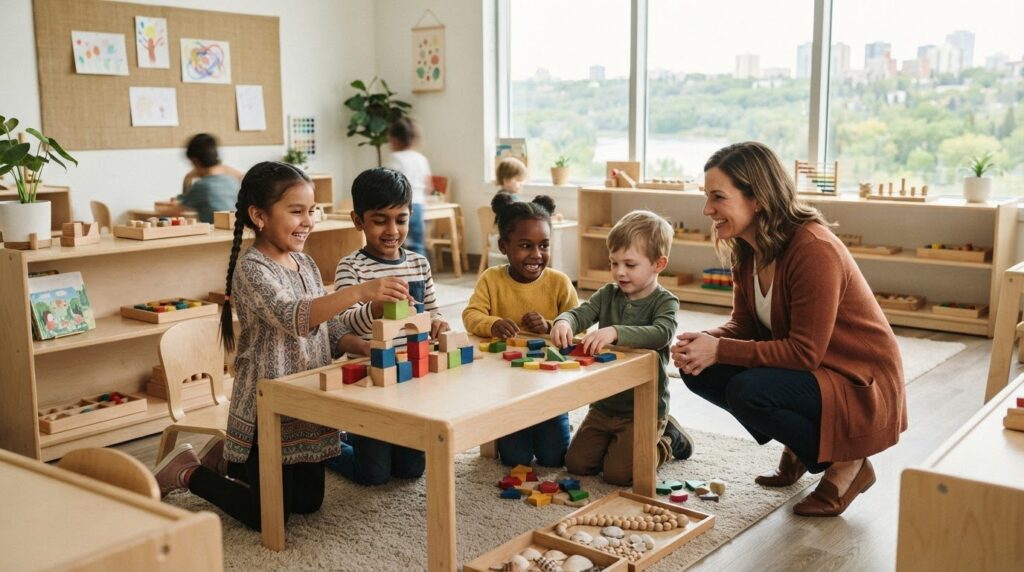
Play isn’t a break from learning; in a well-designed preschool, it’s one way children build new skills. In Edmonton, children commonly begin preschool between ages 3 and 4, with developmental readiness helping guide the timing. An academic preschool in Edmonton can combine purposeful play with structured learning, supporting children as they grow toward kindergarten.
It’s natural to wonder whether an academic program will feel too formal or put pressure on a young child. A thoughtful balance of teacher-guided activities and purposeful play can make early learning engaging while giving children room to practise social and emotional skills.
This article explains how academic and play-based preschool curricula work, which ages they serve, and how early education can benefit children. You’ll also learn what can set a private preschool apart and what to consider when choosing a program for your family.
Key Takeaways
- Look for a curriculum that connects early literacy and numeracy with purposeful play, social learning, and a predictable routine.
- Use your child’s developmental readiness, not age alone, to guide when preschool may be a good fit.
- Compare programs by how they support kindergarten readiness, observe children’s progress, and keep families informed.
- Explore age-aligned preschool and kindergarten programs to find a learning path that suits your child’s next step.
Academic and play-based preschool curriculum
Academic preschools and play-based preschools can both build early skills. In an academic preschool in Edmonton, teachers may guide literacy and numeracy through planned activities; play-based programs centre learning around children’s play. Many combine both, such as practising counting with blocks during a building activity.
Montessori-inspired teaching uses hands-on materials and child-led exploration in a prepared classroom. A teacher introduces an activity, then gives children time to practise skills at their own pace. For example, children might sort objects by size and describe their choices aloud.
A nature-based Montessori preschool can bring those activities outdoors. Children might observe leaves, compare textures, or plant seeds, connecting science vocabulary with sensory discovery. In welcoming classrooms, teachers can extend the activity with drawing, counting, or shared storytelling.
Play-based early learning is purposeful, not simply unstructured time. A predictable preschool routine can include learning, meals, rest, and play. During a pretend shop activity, children might take turns, recognize written labels, and count play food. A child’s brain grows most during the first five years, reaching approximately 90 percent of adult size by age 5.
Academic content doesn’t determine a program’s licensing status. Families can review its current licence details. In Alberta, staffing qualifications and child-to-staff ratios depend on the program’s licensed classification and the children’s ages, so consider these factors rather than relying on the word “academic.”
Each school sets its own application forms, required documents, and registration dates. Review its enrolment instructions, note the requested records and deadlines, and follow the stated process. Schedules also vary by program. Compare published timetables, including session length and attendance days, to find an option that fits your family.
Preschool age range
In Edmonton, most children begin preschool between ages 3 and 4, depending on developmental readiness. Academic preschool classes may group children by age, readiness, or both. The school-year schedule and activities vary by program, so families should consider the child’s needs alongside the calendar.
Readiness isn’t a single skill. Consider whether your child is beginning to join group activities, communicate basic needs, and manage familiar routines. For example, enjoying a short story or taking turns during play can be a starting point for practising these skills with classmates. These are useful observations, not a pass-or-fail test.
Age rules differ between preschool and Edmonton Public Schools’ Pre-Kindergarten. For Pre-Kindergarten, children must fall within the program’s age range by September 1 of the year they attend. This date is specific to that program; it shouldn’t be treated as a universal cutoff for every preschool.
To choose a suitable school year, compare your child’s birthday with the program’s age criteria, then consider how they respond to group learning. Ask how classes are organized and activities adapted for different levels of independence. Some children benefit from a gradual transition into group routines; others may feel comfortable joining structured learning sooner.
Schedules shape the preschool experience, too. Attendance may follow set class times, while session length and frequency depend on the program. Review the calendar, attendance options, and daily routine together. This helps you decide whether the school-year schedule fits your family’s routines and your child’s energy.
Which Edmonton preschools offer academic or kindergarten-readiness curricula?
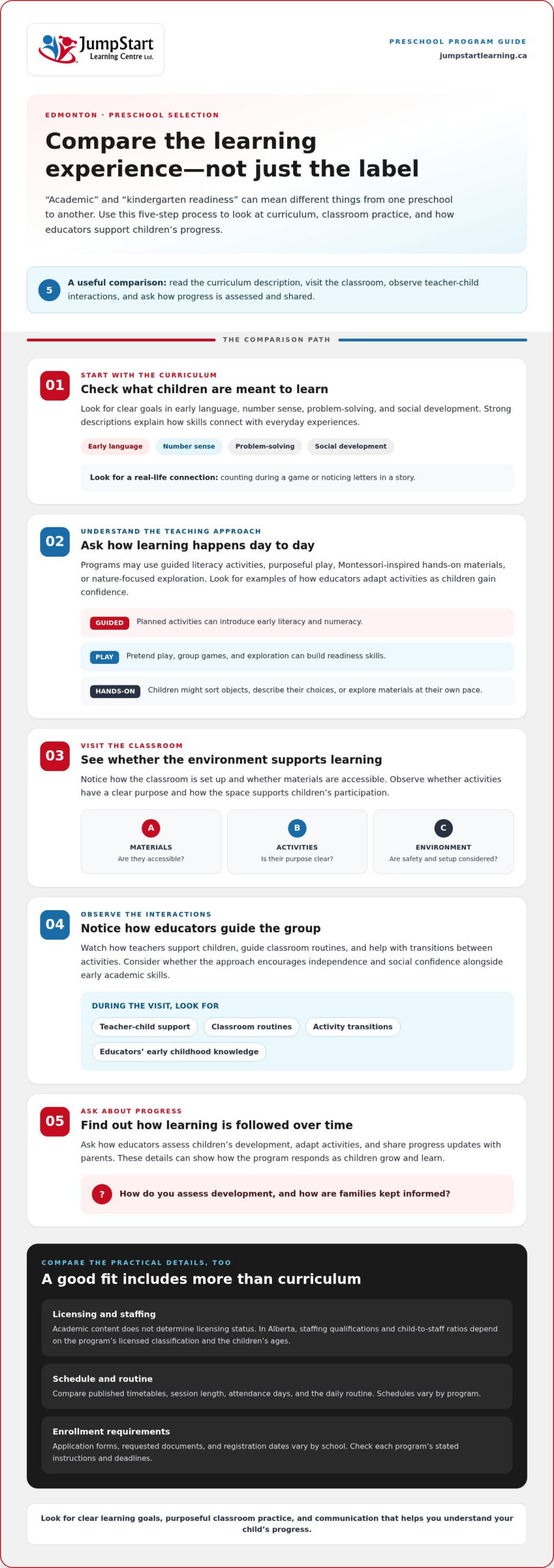
In Edmonton, compare programs by curriculum and classroom practices, not labels alone. “Academic” and “kindergarten readiness” can describe different approaches. One preschool may schedule guided literacy activities; another may build early skills through purposeful play. Look for clear examples of what children learn and how teachers support their progress.
Compare each program’s stated learning goals. Check whether it describes early language, number sense, problem-solving, and social development. A useful curriculum connects these skills with daily experiences, such as counting during a game or noticing letters in a story. Ask how activities adapt as children gain confidence.
Consider the teaching approach, too. Montessori-inspired classrooms may emphasize hands-on materials and child-directed tasks. Play-based programs can build readiness through pretend play, group games, and guided exploration. Nature-focused activities, such as sorting leaves by shape, can combine observation with vocabulary and classification.
Before deciding, use a simple comparison process: read the curriculum description, visit the classroom, and observe teacher-child interactions. Notice whether materials are accessible and activities have a clear purpose. Ask how educators assess development and share progress updates with parents. These details reveal more about a structured, welcoming learning environment than a list of subjects alone.
When comparing programs, consider educators’ early childhood knowledge, understanding of development, and ability to guide classroom routines. During a visit, notice the classroom setup, safety measures, and how teachers support transitions between activities. A kindergarten-readiness program should foster independence and social confidence alongside early academic skills. Use these observations to compare Edmonton preschool options with your child’s needs.
Jumpstart Learning Academy: Preschool Program (3 Year Olds)
Jumpstart Learning Academy offers a Preschool Program (3 Year Olds) for families considering an early, structured learning experience. Its research-based curriculum combines guided academics with purposeful play, supporting intellectual and social growth. Personalized learning plans and assessments help educators respond to each child’s progress.
As children grow, the Junior Kindergarten Program (4 Year Olds) and Kindergarten Program (5 Year Olds) provide age-aligned next steps. This progression can help families plan for learning continuity while children practise early academic skills, independence, and social confidence.
If you’re weighing preschool options, consider your child’s readiness and learning needs. Contact Jumpstart Learning Academy to discuss its structured preschool and kindergarten programs in Edmonton.
Choose a Next Step That Fits Your Child
Choosing an academic preschool in Edmonton is also a chance to notice what helps your child feel curious and capable. Consider where they’re most ready to participate, whether that means hands-on discovery, teacher-guided practice, or a blend of both. These observations can help you have a focused conversation about your child’s next stage.
Jumpstart Learning Academy offers a Preschool Program (3 Year Olds), Junior Kindergarten Program (4 Year Olds), and Kindergarten Program (5 Year Olds). Contact the academy to talk about these options and your child’s learning needs. Contact Jumpstart Learning Academy to take that next step. With a thoughtful fit, early learning can become a positive foundation for growth and discovery.
Frequently Asked Questions
Private Preschool Edmonton: What Sets It Apart?
A private preschool may offer a distinct curriculum and program structure, but “private” alone doesn’t explain a child’s daily experience. Compare learning goals, activities, and communication with families. For example, ask how a teacher supports a child who prefers to observe before joining a group. The answer can show whether the program’s approach suits your child.
What Makes a Great Preschool Edmonton Program?
A strong Edmonton preschool program makes its learning goals clear to families and connects them with children’s everyday experiences. Ask how teachers support a skill, such as listening during a story or taking turns in a game. Notice whether the explanation accounts for individual needs rather than expecting every child to participate in the same way.
What academic preschool programs are available in Edmonton?
Families looking for an academic preschool in Edmonton can explore age-aligned programs at Jumpstart Learning Academy: Preschool Program (3 Year Olds), Junior Kindergarten Program (4 Year Olds), and Kindergarten Program (5 Year Olds). The academy also offers a Pre-K Program and Literacy and Numeracy Enrichment. Compare the program focus with your child’s current learning goals when deciding where to begin.
What should parents look for when choosing an academic preschool in Edmonton?
Look for a program with a clear daily learning approach that suits your child. During a visit, notice how teachers respond when a child needs more time, changes activities, or asks for help. Ask how the school shares progress with parents and what a typical day involves. These details help you picture your child’s experience beyond the curriculum description.
