

Last Tuesday, an Edmonton parent sat at her kitchen table in Glenora, staring at a 40-page government document and wondering if she needed a law degree just to choose a preschool. It’s a common feeling for families trying to decipher the latest provincial regulations. You likely feel that same weight of responsibility, wanting to move past the anxiety of “daycare” labels to find a nurturing partner for your child’s growth. You deserve to feel the relief that comes from knowing your child is in a space where their confidence and literacy skills are the primary focus.
Licensing acts as a protective shield for Edmonton families. It establishes the mandatory baseline for health, safety, and child supervision that every facility must follow. These rules prevent children from being placed in unregulated or unsafe environments that lack proper oversight. To maintain these high standards, Alberta Children’s Services conducts at least two unannounced inspections every year at each site. These rigorous checks ensure that the evidence-based practices required by law are actually being put into action every day. It’s a structured system designed to give you peace of mind while you’re at work or school. For families in the nearby St. Albert area, you can read more about how Trinity Early Learning & OSC maintains these essential safety standards.
We believe that understanding the alberta early learning standards shouldn’t be a full-time job. This guide simplifies the 2026 updates to the ELCC Act, helping you look past basic licensing to find evidence-based markers of true quality. We’ll show you how to identify programs that use multisensory approaches to unlock your child’s hidden potential, ensuring they don’t just meet the provincial minimums but actually thrive in a structured environment.
By the end of this article, you’ll have a clear checklist for evaluating Edmonton preschools and the confidence to choose a program that prepares your child for a successful transition to Kindergarten. We’ll break down what accreditation really means in 2026 and provide a steady, guided path through the often-chaotic world of early childhood education so you can focus on the joy of your child’s achievements.
Key Takeaways
- Gain clarity on the 2026 ELCC Act updates to feel confident that your chosen Edmonton childcare centre meets the latest provincial legal requirements.
- Master the essential safety metrics, from staff-to-child ratios to ventilation standards, to ensure your child’s daily environment is both healthy and secure.
- Explore how the FLIGHT framework elevates alberta early learning standards by focusing on your child’s holistic development through play and communication.
- Use our expert school tour checklist to verify licensing and evaluate staff commitment, helping you find a nurturing partner in your child’s education.
- Learn how a “Play with Purpose” approach exceeds minimum requirements to foster the joy of achievement and unlock your child’s full potential.
Understanding Alberta’s Early Learning and Child Care (ELCC) Act
Choosing the right childcare in Edmonton often feels like a heavy weight on a parent’s shoulders. You want to know your child is safe, supported, and truly seen by their educators. The Early Learning and Child Care (ELCC) Act serves as the essential legal framework for every childcare centre in our city. It’s the foundation that ensures your child’s environment is regulated and secure. To stay informed, you can access the most recent 2026 legislative updates through the Alberta King’s Printer, which maintains the official records of these provincial laws. This transparency helps replace parental anxiety with the quiet confidence that comes from being well-informed.
Every preschool or daycare program in Edmonton that cares for more than six children must be licensed by the province. You might hear different terms used by providers, specifically “Licensed” versus “Accredited.” In the current alberta early learning standards, the province has moved toward a unified funding and quality model. While “Accreditation” was once a separate voluntary process, its core quality benchmarks are now being integrated directly into provincial licensing and grant requirements. Understanding the broader context of Education in Alberta helps parents see how these early standards create a bridge to future academic success. We believe that when the legal framework is strong, your child’s potential can truly flourish without obstacles.
The Core Purpose of Provincial Licensing
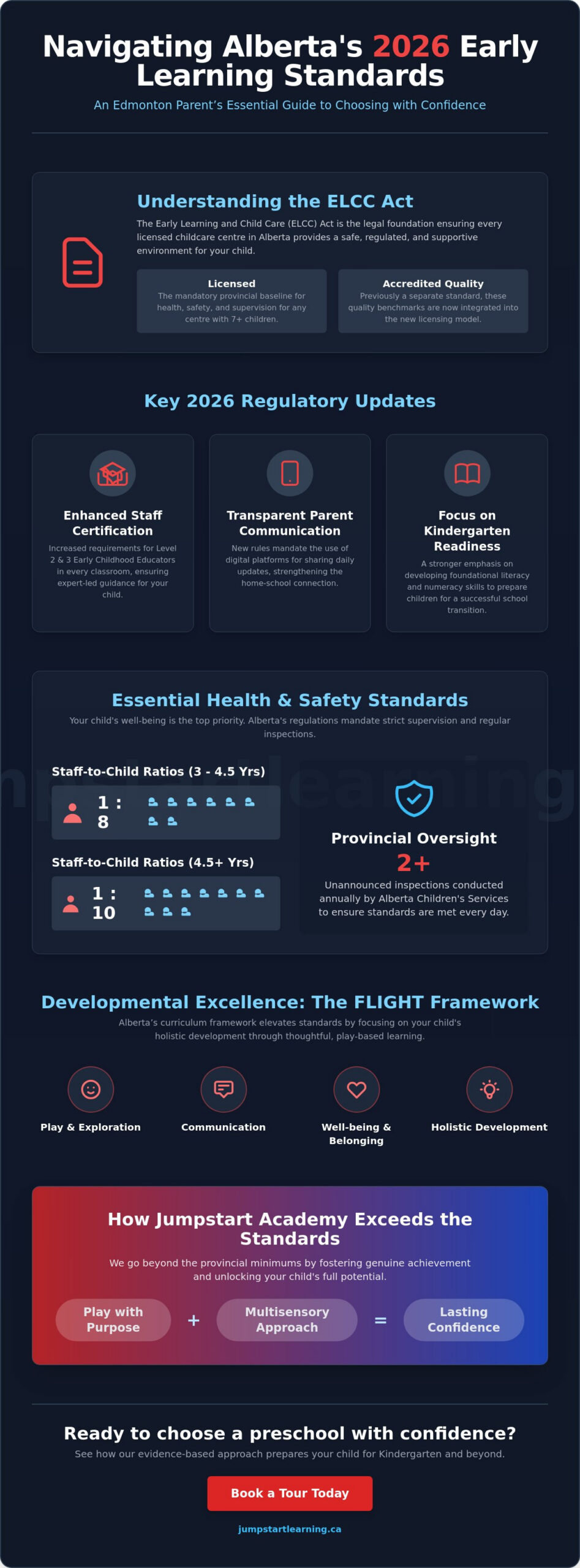
Licensing acts as a protective shield for Edmonton families. It establishes the mandatory baseline for health, safety, and child supervision that every facility must follow. These rules prevent children from being placed in unregulated or unsafe environments that lack proper oversight. To maintain these high standards, Alberta Children’s Services conducts at least two unannounced inspections every year at each site. These rigorous checks ensure that the evidence-based practices required by law are actually being put into action every day. It’s a structured system designed to give you peace of mind while you’re at work or school.
2026 Regulatory Updates for Edmonton Parents
The 2026 updates to the ELCC Regulation bring exciting changes focused on professional excellence and parent connection. One major shift involves staff certification levels; the province now requires a higher percentage of Level 2 and Level 3 Early Childhood Educators in every classroom. This ensures your child is guided by experts who understand complex developmental needs. Additionally, new requirements for digital communication mean centers must use transparent platforms to share daily updates with you. These alberta early learning standards updates aim to boost Kindergarten readiness by focusing on early literacy and numeracy. By strengthening the bond between home and school, we unlock each child’s hidden potential through a tailored, multisensory approach to growth.
Essential Health and Safety Standards for Edmonton Preschools
Choosing a preschool often feels like a high-stakes decision where safety is the non-negotiable foundation. You want to know your child is protected while they explore, learn, and grow. The alberta early learning standards provide a rigorous framework to ensure every Edmonton centre meets high benchmarks for care. These regulations aren’t just red tape; they’re the guardrails that allow children to take the risks necessary for healthy development. By 2026, these standards will continue to evolve, placing even greater emphasis on the intersection of physical safety and emotional well-being.
Staff-to-child ratios are the most vital metric for safety in any classroom. In Alberta, for children aged 3 to 4.5 years, the ratio is 1 staff member for every 8 children. For those 4.5 years and older, it shifts to 1:10. These numbers ensure that every child receives the “eyes-on” supervision and emotional support they need to feel secure. When ratios are maintained, educators can provide the multisensory, individualized attention that helps a child’s confidence bloom. Health and nutrition protocols also follow strict guidelines. All snacks provided must align with Canada’s Food Guide, ensuring children have the nutrient-dense fuel required for complex brain development. For families managing allergies, Edmonton centres must maintain clear anaphylaxis protocols, including staff training on epinephrine auto-injectors and visible, updated allergy lists. To understand the level of professional training that high-quality centres prioritize, you can check out JPF First Aid, an award-winning provider of regulated first aid courses.
Emergency preparedness is equally structured. Edmonton municipal codes require monthly fire drills and specific lockdown protocols tailored to early childhood settings. These routines turn potentially scary scenarios into calm, practiced responses. Educators often integrate these safety concepts into the FLIGHT Framework, which guides them in creating environments that are both secure and intellectually stimulating. If you’re looking for a program that exceeds these safety benchmarks while nurturing your child’s literacy, you can explore our enrollment options to see how we put these standards into practice.
Staff Qualification and Certification Levels
Alberta recognizes three distinct levels of Early Childhood Educator (ECE) certification. Level 1 involves a foundational 45-hour course. Level 2 requires a one-year diploma, while Level 3 represents a two-year diploma or a full degree in Child Development. Jumpstart prioritizes Level 3 Child Care Administrator certification for lead educators because advanced training is a proven catalyst for unlocking a child’s hidden potential. Beyond education, every staff member must clear a criminal record check with a vulnerable sector screening every 3 years to ensure the highest level of integrity within the school community.
Indoor and Outdoor Play Space Regulations
Physical space is governed by the 3.5 square metre rule to prevent overcrowding and reduce student stress. According to the ELCC Regulation, unobstructed floor space is defined as the floor area in a licensed facility that is available for children’s use and is not occupied by permanent fixtures or furniture that cannot be easily moved. Outdoor zones are designed for “play with purpose,” utilizing equipment that meets CSA safety standards. These areas are essential for building the gross motor skills that eventually support fine motor tasks like writing and drawing.
Developmental Outcomes: The FLIGHT Framework Explained
In Alberta, early childhood education has evolved far beyond the outdated concept of “babysitting.” The province utilizes a research-based curriculum framework called FLIGHT. This framework sets the alberta early learning standards by focusing on how children learn through relationships and purposeful play. It provides a roadmap for educators to move from simple supervision to intentional instruction that honors each child’s unique pace and potential. It’s a shift that recognizes children as mighty learners and citizens of today, not just students of tomorrow.
The framework is built around four core “Curriculum Meaning Making” goals. These aren’t just checkboxes; they’re the foundation of a child’s future success. Educators focus on the following pillars:
- Well-being: Prioritizing physical health and emotional safety.
- Play and Playfulness: Using imagination to solve problems and spark creativity.
- Communication and Literacies: Building the tools to express thoughts and understand others.
- Diversity and Social Responsibility: Fostering a sense of community and respect for different perspectives.
By prioritizing these goals, preschools help children develop “dispositions to learn.” This means fostering qualities like curiosity, resilience, and persistence. When a child is curious, they don’t just memorize facts; they seek to understand the world around them. This internal drive is what carries them through academic challenges later in life. It’s about building a sturdy emotional and cognitive foundation that makes future learning feel like a joy rather than a chore.
Literacy and Numeracy in the Alberta Framework
Many parents worry that play-based learning means their child might fall behind in academics. The alberta early learning standards actually integrate literacy and numeracy through meaningful, multisensory experiences rather than boring rote memorization. Instead of repetitive worksheets, children might count wooden blocks during building time or trace letters in sand trays. This approach respects how young brains develop. You can explore our literacy and numeracy enrichment programs in Edmonton to see how these communication goals translate into real-world skills. Research indicates that children who engage in multisensory learning retain information more effectively than those who learn through passive instruction. If you’re weighing the merits of different approaches, our in-depth guide on play-based learning versus structured academics in Edmonton offers a clear, evidence-based comparison to help you make the most informed choice for your child.
Social-Emotional Growth and Citizenship
Preschool is often a child’s first experience as a citizen in a community outside their home. Alberta’s framework emphasizes social responsibility and a child’s sense of belonging and identity. It involves helping children understand their role within a group. This transition is vital for Kindergarten readiness. By learning to regulate their emotions and navigate social conflicts in a supportive environment, children gain the confidence they need for the school years ahead. Educators use everyday moments to teach empathy and problem-solving, turning a shared toy dispute into a lesson in negotiation and mutual respect.
Evaluating Quality: An Edmonton Parent’s School Tour Checklist
Finding the right childcare or preschool environment can feel like a heavy responsibility. You aren’t just looking for a safe place to drop off your child; you’re looking for a partner in their development. Before you step foot in a facility, visit the Alberta Child Care Lookup website. This tool allows you to verify a centre’s current license and review their inspection history. Look for programs in Edmonton that have maintained a clean record with zero critical violations for at least 24 months.
During your tour, don’t be afraid to ask direct questions about the educators. High staff turnover is a common challenge, but stable programs usually keep their annual turnover rate below 20%. Ask how the facility supports professional development regarding the alberta early learning standards. You want to hear that teachers are actively trained in modern pedagogical approaches rather than just relying on outdated methods.
Observe the “Play with Purpose” philosophy. In a high-quality classroom, play isn’t aimless. You should see teachers acting as co-learners, perhaps sitting on the floor to help a child balance a wooden block tower while discussing concepts of gravity or symmetry. Red flags include a heavy reliance on worksheets, muted or “shushing” environments, or teachers who spend most of their time standing in corners supervising rather than engaging. These signs often indicate a program is barely meeting the minimum provincial requirements. Parents who want a deeper understanding of how play-based learning compares to structured academics for Edmonton children in 2026 will find the research behind this approach invaluable when evaluating programs. For a comprehensive overview of the key qualities that separate exceptional programs from average ones, our guide on what to look for in a preschool in Edmonton for 2026 provides a detailed, parent-focused framework to help you ask the right questions on every tour.
Assessing Classroom Environment and Engagement
Walk through the rooms and look for multisensory learning stations. A high-quality space features evidence-based materials like tactile sand trays, diverse libraries, and open-ended building tools. These environments help children as they are preparing for kindergarten in Edmonton. Use the “smell and sound” test. The air should smell fresh, not masked by heavy fragrances or bleach. The sound should be a “productive hum” of busy children, not chaotic noise or total silence.
Transparency and Parent Communication
The alberta early learning standards highlight the importance of the relationship between the educator and the family. Ask to see a sample of a daily report. While basic provincial standards require reporting on health and safety, Jumpstart uses personalized learning plans to exceed these expectations. We focus on specific milestones in literacy and numeracy to ensure you’re never in the dark about your child’s growth. A professional registration process that includes a detailed intake interview is a sign of a program that values individual student needs. To understand exactly what that process looks like at Jumpstart, our Jumpstart Academy registration process step-by-step guide for Edmonton parents walks you through each stage, from initial inquiry to securing your child’s confirmed spot for September 2026. Families who want to go further in building that home-school connection can explore parental involvement preschool strategies for Edmonton families to discover practical ways to stay actively engaged in their child’s learning journey.
Ready to see the difference an evidence-based, nurturing environment can make for your child? Book a consultation with Jumpstart Learning today to unlock your child’s hidden potential.
How Jumpstart Academy Exceeds Alberta’s Early Learning Standards
Meeting the alberta early learning standards is a baseline, but your child deserves a foundation that reaches higher. Many programs focus on basic supervision, yet we believe these early years are the most critical window for cognitive development. We’ve evolved the traditional play-based model into what we call “Play with Purpose.” This isn’t just about keeping children busy; it’s a deliberate pedagogical approach where every activity is intentionally designed to build specific cognitive or social skills. While a standard program might offer blocks for free play, our educators use those same blocks to teach spatial awareness, early physics, and collaborative problem-solving.
One way we ensure this level of quality is through our commitment to staffing. Alberta’s provincial regulations for 2024 and 2025 typically require a 1:8 ratio for children aged three to four and a half. At Jumpstart Academy, we often exceed these provincial minimums. Smaller groups mean our teachers don’t just supervise; they mentor. This increased individual attention allows us to identify a child’s specific struggles or strengths early, ensuring no one falls behind before they even reach Grade 1. It’s the difference between a child being a face in the crowd and a child being truly seen and supported.
Our curriculum focuses heavily on evidence-based literacy and numeracy enrichment instruction. We recognize that early success in these areas is the greatest predictor of long-term academic achievement. By using multisensory techniques, we engage sight, sound, and touch to help children grasp complex concepts. This approach bridges the gap between the broad goals of the provincial standards and the practical skills needed for success in Edmonton’s competitive school environment. Parents looking to give their child an additional advantage can explore our dedicated kindergarten readiness programs in Edmonton to see how we build on these foundations with targeted, structured preparation.
Structured Academics within a Nurturing Framework
We’ve found a way to balance the warmth of the provincial FLIGHT framework with the scientific rigor of the Orton-Gillingham approach for literacy. This combination ensures that while children feel safe and nurtured, they’re also gaining the phonetic awareness and decoding skills usually reserved for older students. You can learn more about how we balance these elements in our guide on Structured Academics Preschool in Edmonton: Myth vs. Reality. The result is a group of children who enter Edmonton schools with high confidence and the academic potential to lead their peers.
Join the Jumpstart Family in Edmonton
If you’re a parent who wants more than just “licensed” care, we invite you to see the Jumpstart difference firsthand. We operate multiple locations across Edmonton, offering both our core preschool programs and seasonal summer camps designed to prevent the “summer slide” in learning. We understand the anxiety that comes with choosing the right start for your child, and we’re here to provide the relief of a proven, structured path forward. Don’t wait for the fall rush to secure your place in our community. Families ready to take the next step can follow our Jumpstart Academy registration process guide to understand fees, grant applications, and how to avoid the waitlist before the 2026 school year fills up. Secure your child’s spot and enroll today to start their journey toward genuine achievement.
Give Your Child the Advantage They Deserve
Navigating the 2026 educational landscape doesn’t have to feel like a burden for your family. By understanding the ELCC Act and the FLIGHT framework; you’re already giving your child a significant head start. These alberta early learning standards ensure every preschool provides a safe, high quality environment; yet we know you want more than just the minimum legal requirements. You’re looking for a partner who transforms early learning struggles into lifelong confidence. At Jumpstart Learning Academy; we’ve built our reputation on exceeding these provincial benchmarks every single day. Our 100% licensed and accredited programs utilize a research based Play with Purpose curriculum designed to unlock every child’s unique potential. With multiple locations across Edmonton staffed by expert Level 3 educators; we provide the professional rigor and warm, nurturing care your family deserves. We’re here to turn your uncertainty into the joy of watching your child achieve their first major milestones with ease. You don’t have to navigate this journey alone; we’re ready to support your child’s growth every step of the way.
Unlock your child’s potential, Enroll at Jumpstart Learning Academy today
Frequently Asked Questions
What is the difference between licensed and unlicensed childcare in Alberta?
Licensed childcare programs must meet rigorous provincial safety, health, and programming requirements, while unlicensed providers aren’t monitored by Alberta Child Care Licensing. Choosing a licensed centre ensures your child benefits from the alberta early learning standards, which provide a structured and safe foundation for growth. This oversight gives you the relief of knowing your child is in a space that prioritizes both physical safety and evidence-based development.
How do I find the inspection reports for an Edmonton preschool?
You can access detailed inspection reports through the Alberta Child Care Lookup tool on the provincial government website. This public database allows you to see any recent non-compliance issues and the corrective actions taken by the centre. Reviewing these reports helps you move past the anxiety of the unknown and provides a clear, factual picture of a facility’s commitment to quality care.
What are the legal staff-to-child ratios for 3 and 4-year-olds in Alberta?
For children aged 3 to 4.5 years, Alberta law requires a minimum ratio of 1 staff member for every 8 children. Once a child reaches 4.5 years, the ratio shifts to 1 educator for every 10 children. These specific numbers are designed to ensure your child receives the individual, tailored attention they need to build confidence and succeed in a group setting.
What is the FLIGHT framework and why does it matter for my child?
FLIGHT is Alberta’s curriculum framework that guides educators in creating play-based, multisensory learning experiences for young children. It treats your child as a “mighty learner” with immense potential, focusing on holistic growth rather than just rote memorization. By following this framework, educators ensure that the alberta early learning standards are met through meaningful interactions that spark genuine joy and curiosity.
Is kindergarten mandatory in Alberta, and how does preschool help?
Kindergarten isn’t mandatory in Alberta, but attending a high-quality preschool provides a vital bridge to the structured environment of Grade 1. Preschool programs focus on early literacy and numeracy skills, helping to ease the transition and reduce the struggle many children feel when first entering the school system. This early exposure builds the foundational skills and social confidence your child needs for a smooth educational journey. Families who want to go further can explore specialized kindergarten readiness programs in Edmonton that provide targeted preparation for the academic and social demands of Grade 1.
What should I do if I suspect an Edmonton centre is not meeting provincial standards?
You should immediately contact the Alberta Child Care Licensing Office at 1-844-644-5135 to report your concerns. It’s your right as a parent to advocate for your child’s well-being and ensure their environment is safe and supportive. Licensed consultants will investigate the matter, providing a structured path to resolving issues and maintaining the high standards our community expects.
How much does a high-quality, licensed preschool in Edmonton typically cost in 2026?
By 2026, many parents in Edmonton will see fees average approximately C$10 per day due to the Canada-Wide Early Learning and Child Care Agreement. While some specialized programs may have higher rates, the provincial affordability grant is applied directly to licensed centres to lower costs for all families. This initiative is a significant step in making expert-led early education accessible and affordable for every household.
Does Alberta offer subsidies for licensed preschool programs?
Yes, Alberta offers a Child Care Subsidy for families with a total household income under C$180,000 per year. This financial support is designed to unlock your child’s potential by removing the barrier of high tuition costs. You can apply through the Alberta Supports portal, which provides a clear and methodical way to determine your eligibility and secure funding for your child’s education.
