

What if the secret to your child thriving in an Edmonton Grade 1 classroom isn’t found in a stack of flashcards, but in a pile of building blocks? Many parents feel a deep sense of anxiety as the 2026 school year approaches, wondering if their child is falling behind before they’ve even started. You want to see them succeed, yet the conflicting advice about play-based learning versus structured academics often leads to more confusion than clarity. It’s natural to worry that without enough “real work,” your child might struggle with the transition to a formal school environment.
We understand that you want a clear, evidence-based path for your child’s development. This guide will demonstrate why a play-centered approach is the gold standard for building the multisensory skills needed for long-term academic achievement. You’ll discover how this philosophy prepares children for the specific demands of Edmonton schools and gain a practical framework to evaluate local preschool options. We’ll break down the differences between these educational models so you can make a choice that unlocks your child’s full potential with confidence.
Key Takeaways
- Understand the “Play with Purpose” philosophy and how it shifts the focus from simple activity to intentional, teacher-supported exploration.
- Discover why play-based learning is the most effective way to ensure long-term retention and prevent your child from falling behind in Grade 1.
- Gain insights into the science of neuroplasticity and how the prefrontal cortex develops most effectively through hands-on discovery.
- Learn exactly what to look for when touring Edmonton preschools, from physical environments to the quality of teacher-child interactions.
- See how a nurturing blend of structured literacy and playful exploration can build the confidence your child needs to thrive in a modern classroom.
What is Play-Based Learning? Defining the “Play with Purpose” Philosophy
If you’ve noticed your child struggling to focus on traditional worksheets or feeling frustrated by flashcards, you aren’t alone. Many Edmonton families feel this same pressure as they prepare their children for school. What is Play-Based Learning? At its core, it’s a research-backed pedagogical approach where play serves as the primary context for growth. It isn’t just about letting children run around. It’s a sophisticated method where educators use a child’s natural instincts to build foundational literacy and numeracy skills through hands-on experience.
There’s a critical difference between “free play” and “guided play” that parents should understand. Free play is unstructured exploration. Guided play is intentional. In guided play, a teacher supports a child’s curiosity to reach specific milestones. By 2026, the educational environment in Alberta will shift even further toward these inquiry-based models. This “Play with Purpose” philosophy bridges the gap between fun and rigorous academics. It ensures children don’t just memorize facts but actually understand the concepts behind them. This approach helps lower parental anxiety by replacing academic struggle with the joy of discovery.
The Five Pillars of High-Quality Play
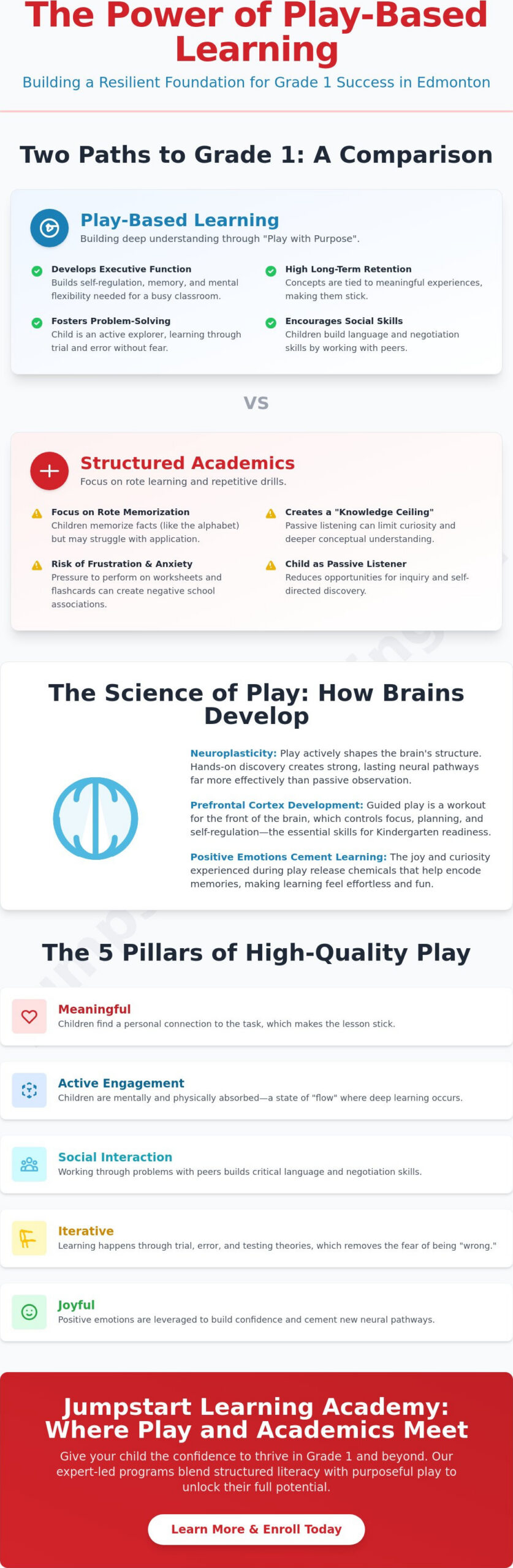
To be effective, play-based learning must meet five specific criteria that transform a simple game into a powerful teaching tool. These pillars are essential for unlocking a child’s hidden potential:
- Meaningful: The child finds a personal connection to the task, which makes the lesson stick long-term.
- Active Engagement: You’ll see your child in a state of “flow,” where they’re deeply focused on hands-on tasks.
- Social Interaction: Children build language and negotiation skills by working through problems with their peers.
- Iterative: It involves testing theories and learning through trial and error, removing the fear of being “wrong.”
- Joyful: We leverage positive emotions to cement new neural pathways in the developing brain.
Why Edmonton Parents are Moving Away from “Old School” Rote Learning
The days of forcing three-year-olds to sit through repetitive drills are fading. Data suggests that rote learning for children under five often creates a “knowledge ceiling” rather than a foundation for growth. In Edmonton, more families are choosing models that align with the Alberta Early Learning Standards. These standards prioritize “responsive curiosity” over passive listening. When we follow a child’s lead, we empower them to become lifelong learners. Instead of forcing a child to sit still, we embrace play-based learning to build the confidence they need for success in 2026 and beyond. If you’re ready to see how this tailored approach can help your child thrive, you can enroll in our programs today.
Play-Based vs. Structured Academics: Which Prepares Edmonton Kids Best?
Many Edmonton parents feel a pang of anxiety when they see their four-year-old stacking blocks instead of tracing letters. The fear that a child will be “behind” by the time they reach Grade 1 is the most common concern we hear at Jumpstart Learning. It is a valid feeling. You want your child to walk into their first elementary classroom with the confidence to succeed. However, current educational research suggests that play-based learning creates a more resilient academic foundation than rigid, repetitive memorization. While a child might memorize the alphabet through a worksheet, they often struggle to apply those letters in a real-world context. Concepts learned through active exploration stay with a child because they are tied to meaningful experiences.
This approach specifically targets the development of “executive function.” This includes the self-regulation, working memory, and mental flexibility required to thrive in a busy classroom of 20 to 25 students. When children lead their own play, they practice focusing on tasks and ignoring distractions. These are the exact skills Edmonton teachers look for during the first weeks of the school year. Beyond academics, students who learn through play enter the school system with a significant social-emotional edge. They know how to collaborate, negotiate, and solve problems without constant adult intervention.
The Literacy and Numeracy Myth
There is a common misconception that math only happens at a desk. In reality, a child running a pretend “grocery store” in their classroom is practicing complex subtraction and addition. They are weighing wooden produce, counting Canadian coins, and organizing inventory by size or type. This hands-on experience builds a deeper understanding of numeracy than a standard worksheet ever could. We see the same results with “pre-literacy” skills. When children engage in dramatic play or group storytelling, they are learning narrative structure and expanding their vocabulary. You can see how these activities align with the Preschool Curriculum in Edmonton to ensure your child meets every developmental milestone for 2026.
Long-Term Success in the Alberta School System
Research into the “fade-out” effect shows that children in high-pressure academic preschools often lose their initial lead by Grade 3. By contrast, students who prioritize play-based learning tend to excel in later years because they have developed independent problem-solving skills. Edmonton Public and Catholic schools increasingly value students who can think critically rather than those who simply follow instructions. This is the secret to future STEM success. Building a bridge out of recycled materials involves physics and engineering principles that spark a lifelong interest in science. If you’re noticing your child struggle with these early transitions, you can explore our tailored support options to help them regain their footing. This balanced approach ensures they don’t just survive the transition to Grade 1; they have the tools to lead.
The Science of Play: How Brain Development Drives Kindergarten Readiness
You might feel a flicker of anxiety when you see your child building a block tower instead of practicing flashcards. It is a common concern for Edmonton parents preparing for the 2026 school year. However, those blocks are actually building blocks for the brain. Between ages 3 and 5, your child’s brain is in a state of rapid neuroplasticity. According to Harvard University’s Center on the Developing Child, the brain forms 1 million new neural connections every second during these years. This window is the most critical time for play-based learning to take root because it maps the neural pathways used for a lifetime of thinking.
The prefrontal cortex acts as the brain’s “command center,” managing focus, problem-solving, and emotional control. When children explore freely, they strengthen these executive functions more effectively than through rote memorization. Science also shows that play regulates cortisol levels. High stress creates a biological barrier to learning; it literally blocks the hippocampus from processing new information. A joyful, playful environment keeps cortisol low, which ensures the brain’s “learning gates” stay wide open. Your child isn’t just playing; their brain is working harder than it ever will in a traditional, sedentary lecture setting.
Unlocking Potential Through Multisensory Exploration
Children learn best when they engage their whole bodies. In a vibrant classroom, this looks like feeling the texture of kinetic sand while tracing letters or hearing the rhythm of a song while counting. Multisensory learning is the integration of three or more senses to strengthen memory. This approach is a cornerstone of success for children with diverse learning needs, providing multiple “hooks” for information to stick. By moving beyond just sight and sound, we ensure every child finds a path to understanding that feels natural and empowering.
Building the “Soft Skills” That Are Actually Hard Skills
We often call these “soft skills,” but they are the essential foundations for academic achievement and future career success. Play-based learning allows children to practice these skills in a low-stakes environment:
- Resilience: When a wooden bridge collapses, a child learns to analyze the structural failure and try again without the fear of a “wrong” grade.
- Empathy and Collaboration: Navigating a shared play kitchen requires complex social negotiation and the ability to understand a peer’s perspective.
- Self-Confidence: Self-directed discovery builds a robust “I can do it” attitude. This internal drive is what carries a student through the challenges of Grade 1 and beyond.
If you are ready to see how a tailored, supportive environment can unlock your child’s hidden potential, you can view our enrollment options here to begin their journey.
How to Evaluate an Edmonton Preschool’s Play Philosophy
Selecting the right environment for your child is a significant milestone. It’s about finding a space where their natural curiosity is met with expert guidance. When choosing the best preschool in Edmonton, you need to look beyond the surface level of tidy classrooms and bright posters. The heart of a high-quality program lies in how they implement play-based learning. You want to see “open-ended” materials rather than “closed” toys. Closed toys, like plastic electronic gadgets, usually have one specific purpose. Open-ended materials, such as wooden blocks, water tables, and loose parts, invite a child to lead the discovery. These tools require children to use their imagination to solve problems; they turn a simple plank into a bridge or a spaceship.
It’s also vital to distinguish between “chaotic play” and “intentional play.” Chaos happens when there is no structure or adult interaction. Intentional play is a sophisticated educational strategy. In these settings, teachers act as facilitators. They observe your child’s interests and “scaffold” the experience. If a group of children is interested in local Edmonton wildlife, a skilled teacher might add bird feathers and magnifying glasses to the sensory bin. This transforms a simple activity into a scientific exploration. This balance ensures your child is challenged without feeling the pressure of a rigid academic drill.
Red Flags in Early Learning Centres
Be cautious of centres that rely heavily on screens or passive entertainment. Digital tablets shouldn’t replace tactile experiences like finger painting or building. Another red flag is a “one-size-fits-all” curriculum. If every child is expected to produce the exact same craft at 10:00 AM, the school may be prioritizing adult convenience over individual growth. Additionally, look at the outdoor schedule. According to the 2024 ParticipACTION Report Card, physical movement is essential for cognitive function. A program that lacks daily outdoor time or vigorous physical play is missing a key component of healthy development.
To complement this focus on physical activity, you can explore Summer Camps from Minisport HK, which provides structured multi-sport programming to help young children develop fundamental motor skills.
Questions for Your Edmonton School Tour
Preparation is the best way to ease parental anxiety during a tour. Start by asking, “How do you incorporate literacy into daily play?” A strong program will point to storytelling, rhyming games, and print-rich environments rather than just worksheets. Ask about the balance between child-led and teacher-guided activities. You want a school that respects a child’s autonomy while providing expert mentorship. Finally, ask how they track a child’s progress. Look for schools that use portfolios or narrative observations to document growth in confidence and social skills. For a deeper look at preparing for the next step, see our guide on Kindergarten Readiness Programs in Edmonton.
Jumpstart Learning Academy: Where Play and Academics Meet in Edmonton
Choosing between a nurturing environment and a rigorous academic start often feels like an impossible choice for Edmonton parents. You want your child to enjoy their early years, yet you worry about them falling behind before they even reach grade one. Jumpstart Learning Academy eliminates this dilemma through our “Play with Purpose” model. We’ve designed a space where the joy of play-based learning and the precision of structured academics coexist perfectly. This isn’t just about keeping children busy; it’s about using their natural curiosity to build a rock-solid educational foundation.
Our approach weaves structured literacy and numeracy directly into the fabric of a child’s day. Instead of dry worksheets, we use multisensory activities that engage a child’s sight, hearing, and touch. This method transforms complex concepts into reachable goals. We recognize that every child develops at a different pace, which is why we create personalized learning plans for every student. These plans ensure that your child is consistently challenged at their specific level, preventing the frustration of struggle and replaced it with the pride of achievement. As we look toward 2026, our commitment remains focused on preparing Edmonton students for both academic excellence and social confidence.
Our Research-Based Curriculum
The Jumpstart curriculum is built on a foundation of evidence-based instruction and child-led discovery. We don’t leave learning to chance. Our experienced Edmonton educators use their expertise to guide children through a curriculum that balances exploration with intentional teaching. For 3, 4, and 5-year-olds, this means developing the specific pre-literacy and social skills required by local kindergarten programs. We focus on the “whole child,” ensuring they have the emotional resilience and the cognitive tools to succeed in any classroom setting.
- Multisensory Literacy: Using movement and touch to master letter sounds and blending.
- Numeracy Through Play: Building mathematical thinking through hands-on games and patterns.
- Social Mastery: Encouraging collaborative problem-solving to build classroom confidence.
Enroll Your Child for 2026 Success
The transition to formal schooling doesn’t have to be a source of anxiety for your family. We invite you to visit our Edmonton locations to see our “Play with Purpose” model in action. Watching our students engage with play-based learning reveals how naturally children soak up knowledge when they’re supported by the right mentors. We’ve streamlined our enrollment process to make it easy for busy parents to take the first step toward their child’s future. Our team is ready to act as your partner and advocate throughout this journey. Unlocking your child’s hidden potential starts with the right foundation.
Empowering Your Child’s Future for 2026 and Beyond
Choosing the right educational path feels like a significant responsibility, but the evidence is clear. Research indicates that play-based learning fosters the essential neural connections required for long-term academic success and kindergarten readiness. By 2026, Edmonton schools will increasingly value the social-emotional skills and cognitive flexibility that our “Play with Purpose” philosophy develops. At Jumpstart Learning Academy, we’ve designed a research-based curriculum that transforms every interaction into a growth opportunity. As a Licensed Early Learning Centre in Alberta with multiple convenient Edmonton locations, we provide a safe, nurturing space where your child’s hidden potential is unlocked through multisensory engagement.
You don’t have to navigate these early years alone. Our team acts as a dedicated advocate for your family, ensuring your child builds the quiet confidence needed to thrive in any classroom setting. We bridge the gap between joyful exploration and scientific rigor, giving you the relief of knowing your child is exactly where they need to be. Let’s work together to turn parental anxiety into the joy of achievement.
Secure your child’s spot for 2026; Enroll at Jumpstart Learning Academy today!
We look forward to welcoming your family into our community and watching your little learner soar.
Frequently Asked Questions
Is play-based learning just “free play” all day?
No, play-based learning is a structured pedagogical approach where educators intentionally design environments to meet specific developmental milestones. In Edmonton, programs following the Flight: Alberta’s Early Learning and Care Framework ensure that play is purposeful rather than aimless. Research from the University of Lethbridge indicates that guided play, where a teacher scaffolds the experience, leads to higher levels of cognitive engagement. Your child isn’t just playing; they’re solving complex problems through curated, multisensory activities.
Will my child learn to read and write in a play-based program?
Yes, children develop essential literacy skills through immersive experiences that build a foundation for formal reading and writing. Instead of repetitive worksheets, a child might practice letter sounds by “writing” in sand or identifying signs in a pretend grocery store. This evidence-based approach aligns with the 2023 Alberta English Language Arts and Literature curriculum, which emphasizes phonological awareness. By the time they reach Grade 1, they’ve developed the confidence and pre-reading skills necessary for academic success.
How does play-based learning prepare a child for the structure of Grade 1?
Play-based learning prepares children for Grade 1 by focusing on executive function skills like self-regulation, following multi-step instructions, and social collaboration. A 2022 study published in the Canadian Journal of Education found that students with strong social-emotional foundations transition 15% more effectively into formal schooling. They learn how to manage transitions and work with peers. These soft skills are the vital bedrock that allows them to sit and focus during more structured lessons later on.
Can play-based learning help children with shorter attention spans?
Yes, play-based learning is particularly effective for children with shorter attention spans because it allows for movement and high-interest engagement. When a child is deeply interested in a “project,” such as building a bridge for toy cars, their focus naturally extends. Educators use these moments to weave in numeracy and physics. This tailored approach reduces the frustration often found in traditional settings, helping the 1 in 5 children who struggle with stationary, lecture-style instruction to stay on task.
What does a typical day look like in an Edmonton play-based preschool?
A typical day involves a balanced mix of “invitations to play,” small group circles, and outdoor exploration. In a standard 2.5-hour Edmonton program, you’ll see 45 minutes of child-led exploration followed by a 20-minute snack time that focuses on social conversation. Teachers act as facilitators, moving between stations to ask open-ended questions. This structure provides the predictability children need to feel safe while offering the freedom to unlock their hidden potential through discovery and active experimentation.
Is play-based learning suitable for children who are already academically advanced?
Play-based learning is ideal for advanced learners because it offers “low floor, high ceiling” activities that can be infinitely adapted. If a child already knows their alphabet, an educator might encourage them to write a “menu” for the dramatic play area or research a complex topic like biodiversity. This prevents the boredom often associated with rigid curriculums. It ensures every student remains challenged at their individual level, fostering a lifelong love of learning rather than just rote memorization.
How do teachers assess progress if there are no tests or worksheets?
Teachers assess progress through detailed pedagogical documentation, which includes observations, photos, and portfolios of a child’s work. In Alberta, educators look for specific indicators of growth defined by the 2024 provincial developmental benchmarks. They track how a child solves a conflict or uses new vocabulary during a building project. This provides a more comprehensive view of a child’s abilities than a single test score, allowing for a truly tailored educational journey that celebrates individual achievement.
