

What if the blocks your child stacks this afternoon could be the secret to their success in Alberta’s kindergarten classrooms next year? You likely agree that every child deserves a head start, yet the pressure to choose the right path can feel overwhelming when generic ideas lack a clear purpose. It is natural to worry about whether your child is meeting literacy or numeracy benchmarks or if they are falling behind their peers. By focusing on intentional preschool enrichment activities, you can transform these early years into a powerful, evidence-based foundation for learning.
This guide will show you how to bridge the gap between simple curiosity and academic readiness through purposeful play that yields real results. We will explore actionable skill-building ideas and provide a clear look at Alberta’s 2026 educational expectations. You will gain the confidence to lead your child toward their full potential, ensuring they enter the classroom not just prepared, but truly empowered to succeed. From multisensory techniques to the relief of a structured path, you’ll discover how to replace uncertainty with the joy of achievement.
Key Takeaways
- Understand the difference between passive childcare and “play with purpose” where intentional interactions spark your child’s natural curiosity.
- Identify the four essential pillars of science, literacy, numeracy, and the arts that build a foundation for your child’s academic confidence.
- Gain access to a curated list of preschool enrichment activities that use multisensory techniques to bridge the gap between play and kindergarten readiness.
- Learn how professional assessments and the guidance of an expert mentor can pinpoint your child’s unique learning needs and unlock their hidden potential.
- Discover why tailored, evidence-based programs in Edmonton provide the relief and results families need to navigate the transition to school with ease.
What are Preschool Enrichment Activities? Beyond the Standard Daycare Routine
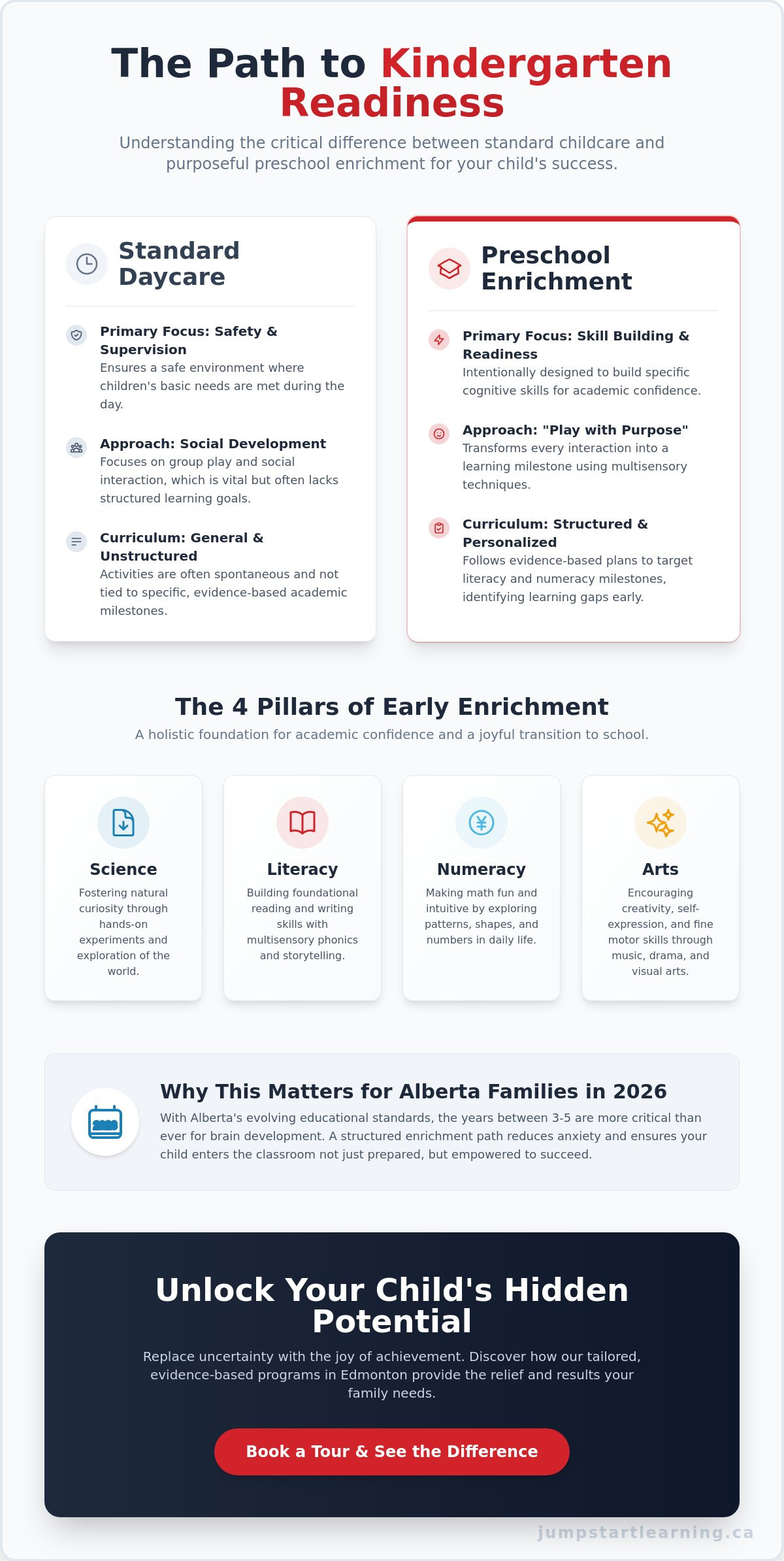
Many parents find themselves at a crossroads when their child turns three. You might notice your child is eager for more than just a safe place to spend the day; they are ready to absorb the world around them. While standard childcare focuses on safety and social supervision, preschool enrichment activities are intentional, research-based experiences designed to spark curiosity and build specific cognitive skills. These activities aren’t just about keeping little hands busy. They represent a “play with purpose” philosophy that transforms every interaction into a learning milestone.
Enrichment targets the hidden potential within every child by using multisensory engagement. This means children aren’t just listening to a story; they are feeling the textures of props, moving their bodies to mimic characters, and connecting sounds to letters in a way that sticks. It’s a method that moves away from the frustration of academic struggle before it even begins, replacing it with the joy of early achievement. By engaging multiple senses, we ensure that foundational concepts in literacy and numeracy become second nature.
The Difference Between Daycare and Enrichment
Standard care is a vital service for many families, but it often lacks the structured academic focus required for modern school readiness. While daycare ensures your child is supervised, enrichment focuses on specific literacy and numeracy milestones through personalized learning plans. This approach treats every child as an individual with unique strengths and identifies learning gaps before they become obstacles. Learning through play is the cornerstone of this philosophy, ensuring that social and cognitive development happen simultaneously. If you’re weighing your options, understanding the key differences between a preschool vs play-based program Edmonton families consider can help you make the most informed choice for your child. Enrichment serves as a vital catalyst for kindergarten readiness by ensuring no child enters the classroom feeling behind.
Why 2026 is the Year of Purposeful Play
The educational environment in Alberta is changing rapidly. As of April 1, 2026, the province has implemented a 2% inflationary increase to Schedule A fees for eligible programs, reflecting a commitment to maintaining high-quality early education standards. This shift highlights a growing recognition that the years between ages three and five are the most critical for brain development. For parents, choosing a program with a structured path reduces the anxiety of the unknown. You don’t have to guess if your child is ready for school; you can see their progress through clear, actionable outcomes. If you’re ready to see this progress firsthand, you can explore our enrollment options to find the right fit for your family. By choosing purposeful play, you are providing a steady, optimistic start to your child’s lifelong educational journey.
The 4 Pillars of Early Enrichment: Science, Literacy, Numeracy, and Arts
Choosing the right path for your child often feels like trying to solve a puzzle with missing pieces. You want them to be happy and social, but you also want to know they won’t struggle when they sit down in a kindergarten classroom for the first time. This is where the four pillars of preschool enrichment activities come into play. By focusing on Science, Literacy, Numeracy, and the Arts, we provide a holistic approach that balances academic rigor with a nurturing touch. These pillars are the heart of kindergarten readiness programs in Edmonton, ensuring that your child’s transition to formal schooling is seamless and joyful.
The way these skills are delivered matters just as much as the skills themselves. Research into early childhood development shows that children learn best when they feel safe, seen, and supported by an expert mentor. We don’t just teach; we advocate for your child’s success by tailoring every lesson to their specific stage of growth. This empathetic approach moves away from the pressure of performance and focuses on the relief of achievement, helping your child build a lasting bond with learning.
Literacy and Numeracy: Building the Foundation
We believe that learning to read shouldn’t be a chore. By using a multisensory, Orton-Gillingham inspired approach, we turn phonics into an engaging game where children see, hear, and touch the letters they are learning. This builds a deep, intuitive connection to language. Similarly, numeracy isn’t about memorizing a sequence of numbers. It is about developing “number sense”—the ability to understand how quantities work in the real world. This specific literacy and numeracy enrichment empowers students to approach math and reading with curiosity rather than fear, unlocking their potential for years to come.
STEM and Creative Arts: Fostering Curiosity
Science activities are framed as discovery sessions. When a child experiments with magnets or explores how water flows, they aren’t just playing; they’re developing critical problem-solving skills and scientific inquiry. Creative arts complement this by focusing on fine motor development and emotional expression. Holding a paintbrush or molding clay strengthens the small muscles needed for writing, while also giving children a safe space to express their big feelings. If you’re ready to see how these pillars can transform your child’s learning journey, you can view our upcoming programs and find a community that truly cares.
Structured Programs vs. At-Home Activities: A Comparison for Parents
You have likely spent hours browsing online for DIY crafts and learning games to try in your living room. Being your child’s first teacher is a beautiful, vital role, and those moments of bonding are irreplaceable. However, many parents eventually feel a familiar sense of worry: are these home-based preschool enrichment activities enough to meet the rigorous kindergarten benchmarks of 2026? While home play is essential, a licensed center offers the specialized eye of an expert mentor. These professionals use evidence-based assessments to identify subtle learning gaps that might otherwise go unnoticed until a child enters the formal school system.
There is also the crucial element of social complexity. In a group setting, children navigate peer dynamics and collaborative problem-solving in ways that solo play simply cannot replicate. You might worry that adding a formal program to your child’s life will lead to “over-scheduling” or stress. On the contrary, a balanced, structured environment provides a predictable rhythm that helps children feel secure. It replaces the chaos of unstructured time with the calm of purposeful achievement, effectively lowering a child’s stress levels by giving them a clear sense of what to expect. Understanding how community involvement in education extends this support network beyond the classroom can further enrich your child’s social and academic development.
The Value of a Licensed Early Learning Centre
Quality in early education isn’t a guessing game. The Alberta Early Learning Standards serve as a rigorous benchmark for excellence in our province, ensuring that programs meet high cognitive and social milestones. Within these centers, experienced educators facilitate serve and return interactions that are fundamental to brain development. These back-and-forth exchanges are tailored to your child’s unique learning style, ensuring that every multisensory experience is maximizing their potential.
When to Choose a Specialized Program
How do you know if your child is ready for a more challenging environment? Look for these signs of readiness:
- They are asking “why” and “how” questions that require deeper scientific or mathematical explanations.
- They show a strong interest in letters and sounds but seem frustrated by basic alphabet toys.
- They seek out peer interaction and thrive in collaborative settings.
Choosing a structured academics preschool doesn’t mean your child will be sitting at a desk all day. Instead, it means they are entering a “play with purpose” environment where every activity is designed to build academic confidence. If you want to see how a professional setting can support your child’s journey, you can explore our enrollment options for the 2026-2027 school year. This step moves your family away from the anxiety of “is this enough” and toward the relief of a proven path to success.
A Roundup of Preschool Enrichment Ideas to Try in 2026
You might feel a sense of relief knowing that effective learning doesn’t require complex technology or expensive gadgets. Instead, the most impactful preschool enrichment activities focus on the intersection of sensory exploration and cognitive challenge. By choosing activities with a specific purpose, you move away from the frustration of “busy work” and toward the joy of genuine skill-building. Whether you’re trying these at home or looking for them in a professional program, these ideas ensure your child’s playtime is working toward their future success.
Sensory and Fine Motor Enrichment
Building a strong foundation for writing and reading starts with the hands and the ears. These activities are designed to make the mechanics of literacy feel like a natural extension of play.
- Letter Hunts in Sensory Bins: Hide plastic letters in a bin of rice, beans, or sand.
Purpose: This builds phonemic awareness and tactile memory as children feel the shape of the letter while saying its sound. - Pattern Threading with Beads: Use colorful beads and strings to create specific sequences.
Purpose: This develops the fine motor control necessary for pencil grip while introducing early math concepts like pattern recognition and algebraic thinking. - Shaving Cream Writing: Spread a thin layer of cream on a tray and have your child “write” letters or numbers with their finger.
Purpose: It provides a multisensory experience that strengthens the brain’s connection to letter formation without the pressure of a paper and pencil.
Social-Emotional and Cognitive Challenges
As we’ve discussed, kindergarten readiness is about more than just ABCs. It’s about how a child navigates the world and interacts with their peers. These activities foster the resilience and empathy needed for a busy classroom environment.
- Collaborative Storytelling: Start a story and have your child add the next sentence, alternating until the “book” is finished.
Purpose: This expands vocabulary and encourages emotional empathy as children imagine how characters might feel or react in different situations. - Purposeful Play Scenarios: Set up a “grocery store” or “post office” where children must take turns being the customer and the clerk.
Purpose: These scenarios require turn-taking, social navigation, and practical problem-solving in a low-stress environment. - The “Sink or Float” Discovery Session: Use a tub of water and various household objects to predict and test what happens.
Purpose: This builds scientific inquiry and the ability to form and test a hypothesis, which are core cognitive milestones.
Many of these engaging methods are core components of our summer camp programs in Edmonton, where we bridge the gap between the school years with intentional fun. If you’re ready to see your child’s confidence soar through professional guidance, you can secure your spot in our upcoming programs today. We’re here to help you unlock your child’s hidden potential with a clear, supportive path forward.
Choosing the Best Enrichment Program in Edmonton: The Jumpstart Advantage
Finding the right fit for your child in the Edmonton and Beaumont communities is a significant milestone. You want more than just a classroom; you want a partner who sees your child’s unique spark and understands the weight of your parental concerns. At Jumpstart Learning Academy, we believe that preschool enrichment activities should do more than just fill time. Our “Play with Purpose” philosophy is the intentional bridge where evidence-based academics meet the joy of discovery. This approach ensures that your child is not just occupied, but actively building the cognitive and social skills required for future success.
We don’t rely on guesswork or generic play ideas that lack a clear goal. Instead, we provide a structured environment that mirrors the methodical and sequential nature of the interventions your child needs to thrive. By shifting the focus from the frustration of academic struggle to the relief of achievement, we create a steady, optimistic path forward. Our programs are designed to lower your stress levels by providing order and a clear educational trajectory in what often feels like a chaotic decision-making process. For families still navigating the broader question of day care vs. preschool in Edmonton, understanding how each model nurtures your child’s curiosity differently can make all the difference in choosing the right environment.
Our Research-Based Approach to Enrichment
We don’t just teach; we advocate for your child’s hidden potential. Our curriculum is built on proven pedagogical theories, including the multisensory Orton-Gillingham approach for literacy. This method helps children who might struggle with traditional phonics by engaging their sight, hearing, and touch simultaneously. Our expert mentors use regular assessments and personalized learning plans to identify your child’s specific strengths and areas for growth. This focus on specialized academic support, much like the targeted approach offered by Learning Voyage Education Centre for older students, ensures that learning gaps are addressed early to build lasting confidence before primary school.
Preparing Your Child for the Next Stage
The transition to formal schooling can feel daunting, but it doesn’t have to be a source of anxiety. Our Pre-K and Junior Kindergarten programs are specifically designed to foster kindergarten readiness by aligning with the latest Alberta educational standards. By the time your child completes their journey with us, they won’t just know their numbers and letters. They will have developed the emotional resilience and problem-solving skills to thrive in any environment. You can move away from the uncertainty of “play” and toward the confidence of a proven educational path.
The 2026-2027 school year is an opportunity to set a new course for your child’s education and unlock their full potential. We invite you to secure your child’s spot for the 2026 term and join a community that values integrity, growth, and genuine connection. Let’s work together to transform early learning obstacles into a lifetime of empowerment and success.
Investing in Your Child’s Brightest Future
Your journey toward your child’s kindergarten success starts with a single, intentional choice. You’ve discovered how purposeful preschool enrichment activities provide the multisensory foundation needed to turn academic anxiety into the joy of achievement. By focusing on the core pillars of literacy and numeracy while leveraging the expertise of a licensed Alberta early learning centre, you’re ensuring no part of your child’s potential remains hidden. Whether you’re implementing “play with purpose” at home or seeking a structured environment, the goal remains the same: a confident, empowered student ready for the 2026 school year.
At Jumpstart Learning Academy, we act as dedicated advocates for your child’s individual growth. Our research-based curriculum and personalized learning plans provide a clear, steady path through the complexities of early education. You don’t have to navigate these challenges alone. We invite you to Join the Jumpstart Family: Enroll Your Child Today and experience the relief of knowing your child is on the right educational path. Together, we can transform early learning obstacles into a lifetime of success and empowerment.
Frequently Asked Questions
What exactly is a preschool enrichment program?
A preschool enrichment program is a specialized curriculum designed to supplement core early learning with intentional, skill-based instruction. Unlike general childcare, these programs focus on specific developmental areas like literacy, numeracy, and fine motor skills. At Jumpstart Learning, our programs for three to five year olds use evidence-based methods to bridge the gap between play and school readiness, ensuring your child develops the confidence needed for their first day of kindergarten.
How do enrichment activities differ from standard preschool play?
Enrichment activities differ from standard play by incorporating a “play with purpose” philosophy that targets specific cognitive outcomes. While standard play is often self-directed and social, preschool enrichment activities are guided by an expert mentor to build foundational skills. For example, a sensory bin isn’t just for touch; it becomes a tool for letter recognition and phonemic awareness, turning a fun moment into a measurable learning milestone.
Will enrichment activities help my child with kindergarten readiness in Alberta?
Yes, these activities are specifically designed to align with the Alberta Early Learning Standards to ensure a smooth transition into the provincial school system. By focusing on the 2026 benchmarks for literacy and numeracy, enrichment helps children meet or exceed the expectations of Alberta’s kindergarten classrooms. This structured approach reduces parental anxiety by providing a clear, proven path toward academic success and social-emotional resilience in a formal school setting.
At what age should I start looking into enrichment for my child?
Most parents begin exploring enrichment options when their child is three years old, as this is a critical window for rapid brain development. Our Preschool Program for three year olds introduces multisensory learning in a nurturing environment. Starting early allows educators to identify any learning gaps before they become obstacles, ensuring your child has ample time to build the foundational confidence and skills required for Junior Kindergarten and beyond.
How much time should my child spend on structured enrichment each week?
The ideal amount of time depends on your child’s individual needs, but many families find success with programs ranging from one to five days per week. For instance, our Scholars programs offer flexible options from a single day of focused enrichment to a full five-day schedule. The key is consistency rather than intensity; regular, short bursts of purposeful play are more effective for long-term retention than infrequent, long sessions.
Are these activities suitable for children with different learning styles?
Enrichment activities are exceptionally well-suited for diverse learning styles because they utilize multisensory techniques like the Orton-Gillingham approach. Whether your child is a visual, auditory, or kinesthetic learner, these activities engage multiple senses to make concepts stick. This tailored approach ensures that every student can unlock their hidden potential, moving away from a “one-size-fits-all” model toward a learning experience that respects their unique way of processing the world.
How can I tell if an enrichment program is research-based or just “extra play”?
A research-based program will clearly identify the evidence-based methodologies it uses, such as multisensory phonics or structured numeracy frameworks. You should look for programs that employ licensed educators and provide regular, data-driven assessments of your child’s progress. If a program can explain the “why” behind every activity and how it connects to established developmental milestones, it is likely a true enrichment environment rather than just a supervised play session.
Can enrichment activities help with social-emotional development?
Social-emotional development is a primary outcome of high-quality preschool enrichment activities, as children learn to navigate peer interactions and self-regulation. Collaborative storytelling and group problem-solving tasks require children to practice empathy, turn-taking, and resilience. By building these social skills alongside academic ones, enrichment ensures your child is emotionally prepared for the social dynamics of a busy kindergarten classroom, fostering a sense of belonging and confidence.
