
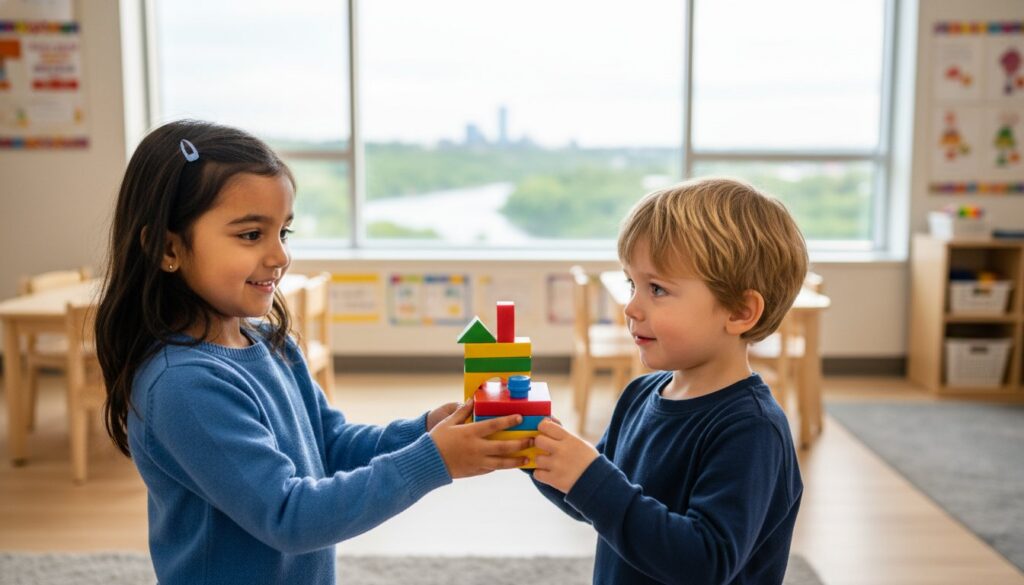
Last Tuesday, Sarah watched her three year old stand silently on the edge of the sandbox while two other children shared a bucket. That quiet moment of hesitation is one many parents recognize, sparking a deep worry about whether their child is lonely or simply lacks the tools to join in. You aren’t alone in these feelings. Fostering friendships preschool children can maintain is a complex, learned skill that bridges the “play with purpose” found in the classroom with intentional modeling at home.
You want your child to feel the joy of a first best friend and the confidence that comes with belonging. While it’s normal to feel confused by the difference between healthy boundary setting and aggressive behavior, these social capabilities are developed through a steady, guided process. This guide offers practical, research based strategies to help your child build meaningful connections. We’ll explore age appropriate social milestones, provide you with actionable scripts to resolve playground conflicts, and help you identify a preschool or junior kindergarten program, such as RC International School and Ruam Rudee Learning & Day Care Centres, that values emotional growth as much as early literacy and numeracy.
You want your child to feel the joy of a first best friend and the confidence that comes with belonging. While it’s normal to feel confused by the difference between healthy boundary setting and aggressive behavior, these social capabilities are developed through a steady, guided process. This guide offers practical, research based strategies to help your child build meaningful connections. We’ll explore age appropriate social milestones, provide you with actionable scripts to resolve playground conflicts, and help you identify a preschool or junior kindergarten program that values emotional growth as much as early literacy and numeracy.
Key Takeaways
- Understand how social milestones for 3-year-olds differ from older children according to Alberta’s provincial guidelines.
- Learn why “parallel play” and observing others are vital building blocks for your child’s future social confidence.
- Discover the “Playdate Blueprint” for fostering friendships preschool children need to build meaningful connections outside of the classroom.
- Gain specific, gentle scripts to help your child resolve conflicts and transition from “me” to “we” in group settings.
- Explore how a “Play with Purpose” philosophy integrates social-emotional growth with early literacy and numeracy skills.
Why Preschool Friendships are the Foundation for Kindergarten Readiness
When your child walks into a classroom for the first time, they’re stepping into a vibrant world of shared toys and group activities. This transition marks a significant shift from “me” to “we” as they learn to navigate a structured environment. While you might worry about their academic progress, the truth is that social-emotional growth is the engine that drives future success. In Alberta schools, children who feel socially connected are often more engaged and ready to learn. Fostering friendships preschool age is about more than just having playmates; it’s about building the “soft skills” that teachers prioritize in Kindergarten readiness programs. When a child understands empathy, they experience less transition anxiety, allowing them to focus on the joy of discovery rather than the fear of being alone.
The Science of Social-Emotional Development
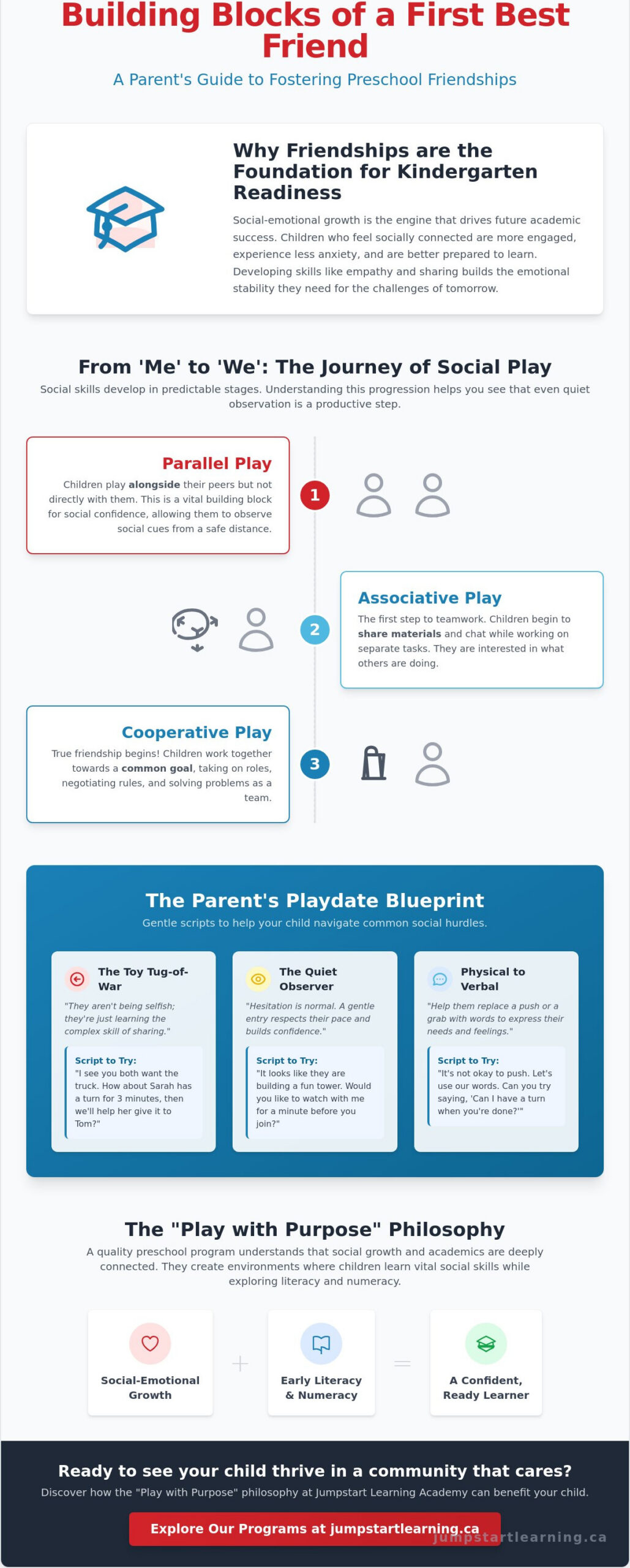
The brain of a three or four year old is undergoing a remarkable transformation. The prefrontal cortex, which governs impulse control, is still maturing. This explains why sharing a favorite truck is a monumental challenge; it requires a level of self regulation they’re just beginning to master. Mirror neurons also play a vital role, allowing your child to observe a peer’s smile and map those social cues onto their own behavior. You might notice your child playing near others without interacting, a stage called parallel play. As they grow, they move into associative play, where they share materials and chat while working on separate tasks. Recognizing this shift helps you see that even quiet observation is a productive step toward deeper connection.
Building Empathy Through Purposeful Interaction
Taking turns is a complex cognitive task for a preschooler. It requires them to hold a desire in check while acknowledging another’s needs. By helping your child identify emotions in others, such as noticing a friend’s sad face, you’re laying the groundwork for genuine connection. We define social competence as the ability to navigate peer group dynamics effectively. For parents interested in the research, understanding social competence reveals how temperament and environment shape these early interactions. Fostering friendships preschool students enjoy today creates the emotional stability they need for the academic challenges of tomorrow.
Understanding the Alberta Early Learning Framework and Social Milestones
Navigating the social world of a three year old can feel like deciphering a complex new language. You might wonder if your child’s preference for playing alone is a sign of shyness or simply a developmental phase. In our province, educators look to the “Flight” framework, which forms the core of Alberta Early Learning Standards. This approach views your child as a “mighty learner” and a citizen with a right to social wellness. Fostering friendships preschool children can rely on begins with recognizing that social play evolves rapidly. While a three year old often engages in parallel play, playing near others without direct interaction, a four year old begins to actively seek out cooperative roles. Licensed Edmonton preschool centres provide the nurturing environment needed to bridge these stages through “gentle entry” experiences that respect each child’s unique pace.
Preschool Milestones: What is “Normal” Social Behaviour?
It’s helpful to manage expectations regarding sharing, especially with “special” toys. For a three year old, the concept of ownership is still very literal; they aren’t being selfish when they resist sharing, they’re simply protecting their immediate world. Educators often use the importance of early childhood friendships as a guide to teach verbal communication. Instead of a “toy tug-of-war,” children learn to say, “Can I have a turn when you’re done?” This shift from physical to verbal resolution is a major milestone. If you notice persistent social withdrawal or aggression that doesn’t improve with teacher support, it may be time to seek further guidance. Most often, however, these moments are just the growing pains of a developing social brain.
The Role of Play with Purpose in Social Learning
Many parents worry that a structured academics preschool might limit social time, but the opposite is true. Predictable social routines, like circle time, provide a safe “container” for interaction. During these group activities, children practice active listening and peer validation, which are essential for fostering friendships preschool students will carry into kindergarten. The balance between free play and teacher led activities allows children to test their social boundaries in a supervised way. If you’re looking for a program that prioritizes these social foundations, you can explore our enrollment options to find the right fit for your family.
Navigating Social Challenges: Helping the Shy or Overwhelmed Child
Seeing your child stand on the periphery of a group can trigger a deep sense of parental anxiety. You might worry they’re lonely or that they won’t find their place in the classroom. It’s helpful to remember that being an “observer” is a valid and productive social stage. These children are often gathering data, learning the rules of the game, and waiting for a moment that feels safe. Fostering friendships preschool students can lean on doesn’t always require them to be the life of the party. Sometimes, social success is found in a single, deep connection rather than a wide circle of acquaintances. This “quality over quantity” approach allows shy learners to build confidence at their own pace without feeling overwhelmed by the bustle of a large group.
If you’re thinking, “My child is too shy for preschool,” consider that a structured environment is exactly where they can learn these skills safely. Specialized educators in Edmonton classrooms are trained to recognize when a child needs a gentle nudge and when they need space to watch. We don’t just leave them in small groups; we provide a clear transition plan to help them eventually feel comfortable in larger classroom settings. This gradual exposure builds the internal resilience they’ll need for years to come. Understanding how building resilience in children works can help you see why allowing your child to navigate small social challenges, rather than shielding them from every difficulty, is one of the most powerful things you can do as a parent.
The “Bridge” Technique for Social Entry
Instead of the daunting question “Can I play?” which often leads to a “no” from peers already deep in a game, we teach children specific entry phrases. Suggesting “Can I help build the tower?” or “Can I use the blue block?” gives the child a clear, functional role in the existing play. Shared activities like playdough or blocks act as low pressure social anchors. They allow children to work side by side, moving from parallel play into collaborative interaction naturally. In these moments, the educator acts as a social translator. They help clarify intentions and bridge the gap when peer friction arises, ensuring the child feels supported while they practice these new skills.
Managing Conflict and “Big Feelings”
Conflict isn’t a sign of failure; it’s a healthy part of learning friendship boundaries. Disagreements over a shared toy or a game’s rules provide real time lessons in negotiation and empathy. We use the “Pause and Reflect” method to help children identify their feelings before they react. This steady approach lowers stress and teaches children that a disagreement doesn’t mean the end of a friendship. Strong parental involvement preschool initiatives ensure that the scripts we use in the classroom are echoed at home. When children hear the same encouraging language in both environments, they feel more secure in their ability to resolve disagreements and maintain their connections.
The Parent Blueprint: How to Foster Friendships Outside the Classroom
Your role as a parent is vital because you are your child’s first and most influential social mentor. Fostering friendships preschool children enjoy often begins with the subtle cues they observe in your daily life. When you greet a neighbor warmly or navigate a minor disagreement with a partner using calm language, you’re demonstrating the mechanics of connection. Beyond modeling, you can use storytelling to explore empathy. Books about sharing or resolving playground disagreements allow your child to process complex emotions in a safe, quiet space before they face them in real time. Shift the focus of your daily conversations by asking about social wins. Questions like “Who did you help today?” or “Did someone make you smile?” signal that you value their emotional journey as much as their academic progress.
The 60-Minute Playdate Strategy
A successful first social visit at home requires a structured approach to prevent over-stimulation. Follow this five step blueprint for a smooth experience:
- Step 1: Choose a “Parallel” activity. Set out LEGO or coloring supplies. This allows children to work side by side, reducing the immediate pressure for direct interaction.
- Step 2: Set a clear “end time.” Keep the first few visits to exactly 60 minutes. This prevents the fatigue that often leads to late-afternoon tantrums.
- Step 3: Pre-select toys. Identify “special toys” that stay in the closet and “sharing toys” that are fair game. This avoids ownership conflicts before they start.
- Step 4: Plan a shared snack. Eating together provides a natural, low-pressure break where children can practice basic table manners and conversation.
- Step 5: End on a high note. Transition to a quick, joint cleanup activity so the visit ends with a sense of shared accomplishment.
Scripts for Success: What to Say to Your Child
Providing your child with specific “social scripts” can lower their anxiety in new situations. Instead of the vague “Can I play?” which often invites a rejection, teach them to ask, “Can I help build the tower?” or “Can I use the blue block next?” These phrases give the child a functional role in the existing play. Always praise the effort of trying, even if the interaction was brief. You might say, “I noticed how you waited for your turn with the slide; that was very patient.” We define positive reinforcement as the intentional use of praise or rewards to encourage a child to repeat a desirable social behavior, such as waiting for a turn or sharing a favorite marker. If you’re looking for a community that supports this intentional growth, you can register for our preschool or junior kindergarten programs to see these strategies in action.
How Jumpstart Learning Academy Cultivates Community in Edmonton
At Jumpstart Learning Academy, we believe the classroom is a laboratory for life. While academic skills are essential, we know that fostering friendships preschool students can rely on is the true catalyst for a joyful education. Our philosophy centers on “Play with Purpose,” where every interaction is intentionally designed to build social-emotional strength. By integrating literacy and numeracy enrichment with collaborative group work, your child learns to solve math puzzles with a partner or share a storybook with a peer. This approach ensures that learning is never a solitary struggle but a shared victory. For children who find peer groups challenging, we develop personalized social learning plans that provide the specific scaffolding they need to thrive. We also extend this sense of belonging to our families in Edmonton and Beaumont, creating a parent community where you can connect with others navigating the same rewarding journey. Families in the area can explore the range of preschool programs Beaumont offers to find the right social and academic environment for their child.
Our Research-Based Approach to Social Growth
Our experienced educators facilitate small group “friendship circles” daily. These circles are safe spaces where children practice identifying feelings and expressing needs using the scripts we’ve discussed. The impact of our preschool curriculum goes beyond the classroom; it instills a long-term social confidence that prepares children for the complexities of kindergarten. This is a core strategy for fostering friendships preschool educators use to turn abstract concepts like “kindness” into tangible actions. Purposeful play activities, such as building a “community garden” out of recycled materials, specifically target empathy and sharing. These tasks require constant negotiation and cooperation, helping children discover their own latent capabilities for leadership and teamwork.
Joining the Jumpstart Family
The first few weeks of social integration are handled with extreme care. We understand that every child has a unique social battery, so our “gentle entry” process allows new students to find their footing without pressure. We keep you informed through regular updates on your child’s social milestones and the peer bonds they are forming. You won’t have to wonder if your child is finding their place; we’ll be right there to share the news of their first shared laugh or collaborative project. This transparency is designed to lower your stress and provide a clear path forward. If you’re ready to see your child’s social and academic potential blossom, you can Enroll your child at Jumpstart Learning Academy today.
Empowering Your Child’s Social Journey
Empowering your child to navigate the social world is one of the most rewarding gifts you can provide. By understanding Alberta’s early learning milestones and using intentional social scripts, you transition from a place of worry to one of active mentorship. Fostering friendships preschool children can cherish involves a delicate balance of teacher led guidance and your own modeling at home. Whether it’s through the 60 minute playdate strategy or validating your child’s role as a quiet observer, every step you take builds the internal resilience they need for kindergarten and beyond. These skills are the foundation for a lifetime of meaningful connection.
At Jumpstart Learning Academy, our Alberta licensed early learning centres are designed to be a safe harbour for this growth. Our dedicated educators specialize in social-emotional development, using a research based Play with Purpose curriculum to ensure no child feels left behind. We are committed to turning social hesitation into genuine connection. The solutions are proven and accessible. We invite you to join a community that values your child’s emotional well being as much as their academic success.
Secure your child’s spot in our nurturing preschool program today!
Your child possesses a unique world of latent capabilities. We are here to help them discover the joy of sharing that world with others.
Frequently Asked Questions
How many friends should a 3-year-old have at preschool?
Most 3-year-olds don’t need a large social circle to feel secure and happy. Having one or two familiar peers they enjoy playing near is a healthy milestone for this age group. At this stage, friendships are often based on proximity and shared toys rather than deep emotional bonds. Focus on your child’s comfort and engagement levels rather than the total number of playmates they interact with daily.
What is the difference between parallel play and real friendship?
Parallel play is the stage where children play side-by-side without direct interaction, acting as a crucial warm-up for social life. Real friendship begins to emerge during associative play, where children start sharing materials and chatting about their activities. Both stages are essential steps in fostering friendships preschool learners will rely on as they transition into more cooperative group settings later in their development.
My child hits or pushes others during play; is this normal?
Physical outbursts like hitting or pushing are often a result of limited impulse control and developing language skills in young children. These actions aren’t usually meant to be mean; they’re a child’s way of saying “I’m frustrated” or “I want that toy.” Educators view these as opportunities to teach better communication. We help children identify their big feelings and provide the words they need to resolve the situation peacefully.
How can I help my shy child make the first move in a group?
Provide your child with a specific “social script” or a physical object to help bridge the gap. Instead of asking a vague question like “Can I play?”, suggest they offer a toy or ask a specific question about the other child’s activity. Watching from the sidelines is also a valid way they gather data before feeling safe enough to join in. Patience and gentle encouragement are key here.
Should I intervene during a playdate conflict or let them work it out?
You should step in when the conflict escalates beyond the children’s current ability to negotiate or if someone is at risk of getting hurt. If they are stuck in a “toy tug-of-war,” intervene to model the language of sharing and turn-taking. Letting them struggle briefly helps build resilience, but they need you to act as a social translator when their emotions become too big to handle alone.
How does Jumpstart Learning Academy handle social exclusion in the classroom?
We address social exclusion by acting as social translators who help bridge the gap between children during daily activities. Our educators watch for “gatekeeping” behavior and gently introduce inclusive play strategies during our group sessions. We focus on building a community where every child’s contribution is valued, ensuring that no one feels left on the periphery of the group’s shared joy or learning experiences.
Can summer camps help with social skills before preschool starts?
Our Summer Camp Programs offer a fantastic opportunity for children to refine their social skills in a relaxed, high-interest setting. These programs encourage collaborative projects and group games that naturally build confidence in peer interactions. It’s a supportive way to practice social transitions and fostering friendships preschool students will need before the more structured environment of the regular school year begins in the autumn.
What if my child prefers to play alone most of the time?
Solitary play is a perfectly normal way for many children to recharge or explore their interests with deep focus. Some children have a “slower to warm up” temperament and simply need more time to observe others before joining in. We respect this individual pace while providing gentle invitations to join group activities, ensuring they feel supported whether they are playing alone or choosing to interact with their peers.
